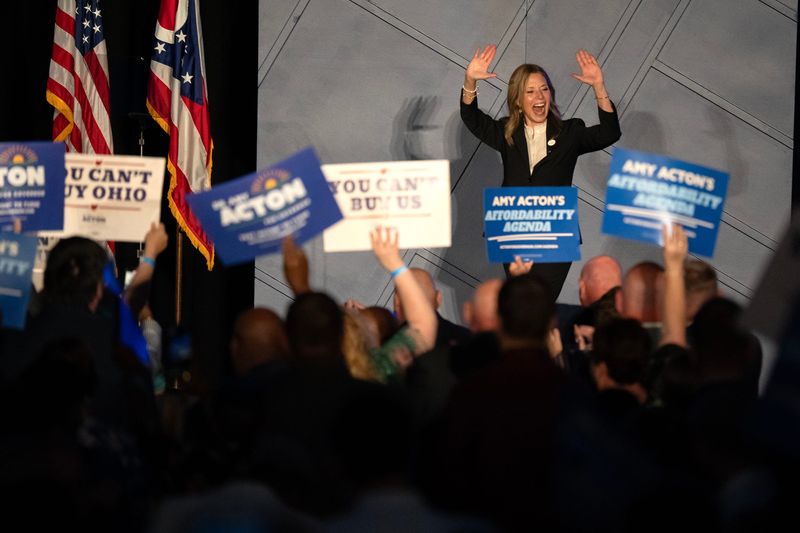
Ohio is one of a dwindling number of states that have never elected a female governor or U.S. senator. Democratic gubernatorial candidate Dr. Amy Acton is trying to change that.
On the campaign trail, Acton doesn’t talk much about potentially breaking a glass ceiling. Instead, she focuses on how unaffordable life has become for Ohioans and why she’s better suited to solve the state’s problems than her Republican opponent Vivek Ramaswamy.

But when the question comes up, Acton has a simple answer: Of course, a woman can lead Ohio.
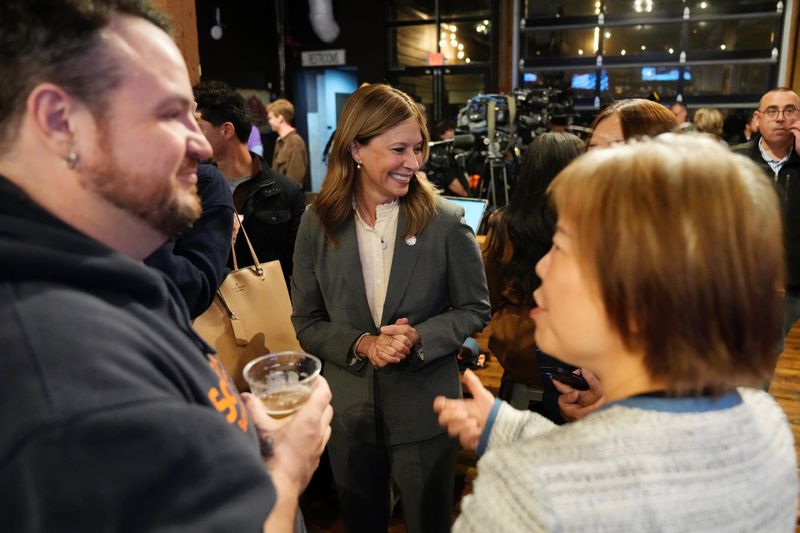
“Can a woman be governor of Ohio?” Acton asked those gathered for a Delaware County Democratic Party event last year. “Kansas, which is not exactly a blue bastion, has had three women governors.”
Ohio is one of 17 states that have never elected a female governor. A record 14 states, including neighboring Michigan, currently have female governors, according to Rutgers University’s Center for American Women and Politics. Ten are Democrats, and four are Republicans.
Acton told the Delaware County crowd that fundraising prowess and political support are more important than gender. “In the end, it is about: can you raise the money? Do you have the numbers to win, all of which we now prove that we do, and we have a clear path to victory.”
Acton and President Donald Trump-backed Ramaswamy are locked in a competitive race for Ohio governor. Whoever wins will break the mold of Ohio’s previous elected governors, all of whom have been white men.
If Ramaswamy wins, he would be Ohio’s first governor from a racial minority. Currently, only three governors nationwide are from racial minorities.
Ohio has never elected a female governor. But it had one for 11 days
Ohio has had just one female governor. Lt. Gov. Nancy Hollister, a Republican, was elevated to the role for 11 days after then-Gov. George Voinovich resigned to join the U.S. Senate. She served until Republican Bob Taft took office in January 1999.
Hollister was the first of four women to serve as lieutenant governor, all Republicans. Maureen O’Connor, who would go on to become Ohio’s first female chief justice, and Jennette Bradley, the first Black woman to serve in that role nationwide, both worked as Taft’s second-in-command. Mary Taylor served as lieutenant governor to Gov. John Kasich and ran unsuccessfully for the top job in 2018.
Only a few women have run for governor of the Buckeye State. In 2022, former Democratic Dayton Mayor Nan Whaley became the first woman to win a major-party nomination for Ohio governor.
“This is a historic moment for the Democratic Party and for all of Ohio,” Whaley said at the time. “And I want every little girl listening to know that this is possible.”
Whaley would go on to lose the general election to incumbent Gov. Mike DeWine. But the open race to replace DeWine has been much more competitive.
“It’s always important to remember in politics that each election is its own story,” said Debbie Walsh, director of the Center for American Women and Politics. “But one of the great things that Amy Acton has is a little bit of a roadmap of some things that worked and some things that didn’t work.”
Ohio, 4 other states could elect first female governors
Ohio isn’t the only state that could elect its first female governor in 2026. Georgia, Minnesota, Tennessee and Wisconsin could do the same.
In many places across the nation, the role of governor has been a harder glass ceiling to break through than other elected positions, Walsh said.
Of the 53 women who have served as governor nationwide, 37 were elected in their own right. Three replaced their husbands, and 13 became governor through succession, like Hollister. Of those 13, seven were elected to full terms after their appointments.
“We’ve seen growth in women candidates (for governor), but the growth in getting elected has been slower,” Walsh said. “We think part of that is the kind of perceptions voters may have about women as leaders.”
Those stereotypes can lead voters to think of women as better lawmakers, willing to work collaboratively and broker compromises, than chief executives, Walsh said. But more women are breaking that stereotype, including recently elected New Jersey Gov. Mikie Sherrill, a former Navy helicopter pilot, and Virginia Gov. Abigail Spanberger, a former intelligence officer.
Acton has never been elected to public office, but she helped lead the state through the early months of the COVID-19 pandemic. More and more, voters are looking for new blood in politics, Walsh said.
“There’s a kind of hunger for some different kinds of voices in politics right now, not just traditional white male lawyers,” Walsh said. “There’s nothing wrong with lawyers. It’s good to think more broadly about who can lead.”
State government reporter Jessie Balmert can be reached at jbalmert@usatodayco.com or @jbalmert on X.
This article originally appeared on The Columbus Dispatch: Amy Acton could become Ohio’s first elected female governor
Reporting by Jessie Balmert, Columbus Dispatch / The Columbus Dispatch
USA TODAY Network via Reuters Connect
By Jessie Balmert, Columbus Dispatch | USA TODAY Network