A black-and-white poster promoting the Roy Rogers Show for “Kids 8 to 80.”
An asphalt chunk of the Milwaukee Mile racetrack, put down after 62 years of harness racing on dirt.

A Blatz beer ad suggesting if nursing mothers drink “the STAR Milwaukee beer” their babies will grow strong.
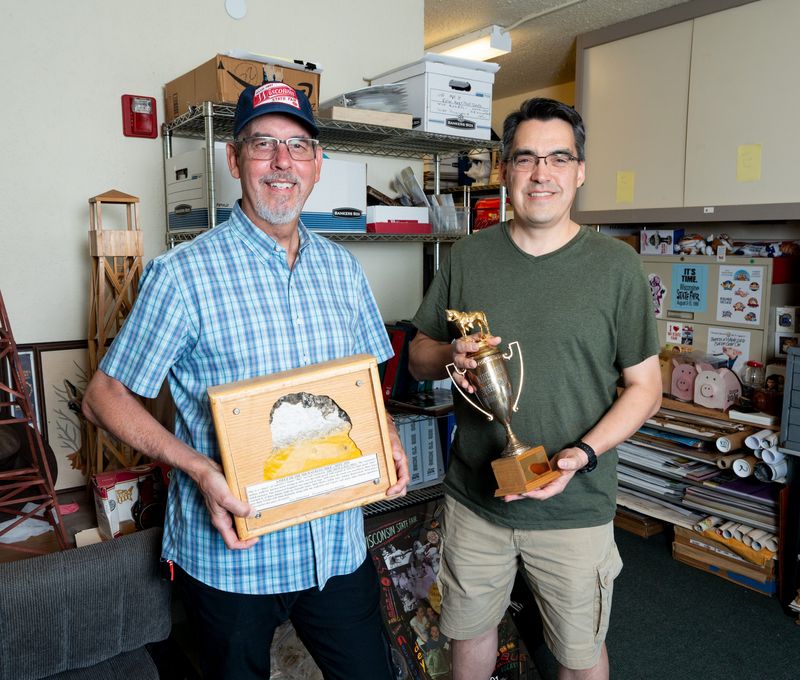
Sometimes nostalgic, occasionally weird, many times funny, the archives of our state’s annual summer get-together fill two rooms on the fifth floor of the Tommy G. Thompson Youth Center at Wisconsin State Fair Park.
“We are mapping history,” Wisconsin State Fair archivist Tom Zimmerman said.
In the archives office filing cabinets are collectibles from every State Fair dating back to the first, in 1851, organized by year. There are charts and drawings of old fairground setups, auction winners’ ribbons from the early 1900s and newspaper clippings about past happenings. The walls are papered with promotions and advertisements, some from more than a century ago. Fair-themed tchotchkes sit on tables and cabinets.
Across the hall, inside a makeshift dormitory, bunkbeds don’t reach high, shelves do. They hold more artifacts and pictures, too many to count.
The collections have been cultivated over the last 30 years by three men: the late Jerry Zimmerman — the fair’s first official historian — his son, Tom, and current historian Jon Van Beckum.
“The State Fair has been hanging on to tradition,” Van Beckum said. “People who come here expect to have those traditions. They get the cream puff. They go for their favorite food. They can go see their favorite performers.”
As the fair celebrates its 175th anniversary this year, it’s worth looking back at the character – and characters – that make it special.
Early features: Plowing contests, speeches and … milk pails
In the Wisconsin State Fair’s earliest years, more than a century before anyone ever heard of a sporkies or rode a SkyGlider, they traveled by horse and buggy and participated in plowing contests.
Organized by the State Agricultural Society, the inaugural fair was a means to bring innovative farming practices to the masses. The two-day event took place in early October — not August — to match with harvest season, and took place in a six-acre field along the Rock River in Janesville.
It featured demonstrations of new farming technologies, such as a flax-pulling machine powered by horses. The principal address, delivered by the University of Wisconsin Chancellor, John J. Lathrop, was titled “Applications of Science to Agriculture and the Useful Arts.”
For entertainment, there was a plowing match, featuring horses and oxen, which the Milwaukee Sentinel in 1928 said “furnished the main thrill.”
Wildly popular, the fair ran out of room to house attendees on the second day. Luckily, local Wisconsinites displayed classic Midwest niceness and opened their homes to the many travelers. Once all those filled, visitors packed into the stables, leaving their horses outside hitched to fences.
Agrarianism remained one of the fair’s main selling points for decades, something its advertisements were centered around well into the 1900s.
When lawyer and future U.S. President Abraham Lincoln attended the fair in 1859, his keynote speech advocated the importance of embracing new agricultural technologies. Those words were likely appreciated by those who hosted machinery displays in hopes they could sell their newest equipment, something that continued well into the 1960s.
During the Great Depression, people were admitted for free if they brought a milk pail. Farmers, needing to offload milk from their many cows, saw the fair as an easy place to do it. Patrons would show up with an empty milk bucket, avoid the 50-cent ticket price, have farmers fill the bucket and then take it home.
“What a great nod to our agricultural roots,” Zimmerman said. “Even back in the Depression.”
Record-setting foods have always made headlines.
The inaugural fair featured a 200-pound squash. In 1857, a 600-pound wheel of cheese was on display, before being trounced in a weight competition in 1989, when a 40,000-pound block of cheddar, aptly named “The Belle of Wisconsin,” concluded its nationwide promotional tour at the State Fair.
Why was the early State Fair so orderly? No alcohol.
Given Wisconsinites’, let’s say, fondness, for consuming alcohol, it feels almost weird there used to be a dissonant relationship between the state’s flagship event and its citizens’ flagship hobby.
During the fair’s earliest days, alcohol sales were prohibited in and around the grounds, making for a much different experience than this year, when fairgoers can pick from over 50 craft beer vendors.
The Milwaukee Sentinel described the inaugural fair — which, with around 13,000 attendees, was credited as the largest reported gathering at any Wisconsin event up to that date — as “an orderly affair without a single intoxicated man in the crowd.”
The fair was once so determined to keep attendees sober that in 1887 it hired a special detective whose entire job was stopping gambling and, most importantly, the selling of liquor. During the second year of Prohibition, agents seized more than eight gallons of alcohol stored in a saloon near the grounds and smuggled into the fair by bootleggers.
By the mid-1900s, the strict rules started loosening, followed closely by the seals on kegs and caps on bottles.
In 1948, at Wisconsin’s Centennial celebration, Pabst and Schlitz built new beer pavilions on the grounds while Miller expanded its. In 23 days, more than 26 train carloads of beer — equivalent to 754,744 12 ounce cans — were sold.
Fast forward three decades, and amateur alcohol-making competitions started; 31 kinds of beer were entered in just the first year.
The fair has been canceled six times
While 2026 is the 175th anniversary of the Wisconsin State Fair, it’s not the 175th edition.
Since 1851, there have been six years in which the fair got called off, mainly because of wars. From 1861 to 1863, it was the Civil War. In 1945, World War II. The COVID-19 pandemic in 2020 and the Chicago World’s Fair in 1893 are the other two instances.
When the fair’s home was still jumping around, it spent three stints – in the 1860s, 1870s and 1880s – in Madison. Earlier, the location had been used as a training camp for troops during the Civil War. The site, named Camp Randall, is where Badger football players, not union soldiers, train to this day.
The other time soldiers occupied fairgrounds, in this case Milwaukee, was in spring 1898 during the Spanish-American War. It didn’t stop the State Fair from taking place that fall.
In 1945, the U.S. Office of War Transportation requested raw materials be dedicated to the war efforts instead of essentially a big party. The government did eventually withdraw the request, but by then it was too late for the fair to take place — so, for one last time to date, it was called off.
Despite the absence of a fair, the stables were still full. Not with livestock, but German POWs who lived there and unloaded vegetables in the barns while Milwaukeeans — like Jerry Zimmerman — stood close enough to talk to them.
In the earlier years of World War II, war stamps or bonds served as admission, and children were admitted for free with one-half pound of copper, three pounds of paper or two pounds of steel or iron.
The year after the war ended, the country’s first official statewide welcome home for veterans was held on opening day of the State Fair.
Staples of the State Fair, then and now
Through the years, elements of the fair became their own traditions.
Jack Albright can be reached at JAlbright@usatodayco.com.
This article originally appeared on Milwaukee Journal Sentinel: On 175th anniversary, Wisconsin State Fair archives jammed with mementos
Reporting by Jack Albright, Milwaukee Journal Sentinel / Milwaukee Journal Sentinel
USA TODAY Network via Reuters Connect
By Jack Albright, Milwaukee Journal Sentinel | USA TODAY Network