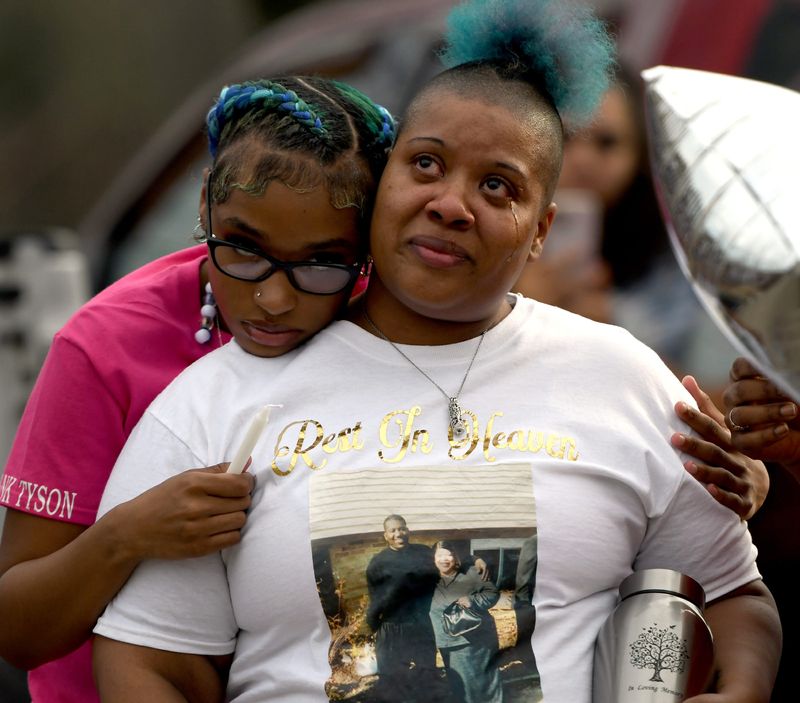
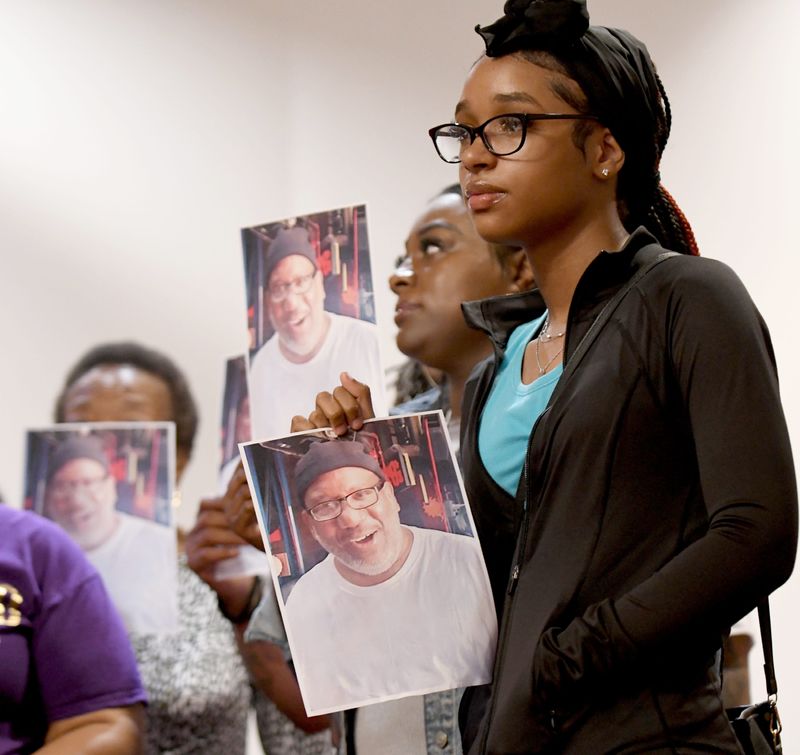
CANTON ‒ The death of Frank Tyson drew national attention, sparked local protests and brought high-profile civil rights leaders such as Ben Crump and the Rev. Al Sharpton to the city for his funeral.
Tyson, a 53-year-old Black man from Canton Township, died April 18, 2024, after he struggled with two White Canton police officers and then was left face down while handcuffed for nearly eight minutes following his arrest.

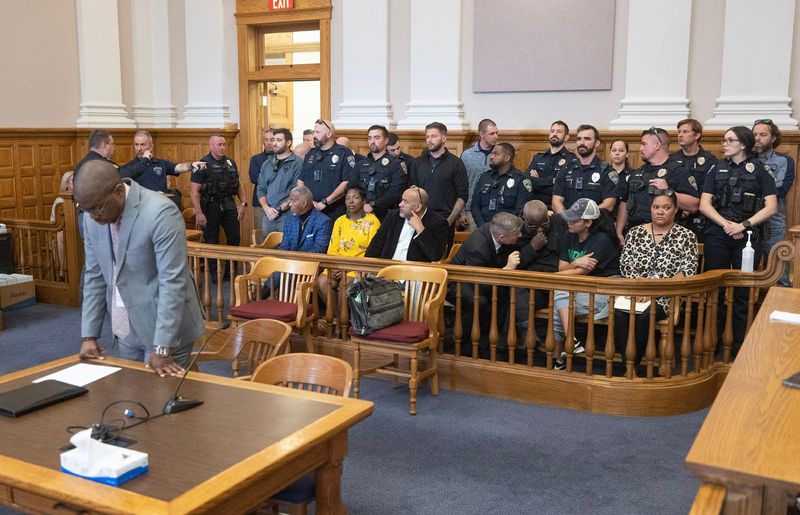
Now, more than two years after Tyson’s death and following numerous delays and postponements, Canton police officers Beau Schoenegge and Camden C. Burch are set to go on trial Aug. 10 in Stark County Common Pleas Court on charges of reckless homicide, a third-degree felony. They will face an unfamiliar judge and prosecutor, as Stark County judges and the Prosecutor’s Office recused themselves.
The jury trial, being overseen by retired Medina County Common Pleas Judge James Kimbler, is expected to last at least two weeks as more than 30 subpoenas have been issued.
The Repository did not interview Tyson family members, prosecutors or defense attorneys for this story because they are covered by a gag order issued by Stark County Common Pleas Judge Kristin G. Farmer, who handled the case before the visiting judge was appointed. The ruling applies to persons defined as participants in the case.
What will the jury be asked?
Jurors will be asked to decide if Burch and/or Schoenegge recklessly caused Tyson’s death.
“The issue is going to be whether or not the government can show the required mental state that the officers need to have in order to be guilty of the crime itself,” said Michael Benza, a Case Western Reserve University professor whose specialties include police use-of-force issues.
He said the defense probably will argue that the use of force was reasonable.
“It doesn’t mean that the use of force was the appropriate thing to do, or that the officers may have even violated department policies or other issues, but whether or not it was reasonable under the Fourth Amendment,” Benza said.
“We don’t often see charges brought in these types of cases because most of the time when the prosecutors or law enforcement does the investigation, they reach the conclusion that … while the outcome is regrettable and tragic, the police officers were reasonable and appropriate in their use of force,” Benza said.
Hector McDaniel: ‘Would love to see justice served’
Hector McDaniel, outgoing president of the Stark County NAACP, said he’s heartened that police officers are being required to justify their actions, but he’s deeply concerned about the influence of qualified immunity, a policy that shields officers in many cases from criminal prosecution.
“I would love to see justice served,” said McDaniel. “It’s encouraging, first of all, to see them in the position that they’re in as officers, facing these kinds of charges, at this space. I don’t know how common or how often we’ve seen that specifically here in Stark County. So, to me, it’s encouraging that it’s made it this far. The second thing for me is, we need to see equal justice applied to these officers as well as we would anybody else facing these charges.”
What preceded Frank Tyson’s death?
The day Tyson died, he had crashed a car into a telephone pole at 8:16 p.m. in the 1700 block of Sherrick Road SE in the city.
Tyson — who didn’t have a driver’s license and had cocaine and alcohol in his system at the time — then wandered into the nearby AMVETS Post 124 at 1822 Sherrick Road SE in Canton Township.
A neighbor called 911 about the downed pole and crash, and two more called 911 complaining about Tyson’s erratic behavior inside AMVETS, seeking to have him removed from the private club.
As officers entered the building around 8:27 p.m., a woman standing in the foyer told police, “Please get him out of here now,” according to police body camera video.
Tyson, who had been released from state prison earlier in the month after serving a 24-year sentence for kidnapping, saw the officers and was agitated. He yelled something inaudible.
He then got into a physical struggle with officers and was handcuffed. He was placed face down on the floor.
His last words — “I can’t breathe” — drew comparisons to George Floyd, whose death in 2020 provoked civil unrest across the country and triggered a national debate about use of force by police and fatal interactions with minorities.
Schoenegge remained with Tyson while Burch left the bar for four minutes to move his cruiser, after Tyson had been restrained. After returning, Burch looked down at Tyson on the floor and asked Schoenegge if Tyson had calmed down.
“He might be out,” Schoenegge said.
“Is he breathing?” one officer asked. It is not clear from the recording who asked the question.
Burch bent down to examine him, then walked away.
At 8:35 p.m., one officer said to Tyson, “All right, stand up.” He turned Tyson around onto his back. The officer began shaking Tyson. Police officers then turned him onto his side.
“Come on, man,” the police officer said to Tyson.
He tapped him a few times.
Another police officer said, “Is he breathing? … I have medics coming.”
The police officer put his hands on Tyson’s back, looking for any signs of life.
At 8:37 p.m., nearly eight minutes after Tyson had last spoken, a police officer removed the handcuffs.
“Does he have a pulse?” the other police officer said, as they turned Tyson onto his back.
“I didn’t feel one,” the police officer said. “Will you tell medics to step it up? He’s not responsive. I don’t know if I can feel a pulse.”
The police officer began administering chest compressions. After a minute, another police officer took over applying compressions. They also gave Tyson two doses of an overdose antidote.
Canton Fire Department medics later arrived to take over.
Frank Tyson’s cause of death
Tyson’s death was ruled a homicide, according to a preliminary autopsy report. The Cuyahoga County Medical Examiner’s Office performed the autopsy,
Homicide is one of five determinations coroners have to rule on the manner of a person’s death. Homicide is defined as the killing of one person by another. A homicide ruling does not mean a crime occurred.
Harry Campbell, the now-retired chief investigator at the Stark County Coroner’s Office, said in August 2024 that a preliminary autopsy listed multiple causes of death for Tyson:
Campbell is among those who received a subpoena to testify at the trial. Others include Stark County Coroner Dr. Ronald Rusnak, Cuyahoga County Deputy Medical Examiner Dr. Alison Krywanczyk, and Cuyahoga County Chief Toxicologist Luigino Apollonio.
Others called to testify include eight current or former Canton police officers, three sheriff’s deputies and an officer who works for two other law enforcement agencies.
Seven employees of the Ohio Bureau of Criminal Investigation have received subpoenas. The agency investigated the incident. Records custodians from the Canton Police Department and Aultman Hospital have been called. Eight other people, including a married couple, have also received subpoenas.
Special Prosecutor Raymond Grogan Jr. and defense attorneys are expected to call expert witnesses. The number and identities of those outside witnesses are not available in online court records about the case. Defense attorneys Donald J. Malarcik and Jacob T. Will have asked the judge to hold a hearing to determine whether one of the prosecutor’s experts should be excluded.
In addition to witnesses, the trial will include jury selection, opening statements and closing aguments by prosecution and defense attorneys, and jury deliberations. Those elements could add another week.
What are the potential punishments?
Reckless homicide carries a maximum penalty of three years in prison and a $10,000 fine. A felony conviction would end employment as a police officer in Ohio. Regardless of the outcome of the trial, Safety Director Andrea Perry could discipline the officers, including firing them. Burch and Schoenegge are both 26 years old.
Benza, the law professor, does not expect plea deals in their criminal cases. He said the defendants might have a reason to accept a plea deal if the likelihood of losing at trial is higher than normal.
“Most of the time, these cases don’t have plea agreements, because it’s a real factual dispute as to whether or not what the officers did was appropriate or not,” he said. “That’s why these cases rarely go to trial, because they’re just not indicted. But then when they are indicted, they tend to go to trial because there’s no incentive to do a plea agreement.”
To be guilty of reckless homicide, Benza said, a defendant would have needed to have taken a substantial risk without a good enough reason to take the risk.
He compared their actions to driving a motor vehicle.
“When you are driving, if you are going 10 miles over the speed limit, … you’re aware that driving faster than the speed limit may cause harm. There’s a greater risk of accident. But if you’re an ambulance driver and you’re taking a critically injured person to the hospital, … that’s a justifiable risk, even if the speed that you are traveling at is a high risk of hurting other people. So, it’s this balancing between those two things,” Benza said.
McDaniel — a member of the city’s Community Relations Commission, a group that reviews police use-of-force cases after the department’s internal investigations are done — said the thorny issue of qualified immunity for officers is one that must be addressed.
McDaniel said the national NAACP is monitoring developments and has been in contact with the U.S. Department of Justice.
“The outcome may determine the course of action for them,” he said.
McDaniel said fair and equal justice should be everyone’s paramount concern.
“I would love to see justice served, but what does that really look like?” he asked. “I mean, we talk about these officers, and what they’re charged with, and again, how they have made it thus far. I’m optimistic. I’d like to think I’m of one of the most optimistic people around. But again, what always overshadows these kinds of things for me, is that influence of qualified immunity.”
Charita M. Goshay is a Canton Repository staff writer and member of the editorial board. Reach her at 330-580-8313 or charita.goshay@cantonrep.com. On Twitter: @cgoshayREP
Reach Aaron at 330-580-8428 or ahhughes@usatodayco.com. On X: @AaronHughe2.
Reach Nancy at 330-580-8382 or nancy.molnar@cantonrep.com. Follow her on X, formerly known as Twitter: @nmolnarTR.
This article originally appeared on The Repository: Two years after Frank Tyson death, Canton police officers go on trial
Reporting by Nancy Molnar, Aaron Hughes and Charita M. Goshay, Canton Repository / The Repository
USA TODAY Network via Reuters Connect
By Nancy Molnar, Aaron Hughes and Charita M. Goshay, Canton Repository | USA TODAY Network