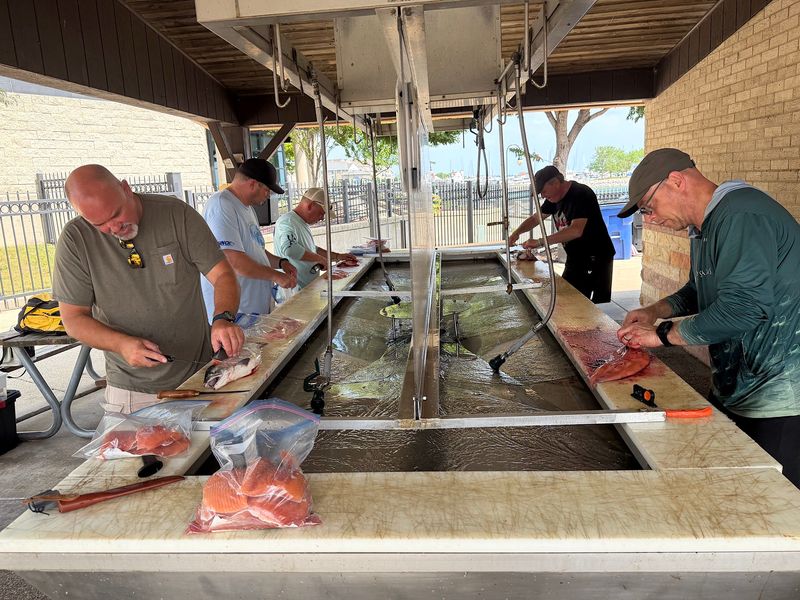
RACINE − The fish cleaning station at the Fifth Street public boat launch in Racine was bustling July 18.
As space opened at the stainless steel table, Manuel Martinez and Jenny Meyers of Racine wheeled their cooler to the front of the line.

The hefty plastic receptacle was emblazoned with “Manuel Labor,” the name of the couple’s boat.
“That tells you how long we’ve been at it,” Meyers said. “It used to be almost all manual.”
Meyers harkened to a time decades ago when most Lake Michigan anglers had to use muscle power to set and lift downrigger balls, for example, and put out devices to measure boat speed and water temperature.
Now its mostly done with the touch of a button or a glance at onboard electronics.
But the years of experience also bring valuable perspectives on the lake’s salmon and trout fishery.
“Fishing has been very good,” Martinez said, unloading a catch of 10 salmon and trout from his cooler. “Of course we also notice this year and last year the fish are running smaller than they used to.”
Martinez and Meyers were among the thousands of anglers participating in the 2026 Salmon-A-Rama Fishing Tournament.
Headquartered in Racine but open to anglers lakewide, the event has been around since 1974 and is annually one of, if not the largest salmon and trout fishing event on Lake Michigan.
This year SAR ran July 11 to 19 and featured thousands of dollars in prizes to anglers in a variety of divisions.
It’s a veritable gold mine for fisheries scientists, too.
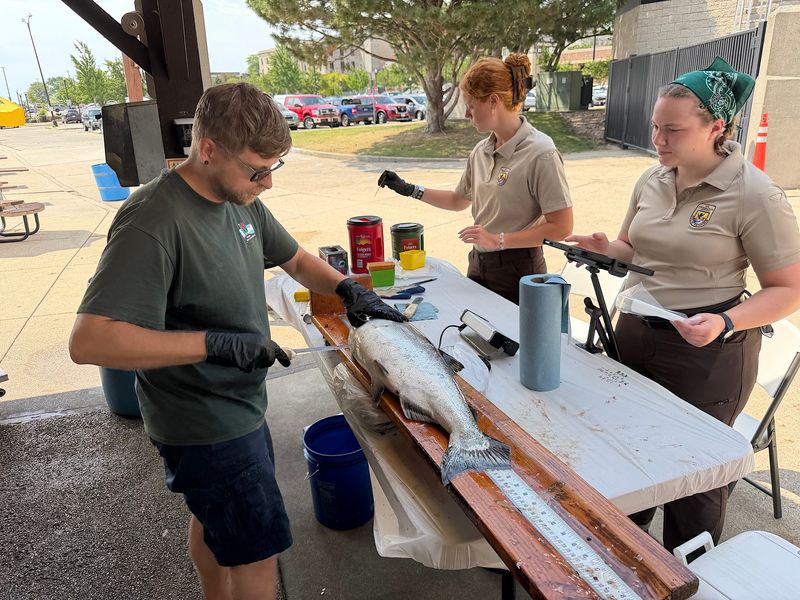
On July 18 three were tapping into the riches at the Racine fish cleaning station.
“Would you be OK if we measured and checked your fish?” asked Tim Urbaniak, fisheries technician with the Wisconsin Department of Natural Resources, of Martinez and Meyer.
Like nearly all anglers that morning, they agreed.
Urbaniak was joined by Emily Carpenter and Madison Colombo, both biological science technicians with the U.S. Fish and Wildlife Service.
Significant to this story, and critical to Lake Michigan salmon and trout management in general, Carpenter and Colombo work for the Great Lakes Mass Marking Program out of the USFWS’ Green Bay Fish and Wildlife Conservation Office in New Franken, Wis.
The mass marking program is only 15 years old but already forms the foundation of Great Lakes fisheries management for salmonid species.
Urbaniak, Carpenter and Colombo had set up a field laboratory on a table adjacent to the fish cleaning station.
Their goal: record the species, sex, weight, length and fin clips on all fish, as well as check each for a tiny metal cylinder, the secret to the mass marking program.
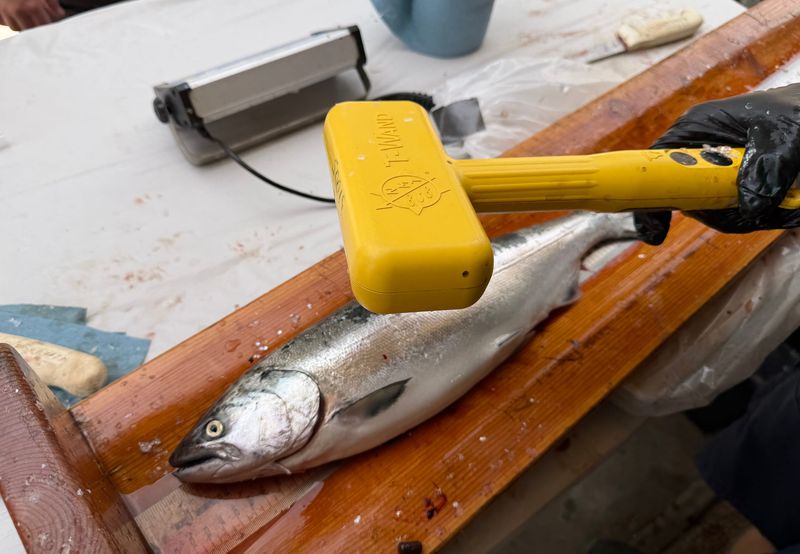
Called a coded wire tag, the 1-millimeter-long magnetized cylinder is implanted in the snout of fish at hatcheries. Similar to the chips in our pet dogs and cats, each tiny tag bears a unique identification number.
A portable USFWS machine is taken to state and other fish hatcheries to implant the tags and clip off the adipose fin of fish. The fish are then stocked and live out their lives.
Several hundred were brought back July 18 to the Racine shore by anglers.
The fisheries crew used a hand-held detector to determine whether each fish had a coded wire tag. If it did, the snout was quickly cut off, placed in marked envelope and stored in a cooler.
Later this year it will be dug out and the information from its code, which will tell scientists where the fish was raised and when and where it was stocked, will be combined with the length, weight, date and location of catch and other data to complete the life history of the fish.
The entire process of data collection took about 20 to 30 seconds per fish at the Racine site.
The fisheries crew then handed the fish back to the anglers to be cleaned and waited for the next batch to show up.
The coded wire tags have ushered in a new era of fish management.
“It’s our key to tracking fish survival, movements and growth,” said Matthew Kornis, director of the USFWS mass marking program. “It’s become a very, very important tool to help understand what is going on in the fishery.”
As you may know, one of the most important things that’s been going on in recent decades in Lake Michigan is natural reproduction of salmon and trout.
When non-native salmon and trout were first stocked in the Great Lakes in the 1960s, the fisheries were considered “put-and-take.”
Fisheries managers operated on the basis that the number of fish stocked was the population in the lake.
After a number of years, however, it became apparent that some of the non-native fish were able to naturally reproduce in the region.
In Lake Michigan, that was especially true in streams on the Michigan side of the lake. Michigan tributaries are generally longer, cooler and have more rocky bottom substrates, all of which are more conducive to natural reproduction of salmon and trout.
It started modestly, but has grown to arguably the most important factor in the population of predator fish in the lake.
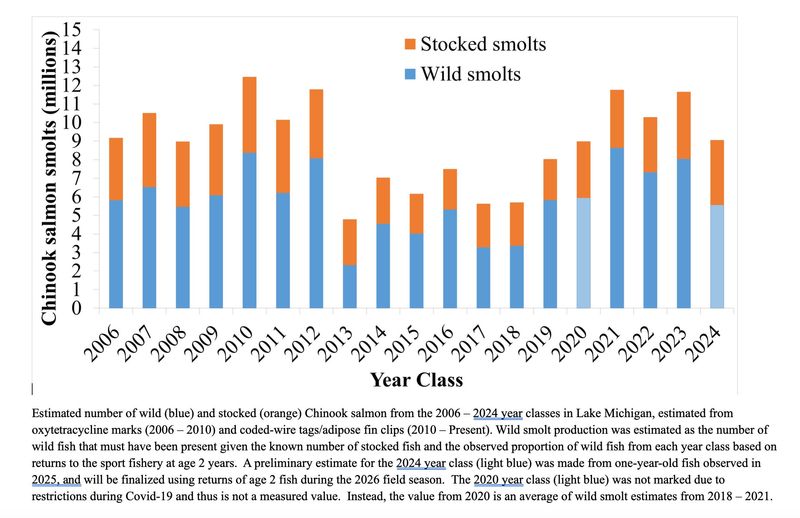
The 2021 year class of chinook salmon, for example, contributed 8.6 million wild fish to Lake Michigan, according to an estimate from the Lake Michigan Technical Committee, a function of the Lake Michigan Committee of the Great Lakes Fishery Commission. The number of wild fish produced that year was more than double the number stocked by agencies.
In 2023 the lake produced 8.1 million wild chinooks, according to Kornis.
It’s not just every-so-often thing, either. From 2019 to 2024, the wild chinook numbers ranged from 6 to 8 million annually, according to estimates from the Lake Michigan Technical Committee.
Other species are pulling off natural reproduction, too.
The success of natural spawning has resulted in about 64% of the chinook, 35% of the rainbow (or steelhead) and 33% of the lake trout in Lake Michigan being wild fish, Urbaniak said.
How do they know?
The coded wire tags are key.
And of course it also takes the valuable work to collect data by fisheries crews such as the one July 18 in Racine.
The USFWS has staff at several dozen sites across the region in a typical year, Kornis said.
The USFWS mass marking program has a budget of $2.4 million this year, down from $2.4 million in 2024.
The funding pays for the tags, 10 cents each to tag about 10 million fish annually, as well as the trailers and staff to run them.
In 2025 the USFWS mass marking program tagged 9.7 million fish, including 3.3 million lake trout, 4.2 million chinook salmon and 2.2 million coho salmon.
The work has helped fisheries scientists learn how salmon and trout move around Lake Michigan, including a large cohort of chinook that swims from Lake Huron into Lake Michigan each year for better feeding. The tags have also yielded improved information on survival and growth rates of stocked fish as well as the best-ever estimates of wild, or naturally-reproduced, salmon and trout in the lake.
The ultimate goal is to inform federal and state fisheries managers as they work to balance the number of predator and prey fish in Lake Michigan and sustain a highly-valued sport fishery.
That balance is increasingly in question in recent years. As Martinez said at the Racine fish cleaning station, the fishing is very good but the size of the fish has been decreasing.
That was evidenced in the catches in July at both the Kewaunee-Door Salmon Tournament and Salmon-A-Rama.
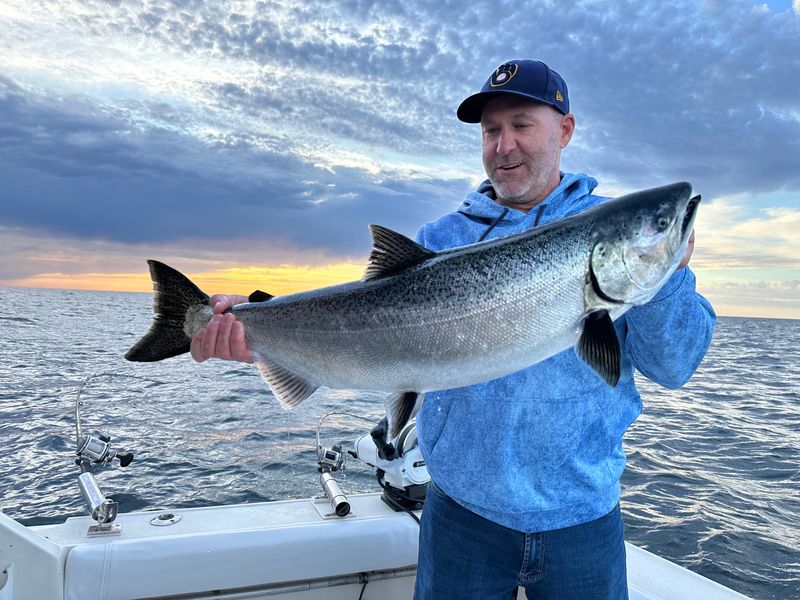
A 27.39-pound chinook took first place in the K-D tourney, the first time a fish less than 30 pounds had won since 2014, according to tournament organizer Kevin Naze of Algoma.
And the top tier of fish was markedly lighter, too. In 2024, 164 25-plus-pounders were brought to tournament scales. Last year there were 10. And this year it dropped to five.
The biggest chinook in SAR weighed 25.44 pounds, the smallest since 2015.
And of the several thousand fish handled in fall 2025 at the Strawberry Creek weir near Sturgeon Bay, the mean weight of 3-year-old female chinook was 14.67 pounds, the lowest since 2015, and well below the long-term mean of 16.97 pounds, according to the DNR.
The scenario is lots of hungry fish and a low forage base creating very good catching conditions for anglers.
So far no disease concerns have cropped up and though fish are smaller they appear healthy, according to most observers.
With all of the natural reproduction in the lake, fisheries managers have control only over the number of fish stocked. If the prey fish population declines, will a stocking cut be in order?
Todd Kalish, deputy director of the DNR’s fisheries bureau, said the he and his colleagues regularly review and assess a variety of salmon and trout population information throughout Lake Michigan to inform potential management strategies. The DNR also works very closely with partners throughout the lake to discuss collaborative management options, Kalish said.
At this point, the plan is to continue with the same stocking numbers in the Wisconsin waters of Lake Michigan as in recent years, Kalish said. That is 1.3 million chinook, 500,000 coho; 460,000 steelhead, 450,000 brown trout, 50,000 brook trout and 45,000 lake trout (USFWS stocking).
“If we are going to propose any stocking adjustments, we would engage the public and our partners prior to making those decisions, and we haven’t planned any public meetings to date,” Kalish said.
Kalish added that if the DNR was going to make any future stocking changes, the agency would ideally make the decision prior to the fall egg take which typically starts around October 15 so they don’t take too few or too many eggs to meet future stocking goals.
The Lake Michigan Technical Committee met in July to review the most recent data, including an update to a metric called the Predator-Prey Ratio. While it has been trending worse in recent years, it has not reached the warning zone as it did in 2010 and 2011.
The updated PPR data is expected to be released to the public in August or September.
In the meantime, anglers will continue to enjoy the world class fishing on Lake Michigan.
And all of us who value the fishery should support the USFWS and DNR for the science the bring to resource management and be grateful for the tiny metal tag that sheds a big light on the status of Lake Michigan salmon and trout populations.
This article originally appeared on Milwaukee Journal Sentinel: Mass marking program key to Lake Michigan fish management | Paul Smith
Reporting by Paul A. Smith, Milwaukee Journal Sentinel / Milwaukee Journal Sentinel
USA TODAY Network via Reuters Connect
By Paul A. Smith, Milwaukee Journal Sentinel | USA TODAY Network