Saline Township — Some candidates in the battleground state of Michigan said they’re seeing a bipartisan wave of opposition to data center projects taking shape this summer with the potential to sway the results of the midterm election.
On Monday, anti-data center demonstrators disrupted a speech by Republican President Donald Trump in Oakland County. Then, while campaigning in Lansing on Tuesday — a week before the primary election — Democratic U.S. Senate candidate Abdul El-Sayed had a blunt diagnosis of the situation, telling reporters people “really effing hate data centers.”

Democrat Will Lawrence of Lansing, who’s running for a key U.S. House seat, was standing nearby while El-Sayed made the remark. Lawrence, who’s a progressive candidate backed by U.S. Sen. Bernie Sanders, then detailed how his campaign had been knocking on some Republicans’ doors near the site of a proposed data center in the 7th District and finding support from Trump voters because of Lawrence’s opposition to the projects.
Voters don’t want billionaire tech executives forcing the expansive developments upon townships and simply don’t trust the utility companies who are promoting the buildouts, he said.
“This is an issue that will swing elections in November for the candidates who are bold enough to stand with the people,” Lawrence said.
As Trump, the leader of the Republicans nationally, and Gov. Gretchen Whitmer, the leader of Democrats in Michigan, have promoted data center developments, the statements and actions of candidates within both parties point to a potential shift in approach on the horizon.
At an anti-data center rally Thursday in Saline Township, Dearborn-area state Rep. Erin Byrnes, a Democrat running for state Senate, said: “I’m here today because I don’t want data centers taking over the state of Michigan. When a community like Saline rises up and says ‘no’ to a hyperscale data center, the government and corporations shouldn’t just go ahead and do it anyway.”
A Detroit News review of political ads placed on Facebook in June and July found 17 Michigan candidates’ campaigns paying to highlight their opposition to data centers. Six were Republicans, and 11 were Democrats.
The tally doesn’t include a handful of groups, like the Sierra Club, that also bought ads to display candidates’ anti-data center positions and Michigan Republican Party Chairman Jim Runestad, who sponsored his own ads on the subject.
No Michigan candidate ran an ad on Facebook over that time touting their support for data centers, according to a Detroit News review.
In one ad in June, Republican state Senate candidate Kenny Clevenger of South Haven noted Detroit Democratic U.S. Rep. Rashida Tlaib’s criticism of a hyperscale data center project in Saline Township that’s been supported by Whitmer.
“Now, I do not agree with Rashida Tlaib on much,” Clevenger said. “When the far left and everyday Michigan conservatives are looking at the same decision and shaking their heads, something has gone seriously wrong.”
The path forward on data center policy will be shaped by voters who will have choices in Tuesday’s primary and in November’s general election between some candidates who want blanket moratoriums on data centers and others who want to greenlight the projects with certain protections for residents.
Supporters of data center developments, including the White House, have contended that the facilities are needed to power the country’s technological future. A year ago, Trump signed an executive order to accelerate federal permitting of data center infrastructure.
State Rep. Mark Tisdel, R-Rochester Hills, who represents a battleground state House district, penned a commentary last week that called on Michigan to consider “embracing data centers” with guardrails.
“Instead of delaying approval of the data centers that power AI, Michigan must embrace the opportunity to lead another transformational industry, just as we did with the assembly line more than a century ago,” Tisdel wrote.
Michigan voters weigh in on data centers
There are 79 operational data centers in Michigan, according to the website U.S. Data Center Map.
However, two more are under construction, and 16 more are planned, the website says. Three of those on the way are magnitudes larger in terms of capacity than anything that’s currently functioning in the state.
Among the upcoming ones is the so-called Stargate project in Saline Township, where a hyperscale facility is under construction on 250 acres of farmland and is expected to eventually demand 1.4 gigawatts of electricity, roughly as much as 1 million homes.
Tech giants Oracle and OpenAI are backing the project. New York-based real estate giant Related Cos. is constructing the data center through its affiliate company, Related Digital.
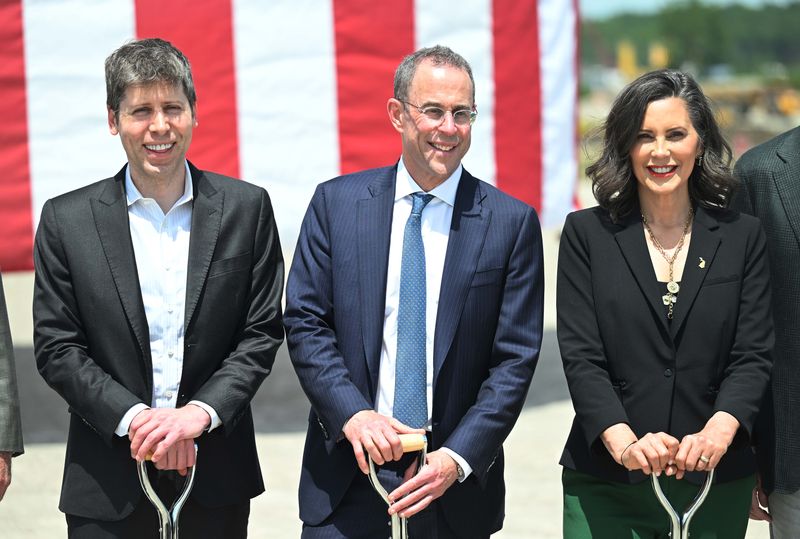
Whitmer has promoted the project and appeared at its June 1 groundbreaking with OpenAI CEO Sam Altman. Whitmer said the data center will create more than 2,500 union construction jobs and more than 450 jobs on site.
“I’m grateful to these cutting-edge companies for betting on Michigan, building on our work to compete for and win big projects in next-generation industries from cars and clean energy to semiconductors and batteries,” Whitmer said in October.
Naomi Ernest, co-lead for Saline Indivisible, spoke at a Thursday rally, organized by El-Sayed’s Senate campaign, near the Oracle/OpenAI data center site that developers have dubbed “The Barn” in homage to the farmland. Saline Indivisible members held up signs reading “Real barns, not bribes. No data centers.”
“Elected officials are ignoring our voices and disregarding our well-being, from local seats all the way to the top,” Ernest said.
In Van Buren Township, there’s been a 282-acre data center project in the works named “Project Cannoli.” It’s projected to use millions of gallons of water per day and one gigawatt of power.
Kenya Phelps, 49, said she’s not necessarily opposed to data centers but wanted more community input in the decision to allow one in her home of Van Buren Township. She said she believes elected officials who support data centers do so out of “greed” and without regard to how residents feel.
“They did what they wanted to do anyway,” Phelps said after voting early in Michigan Thursday. “They already made the choice before they asked us our opinion in the first place, so what’s the point?”
Margaret Woodward, a 77-year-old South Lyon Democrat who submitted her ballot Wednesday, said she would support a total ban on data center development in Michigan. She’s concerned about water and electricity usage.
Woodward said she’s not aware of any Democratic candidates on her August primary ballot who favor data centers.
“It seems to be those who are in the pocket of big business and the wealthy who really want them, and really don’t care that the middle class and the poor are going to bear the brunt of it,” Woodward said. “If they want them, put them in the backyard at Mar-a-Lago or at Elon Musk’s place.”
Senate race spotlights Saline project
There’s been pushback from local residents to the development in Saline Township. And El-Sayed, who’s running for the Democratic nomination for U.S. Senate, appeared Thursday at the rally against the project.
El-Sayed said the democratic process was side-stepped in the handling of the Saline data center.
When asked specifically about the Saline center, he said, “The community here opposes this data center, and if the community here opposes this data center, then I do.”
On Tuesday, he told reporters that residents who live near planned data centers were being asked to “make room for this gigantic drone of a building that’s going to suck up all your power” and “that could poison your water.”
“The tradeoff here is hard to explain to the broader public,” El-Sayed contended. “And we’re doing this in a deeply unregulated era. There is no regulation that is real. Meanwhile, because all of these corporations are so deep in the pockets of all the politicians who should regulate it, it looks like we’re going to move forward with zero regulation.
“I just think it’s a pretty crazy thing that this is a bipartisan consensus almost that we should be building these things and that they’re good for us,” he added, “except for the broader public in a bipartisan way generally doesn’t agree.”
El-Sayed is running against U.S. Rep. Haley Stevens of Birmingham for the Democratic Party’s U.S. Senate nomination on Tuesday.
Asked about her stance on the Saline Township project after an appearance in Lansing on Wednesday, Stevens responded by asking a reporter what the status of the project was.
“Here’s what I support,” Stevens said. “I support tackling why we have 50-some data centers and one being built right now and no federal laws … governing them, ensuring that the money goes into the communities, ensuring that the costs of the consumers in those communities and the states that they’re in don’t continue to go up.”
Stevens has been endorsed by Whitmer, who backs the Saline Township development.
When a reporter attempted to ask a follow-up question about her stance on the Saline Township data center, a staff member of Stevens intervened and said Stevens was running out of time to answer more questions.
The staff member then allowed a reporter from a national media outlet to ask three questions of Stevens, including how many LinkedIn connections she has. Stevens had referenced her use of LinkedIn earlier in the day.
GOP opposition to data centers
On the other side of the aisle, GOP candidate for governor Perry Johnson, who’s from Bloomfield Hills, and Runestad, who is also a state senator from White Lake, have both spoken out against data centers.
Johnson is competing with U.S. Rep. John James of Shelby Township for the Republican nomination for governor.
In June, Runestad called for a one-year moratorium on all data center projects in Michigan.
“Farmland is being destroyed and full communities are being razed to make way for these projects that are being pushed without complete information and with a disregard for public opinion,” Runestad said previously.
On Thursday, Runestad, who’s also a state senator from Oakland County, said he believes data centers will be one of the top three or four campaign issues in Michigan this fall. There’s “overwhelming concern” about the projects, Runestad said.
“It’s just a complete wild, wild west,” Runestad said of current policies on the projects.
Runestad cited the results of an April poll of 600 likely general election voters in Michigan, sponsored by the Detroit Regional Chamber. Asked if participants would be open to allowing a data center to be built within 25 miles of their home, 33% said yes, 55% said no, and about 12% declined to answer or said they didn’t know.
The margin of error was plus or minus 4 percentage points.
Republican former state House Speaker Tom Leonard of DeWitt was among the most vocal politicians in Michigan against data center projects before ending his campaign for governor and endorsing James earlier this year.
“This issue has become one of the most powerful grassroots movements I’ve witnessed in my 25 years in politics,” Leonard said on Thursday. “I’ve never seen an issue generate this level of intensity across party lines.
“These aren’t fringe voices to be dismissed. These are our friends and neighbors with legitimate concerns about rising utility costs, impacts on their communities and a lack of transparency in how these decisions are being made.
Candidates who once hoped to avoid the issue or stay silent are finding out they can’t, Leonard said.
“Every candidate has a choice this fall: stand with the citizens in their communities demanding to be heard or stand with the utilities and special interests behind these projects,” Leonard said. “Voters will remember who listened and who didn’t.”
cmauger@detroitnews.com
sballentine@detroitnews.com
This article originally appeared on The Detroit News: Data center upheaval spills into Michigan primary elections
Reporting by Craig Mauger and Summer Ballentine, The Detroit News / The Detroit News
USA TODAY Network via Reuters Connect

By Craig Mauger and Summer Ballentine, The Detroit News | USA TODAY Network