Another bad wildfire summer in Canada is creating smoky, hazardous air quality across the Great Lakes region and other parts of the United States. Get used to it, a University of Michigan researcher said.
“This is kind of the new normal, right?” said Paige Fischer, an associate professor with U-M’s School for Environment and Sustainability. Fischer directs the university’s Western Forest and Fire Initiative, which “aims to understand and develop strategies for how human communities and ecological communities can adapt to a hotter, smokier and more flammable environment.”

“We know that heat domes are going to happen more frequently,” she said. “Wildfires result from a lot of different, interacting factors. They are a little more complicated. But we know there is going to be more warming, so we know that forests are going to continually get stressed. So you can realistically assume that even if this doesn’t happen every year, it’s probably going to keep happening at least periodically.”
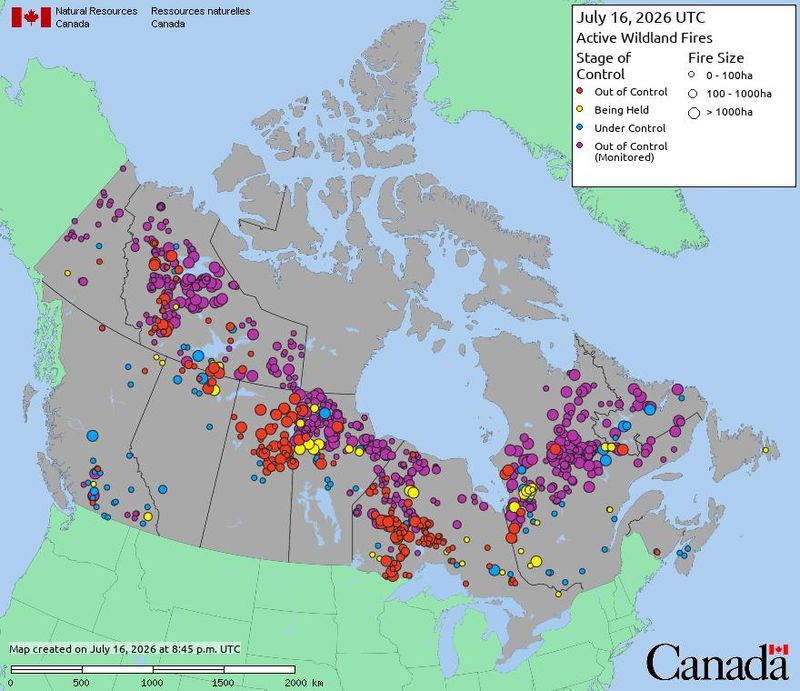
Canada currently reports more than 850 wildfires throughout the country, including 109 fires considered out of control. The worst of the wildfires are in northwest Ontario, northern Manitoba and Saskatchewan. The largest wildfire currently burning in Canada by area is the Kenora 51 fire in northwestern Ontario, which has scorched nearly 345,000 acres, an area nearly the size of Wayne County.
Those fires have combined with current weather conditions to make an air quality mess for Michigan.
“[Wednesday] we had a cold front move through that ushered in the air mass that contains the smoke,” said Bryan Tilley, a meteorologist with the National Weather Service in White Lake Township. “Now there is high pressure in place overhead that’s kind of just trapping [the smoke] over Michigan.”
Tilley likened the atmospheric situation to “a cereal bowl upside-down on a table.”
“It produces a layer of stable air that just keeps the smoke from rising and dissipating,” he said. “And it’s a nearly stationary configuration, so it doesn’t change.”
The U.S. Air Quality Index registered readings above 800 on Thursday, July 16, in metro Detroit — AQI readings of 300 or higher are considered hazardous for everyone. In Detroit, the AQI was at 460, with the website IQAir ranking it among the world’s worst major cities for air quality.
An immense forest faces a warming, drying climate
It’s Canada’s worst wildfire summer since its record-shattering season in 2023, when nearly 58,000 square miles of the nation burned — an area about the size of Illinois — in more than 6,500 wildfires coast-to-coast from April to October — another year that brought smoky skies and poor air quality to Michigan.
The last three fire seasons have been among the 10 worst on record in Canada, according to the Canadian Climate Institute, the nation’s leading independent, nonprofit climate change policy research organization. Research shows accelerating climate change, largely from the burning of fossil fuels, makes wildfires bigger, hotter and more destructive — and Canada is warming twice as fast as the global average, according to a 2019 Canadian government report. Canada’s area burned in wildfires has quadrupled since the 1970s.
Researchers cite two main factors to Canada’s worsening wildfire situation:
Those conditions collide with the stunning magnitude of Canada’s boreal forest. Canada’s is the largest remaining intact forest on Earth, even larger than the Amazon rainforest. With about 1.4 million square miles of forest land, Canada is the third-most forested country in the world, trailing only Russia and Brazil.
Canada’s forest is 15 times the surface area of all of the Great Lakes combined.
“A lot of the forests are completely inaccessible,” Fischer said. “It’s unrealistic to think that we could get up there and manage them, much less put fires out in them.”
Ear nose and throat doctor: Take wildfire smoke pollution seriously
The primary pollutant in the wildfire smoke is PM 2.5, particulate matter 2.5 microns in size or less. It’s particularly insidious stuff, said Dr. Matt Hershcovitch, an ear, nose and throat specialist based in Burbank, California.
“Those very fine particles bypass the usual mucus and filtering mechanisms of the nose. It goes straight down into the lungs and can enter the bloodstream, causing lots of health problems,” he said.
Wildfire smoke also contains carbon monoxide, volatile organic compounds, ozone precursors and other toxins, he said.
Short-term effects from breathing the pollution can include eye, nose, and throat irritation; respiratory symptoms such as coughing, wheezing, shortness of breath, increased phlegm and chest tightness; a worsening of conditions such as asthma, COPD or other lung diseases; chest pain, fast heartbeat, fatigue and other worsening of heart disease, Hershcovitch said.
“Because of the carbon monoxide that you are inhaling, you can get headaches, tiredness, inability to concentrate and reduced ability to clear infections,” he said.
“I would encourage the entire population of Michigan to minimize the amount of time you spend outdoors,” Hershcovitch said.
Those who have to be outdoors should wear an N95 or KN95 mask, he said, adding: “I would not wear a cloth mask or a regular surgical mask because those are not going to catch this small particulate matter. It’s just not going to work. It’s not going to do anything for you.”
Being indoors is the best thing people can do in air quality like Michigan’s right now, Hershcovitch said. “You want to make sure that your HVAC unit filters are clean and that you have a high-efficiency HEPA filter in your HVAC unit. In addition, if you have an air purifier in your house, those are wonderful. Just set the HVAC unit to recirculation mode, so it just recirculates air in the house. Turn your air purifier on, and you can have a pretty clean environment in even the worst conditions outside.”
Work to seal doors, windows and other openings that could allow smoke into the house, Hershcovitch said. Seek medical attention for more serious symptoms such as chest pain or persistent shortness of breath, he said.
Smoky summers a disruption to Michigan’s critical summer economy
The heat dome and high-pressure system that is holding wildfire smoke in Michigan will persist through much of Friday, July 17, when increasing winds from out of the southwest may begin to bring some improvement, Tilley said.
The increasing frequency of Canadian wildfire smoke-filled summers not only are an issue for those who work outdoors, such as farmers and construction workers, Fischer said. It is disrupting summer vacations, festivals and activities — an issue for Michigan and its $54.8 billion tourism economy.
“I’m just looking outside here in Ann Arbor, where [the] Art Fair starts today,” she said. “That’s not only an event that people enjoy; it’s an event that’s economically important for the city of Ann Arbor and all the artists in Ann Arbor. And it’s toxic outside. It’s hazardous. The recommendation is to not be outside.”
Contact Keith Matheny: kmatheny@freepress.com.
This article originally appeared on Detroit Free Press: Wildfire smoke is choking Michigan. Experts warn it’ll keep happening.
Reporting by Keith Matheny, Detroit Free Press / Detroit Free Press
USA TODAY Network via Reuters Connect
By Keith Matheny, Detroit Free Press | USA TODAY Network