Why was there a giant ducky in the Detroit River?
To celebrate Jeep’s 85th anniversary, silly goose — er, duck!

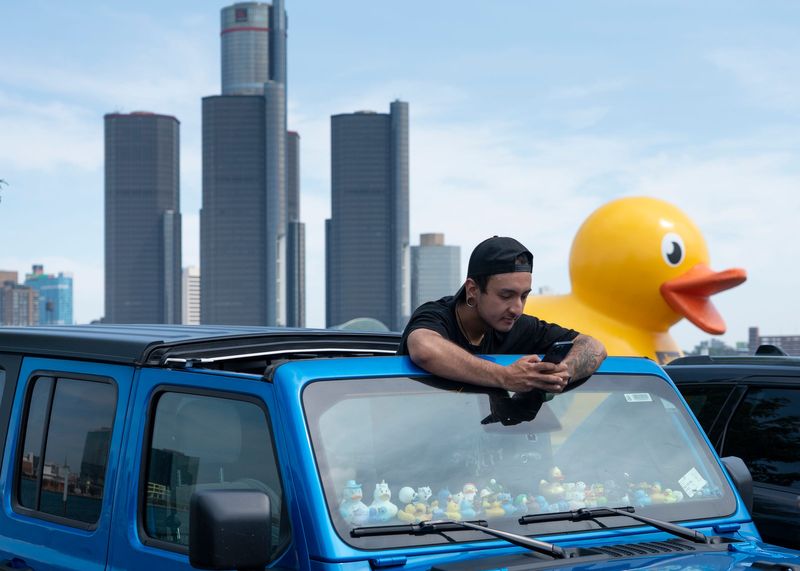
On Wednesday, July 15, across the river from the Renaissance Center in downtown Detroit, outside of Stellantis’ Canadian headquarters in Windsor, Jeep rolled out a clutch of its vehicles ranging from old, military-style classics to the brand’s newest and most powerful off-roaders. The automaker gave away commemorative rubber duckies, much smaller than the one in the river, so attendees could use them to “duck” their Jeep comrades.
The centerpiece of the show, though, was the massive, 40-foot-tall yellow rubber duck that Jeep floated out into the Detroit River for the day to celebrate 85 years of Jeep and the widespread trend of “Jeep Ducking” that, according to Stellantis’ Canadian chief, began in Canada.
What is Jeep ‘Ducking?’
For about six years, Jeep owners, especially those who drive Wranglers, have been engaged in a simple tradition called ducking.
The game is simple: Keep a few rubber ducks in your Jeep, and if you see another Jeep in the wild, leave a rubber duck on the door handle, windshield or mirror of the other driver’s car. Often, you can see Jeeps driving around with a battalion of rubber duckies standing guard on the dashboard, visible through the windshield.
Even Tim Kuniskis, the head of Stellantis’ North American brands and the CEO of Ram, said in an interview with the Detroit Free Press he has seen drivers with so many ducks on their dashboard that they slip away when accelerating.
“I have seen some that are a little crazy,” Kuniskis said.
Kuniskis said the giant duck in the river celebrating Jeep is lighthearted fun, but is really to celebrate the Jeep community and the “dominance” that the brand has enjoyed as it has pioneered, according to Kuniskis, the SUV craze automakers are all participating in today.
Why was the duck in Canada?
The automaker placed the duck outside Stellantis’ Canadian headquarters on the Detroit River, directly across from the Motor City, to mark the anniversary and celebrate the Jeep community, which Trevor Longley, the president of Stellantis Canada, called “one of the most important communities ever in automotive history.”
Jeep has longstanding roots in Canada going back to World War II, Longley said.
Military Jeeps and later civilian models were built in Windsor until the ’60s, Longley said, and currently, Jeep parts are built at Stellantis’ Etobicoke Casting Plant in Toronto. The most duck-worthy Jeeps — Wranglers and Gladiators — are built in Toledo, Ohio.
Beyond the assembly line, another Jeep tradition has its roots in Canada, too: Ducking.
“During the COVID timeframe, when we had lockdowns and issues like that, people were feeling a little disconnected,” Longley said. “(Ducking) was a nice thing that somebody did, and it started a process of leaving a duck on a Jeep. And it spread like wildfire.”
For now, a massive duck was certainly a large enough celebration for 85 years of Jeep. Longley, though, said that at the 100-year mark in 15 years, perhaps the brand may have a larger celebration.
“Maybe it will be a bigger duck, or we’ll have a duck with some ducklings,” Longley said. “But I think the ducking thing is here to stay.”
Liam Rappleye covers Stellantis and the UAW for the Detroit Free Press. Contact him: LRappleye@freepress.com.
This article originally appeared on Detroit Free Press: Why was there a giant rubber duck in the Detroit River?
Reporting by Liam Rappleye and Justin Wan, Detroit Free Press / Detroit Free Press
USA TODAY Network via Reuters Connect
By Liam Rappleye and Justin Wan, Detroit Free Press | USA TODAY Network