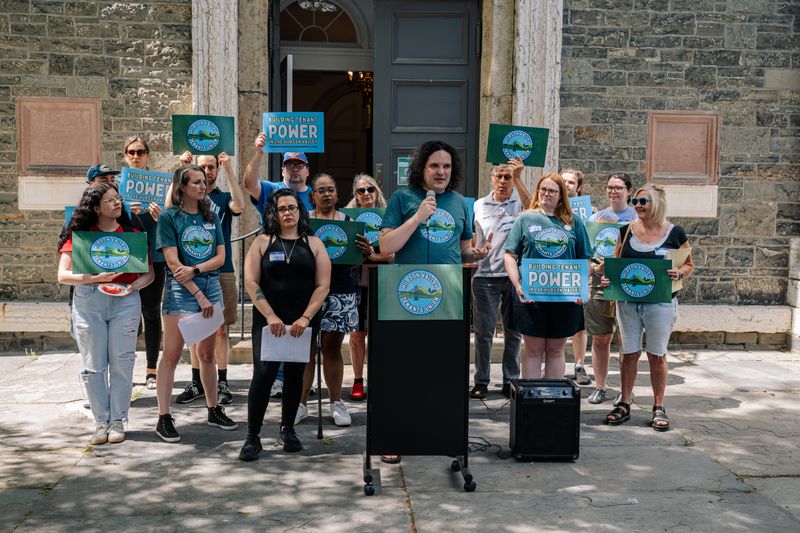
A newly created union aims to protect and advocate for renters all across the Hudson Valley. The Hudson Valley Tenants Union adopted a constitution at its first general assembly in June in Kingston, elected leadership and set an agenda for the upcoming year.
The five resolutions passed by the union include helping Kingston tenants file for legally mandated rent reductions, preventing rent increases and organizing tenants outside Kingston to expand negotiating power and impact legislation. The entity plans to lobby to pass the REST Act and support pro-tenant mayoral candidates in Kingston.

“The only way to actually make any tenant protections work,” said June Nemon, lead organizer, on the phone, “or the only way to actually change the broader dynamics in the housing market, is to shift the balance of power between tenants and landlords. We have a very small, increasing, very exploitative group of people that are extracting an incredible amount of wealth from many, many people, the majority of people in most of the municipalities in our region.”
HVTU is inspired by the models of the Connecticut Tenants Union and the Kansas City Tenants Union. Launched in May, the union aims to put area tenants in a position to negotiate contracts for rents, repairs and other housing conditions with landlords, though the timeline of when that will happen is uncertain, as Nemon expects that landlords may be unwilling to cede power.
What’s the REST Act?
The Rent Emergency Stabilization for Tenants Act (S4659/A4877) was introduced in 2025 by State Sen. Brian Kavanagh and Assemblymember Sarahana Shrestha as a rent regulation measure for empowering localities outside New York City to declare housing emergencies and employ protections under the Housing Stability and Tenant Protection Act of 2019, which expanded the 1974 Emergency Tenant Protection Act.
REST seeks to ease the localities’ ability to declare housing emergencies by addressing three provisions. It would allow alternative methods in conjunction with the current requirement of conducting vacancy surveys, e.g., eviction rates, homelessness rates and rent burdens. REST also seeks to apply to buildings built or renovated before the previous 15 years on a rolling basis as opposed to the current rule of buildings built before 1974. In addition, it seeks to broaden rent stabilization applicability to buildings with four or more units, whereas the current standard covers buildings with six or more units.
The vacancy rate must fall below 5% to prompt an emergency. In a first in the upstate New York region, Kingston opted into rent stabilization, securing a 15% reduction in rents in 2022 after a vacancy survey showed a 1.57% net vacancy rate and escalating rents.
However, landlord groups have challenged the vacancy studies in court and the Kingston rent stabilization effort has been mired in litigation. A March lawsuit is currently pending. In a previous suit, the New York Court of Appeals upheld in 2025 Kingston’s HSTPA protections and the Rent Guideline Board’s 15% rent reduction pertaining to ETPA properties.
Other municipalities have faced similar struggles.
“Both Poughkeepsie and Newburgh actually successfully opted in to rent stabilization,” Nemon said, “but landlords sued both municipalities and got those laws overturned based off of basically technicalities with the study.”
Other efforts to secure rent caps and housing stability include the state’s Good Cause Eviction law, enacted in April 2024. More than a dozen Hudson Valley municipalities have opted into Good Cause Eviction, including Middletown, Newburgh, New Paltz, Poughkeepsie, Kingston, Monticello, Beacon, Fishkill and Pleasant Valley.
The law sets a “local rent standard” established yearly as “reasonable” rent increase based on inflation in the local area, calculated by the rate of inflation plus 5%, capping at 10%. More information on calculation of mid-Hudson rates can be found in the yearly fact sheet by the Division of Housing and Community Renewal.
Hyperlocal to regional
HVTU aims to organize tenant majorities through forming associations in individual buildings or clusters across a landlord portfolio in the Hudson Valley region.
In Kingston, HVTU has formed the Kingston Opus Tenants Association, which covers 211 housing units across Chestnut Mansion, Dutch Village and the 23 John Street building, all owned by a single landlord.
The organization came into being after about a year and a half of planning and unionizing work, said Nemon, who has been an organizer for 13 years and is also a Co-Chair of Mid-Hudson Valley Democratic Socialists of America.
Five HVTU members were elected by the tenants in Kingston for one-year terms each for a governing council, comprising Raquel Gonzalez, Andrew Hiller, Steph De John, Brigid Kelly and Caitlin Ruppert.
Who can join the union?
“Anyone can join the Hudson Valley Tenants Union as long as you’re not the landlord or directly profiting from other people’s housing,” Nemon said.
Currently, there are no dues for membership, though that may change in the future. The organization invites volunteers and others who are leading mobilization efforts in their territories.
Contact reporter Vandana Saras at vsaras@usatodayco.com and @orangecountynyreporter on Instagram.
This article originally appeared on Times Herald-Record: New Hudson Valley Tenants Union aims to protect regional renters
Reporting by Vandana Saras, Middletown Times Herald- Record / Times Herald-Record
USA TODAY Network via Reuters Connect
By Vandana Saras, Middletown Times Herald- Record | USA TODAY Network