Republican U.S. Rep. Zach Nunn and his Democratic challenger, Sarah Trone Garriott, are drawing clear contrasts on their approaches to health care — even as both commit to strengthen cancer treatment and prevention resources in Congress.
Nunn and Trone Garriott, who will face off in the November midterm elections, outlined dueling philosophies on the federal government’s role America’s health system during a series of roundtables in July focused on Iowa’s sky-high cancer rates.

It’s a key issue in the race for south-central Iowa’s 3rd Congressional District.
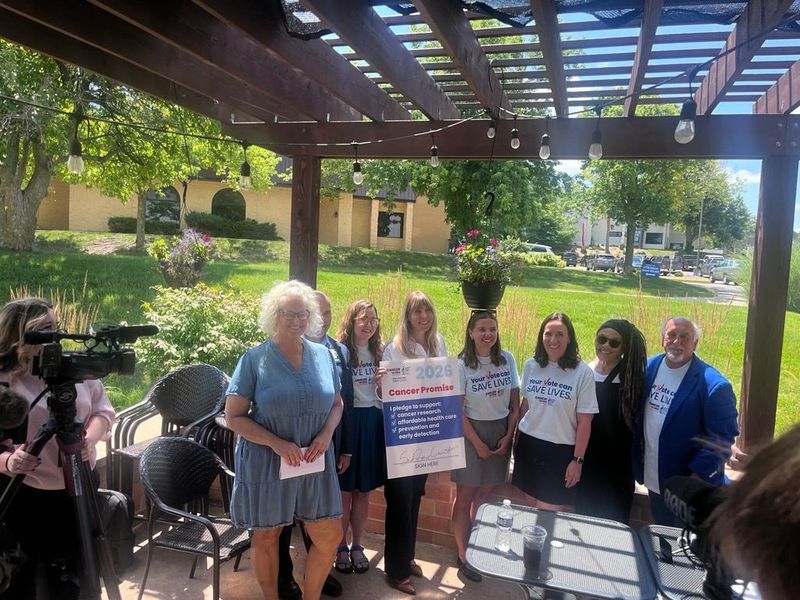
American Cancer Society Cancer Action Network, the advocacy arm of the American Cancer Society, organized a series of candidate conversations where both signed the group’s “Cancer Promise” — saying they will support cancer research funding and also ensure access to affordable, comprehensive health coverage and cancer prevention services, such as tobacco prevention and cessation programs.
Trone Garriott favors public option for health care coverage
Trone Garriott, who is campaigning heavily on health care access and affordability in the wake of Republicans’ tax and spending law dubbed the “One Big, Beautiful Bill,” advocated for a public health insurance option that would allow people to continue to seek private insurance but also turn to an affordable government-backed alternative.
“Making sure that every one of our neighbors has health care coverage so that every U.S. citizen can get the health care they need, I think that should be a top priority because we have a lot of neighbors who they’re struggling to get care,” Trone Garriott said. “They can’t afford to see a doctor. They don’t have coverage. And then even the folks who do have coverage, it’s too expensive for them to truly take advantage of that coverage and get the care that they need.”
She also wants to restore the steep cuts to Medicaid included in the year-old GOP law, which are estimated to total nearly $1 trillion over a decade and leave 10 million uninsured. Already in Iowa, several clinics have reduced service lines because of Medicaid cuts and provider recruitment and retention struggles. MercyOne’s Ottumwa clinic closed in February.
Iowa’s all-Republican congressional delegation, including Nunn, voted for the measure.
Republicans contend the Medicaid changes will preserve benefits for those who truly need assistance and eliminate waste and fraud. Democrats have said the measure will close hospitals, threaten the health system and reduce health care access.
Rescinding the cuts would help ensure Iowans have coverage that allows them access to care, Trone Garriott said, which would help with cancer prevention and early detection.
“Cancer has touched every life in Iowa,” she said. “And it’s something incredibly important to me personally to work on because this is one of the biggest problems facing our state. And health care access in Iowa is struggling, and these Medicaid cuts have made things so much worse.”
Zach Nunn pushes ‘diversified’ health system
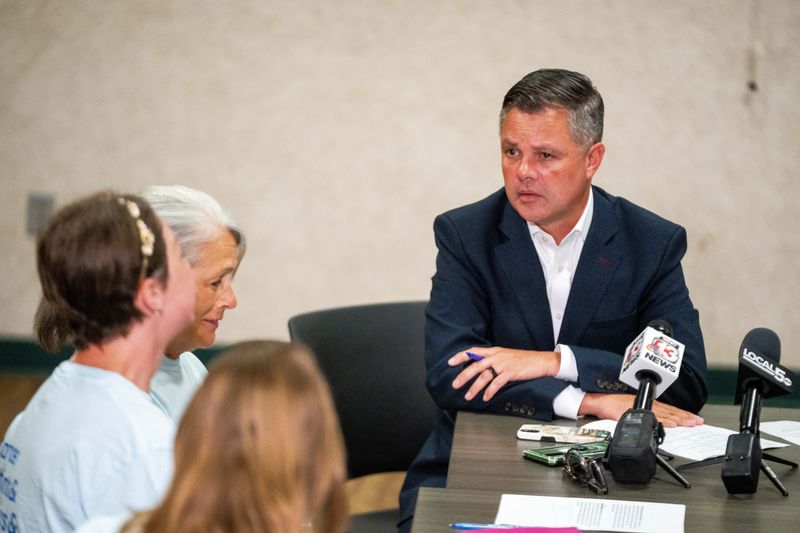
After his cancer roundtable in Adel on July 10, Nunn told reporters he favored a “targeted” health care approach that maintains the integrity of public health programs for those who rely on them without pursuing a “government takeover.”
“What I don’t agree with is an idea here that the government somehow is going to know better than your doctor and we should take over health care,” Nunn said. “I think that not only has proven to be a false equivalent, it’s proven to be incredibly wasteful and actually results in lower patient care. So let’s be smart about this going forward on how do we actually invest in long-term health care? And I think that means a diversified program where both private insurance, Medicare and Medicaid work in tandem, not against each other.”
He touted the $50 billion rural health funding tucked into Republicans’ budget reconciliation law. Iowa received a $209 million federal grant to expand and improve rural health care access; improve cancer prevention, treatment and outcomes; and increase telehealth access, among other efforts.
To make sure federal investments are sustainable, Nunn said he wanted to see clear benchmarks for success instead of pumping more money into a broken system.
He said MercyOne had cited its reliance on Medicaid funding as a factor in the closure of its Ottumwa clinic, saying the reimbursement model was “not going to sustain them going forward.”
But a new family practice clinic has opened at River Hills Community Health Center in Ottumwa, expanding primary care access in the area. Nunn said it will provide new wraparound services and exemplifies the kind of regional health care model Iowa is striving to create.
“As we noted here, that’s more than just taking care of what happens after somebody’s sick,” Nunn said. “There’s a lot of prevention that comes in this.”
Candidates support boosting cancer research funding
Both candidates said they supported bumping cancer research funding and shared legislation they’ve supported to expand research as cancer survivors and advocates pointed to it as a key issue.
Despite federal research funding cuts from President Trump’s DOGE government efficiency initiative, Nunn pointed to his support for a $51.3 billion funding request in the federal fiscal year 2027 for the National Institutes of Health — the full funding level advocates, including the American Cancer Society, wanted.
“We just have to get the red tape of government out of the way and start moving candidly at the speed of cancer and, even better, move at the speed of cancer research,” Nunn said. “I believe that we can make life better for a lot of families that way.”
While the state has been studying the root causes of cancer in partnership with the University of Iowa College of Public Health, Trone Garriott said she would support annual federal research funding bumps to more quickly make an impact.
“We need that research on a large scale on the federal level to be able to find new opportunities for treatment, but then also to understand the root causes that can help us to be healthier and avoid the cancer risk,” Trone Garriott said. “Iowa is an outlier. Among our peer states, we have higher occurrences.”
Marissa Payne covers the Iowa Statehouse and politics for the Register. Reach her by email at mjpayne@registermedia.com. Follow her on X at @marissajpayne.
This article originally appeared on Des Moines Register: Iowa cancer crisis shows health care gap between Nunn, Trone Garriott
Reporting by Marissa Payne, Des Moines Register / Des Moines Register
USA TODAY Network via Reuters Connect

By Marissa Payne, Des Moines Register | USA TODAY Network