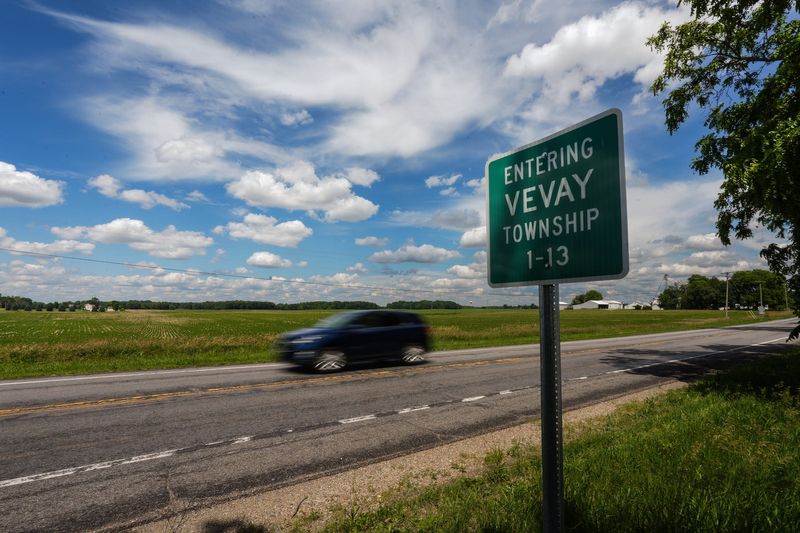
VEVAY TWP. — Negotiations between township and city of Mason officials over a tax sharing agreement for hundreds of acres of land eyed by a data center development have broken down, with township officials rejecting an offer of at least $1 million a year for 30 years, according to Mason City Manager Deborah Stuart.

Tens of millions of dollars are at stake over the years. Mason’s current tax revenue is about $4.3 million a year. The expected tax capture from the data center is $7.6 million annually, according to city documents, meaning the city’s tax revenue would nearly triple to almost $12 million annually. By comparison, Vevay Township’s property tax revenue is about $300,000 a year, online budget documents show.
Township trustees unanimously rejected the idea of entering discussions to explore a Public Act 425 agreement involving a conditional land use transfer at a June 10 meeting, after “public comment was received from many concerned community members (and) the majority of the comments were against a data center and a 425 agreement,” according to the board’s draft minutes.
“I was disappointed by the decision of the township to not pursue a 425 agreement,” Mason Mayor Russell Whipple said in an email. “The city would much rather partner with the township and share the significant tax revenue benefits.”
A 425 agreement allows townships and cities to share tax revenue, and the township and the city have reached deals before, including decades ago before Meijer developed its store south of the city. Online budget documents show the township receives about $44,000 a year in tax revenues from existing 425 agreements.
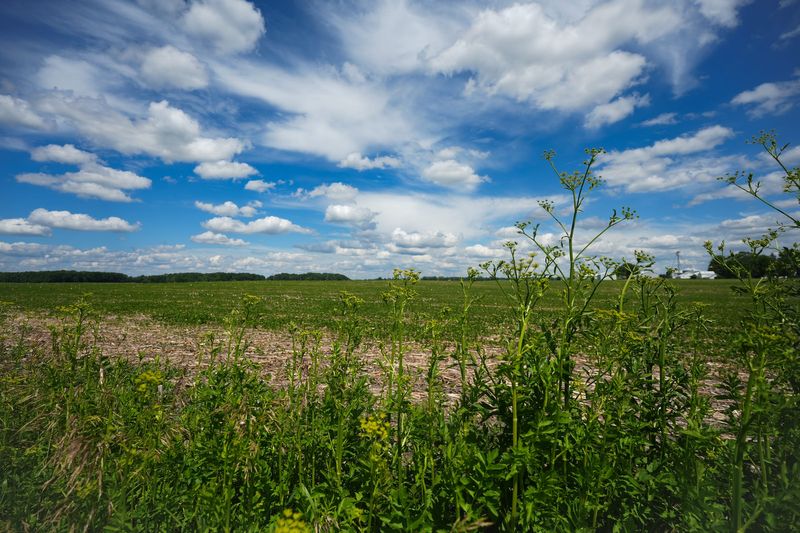
Emotions are flaring publicly over the region’s rural character because a developer is promising an investment of more than $1 billion and a cash infusion that would more than double Mason’s present-day tax stream if a hyperscale data center is built on about 400 acres at the corner of College and West Columbia roads, west of Mason.
The project could mean 1,000 to 1,500 construction jobs and about 150 permanent jobs with $150,000 salaries, Stuart recently outlined in a slide presentation to councilmembers.
Township board members have declined requests for comment in the weeks following the meeting, but Vevay Township and city of Mason officials — and residents with ties to both communities — are now waiting for an annexation application to be filed with the State Boundary Commission.
Once it’s filed, “the petition process … requires three independent meetings of the (commission) spread over 12 (to) 24 months to be completed,” said Emily Fitzgerald, spokeswoman for the Michigan Department of Licensing and Regulatory Affairs.
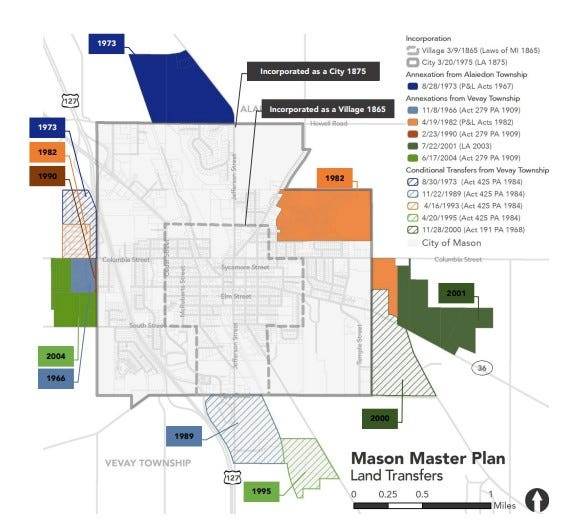
That could mean a continuation of impassioned voices in both communities as they await a decision on the data center. Some may still remember the state boundary commission expanding Mason by 140 acres in 2001 for single-family homes and a church proposed for Vevay Township land north of M-36 and Dexter Trail, near Mason’s eastern city limits.
“We were not surprised by the boundary commission’s decision this month, but were disappointed,” then-Vevay Township Clerk Susan Kosier said at the time. “As a board, we felt the annexation was unnecessary at this time and went beyond the city’s need to square off its boundaries.”
Is Vevay Township vulnerable to annexation?
Vevay and Mason officials have worked together in the past on big development projects. In the late ’90s, a joint Mason/ Vevay Planning Commission OK’d a permit for a Meijer gas station and convenience store near Kipp and Hull roads. Also, Mason’s master plan shows multiple annexations and 425 agreements between the two communities over the years.
Whipple said Meijer was built on land that was part of an expired 425 agreement and now includes Gestamp Mason, CorrChoice Mason, Kent Feeds and others. “There was no annexation involved and the SBC was not involved,” he said.
Stuart said both Mason and Vevay Township already have agreed the proposed data center site is ripe for development.
“This is an area that has been defined contractually as an area for growth for the city and the township and that contract has agreed not to oppose annexation in this area,” she said, referencing a 1989 agreement between the communities that indicate the proposed site “may be annexed by the City when sewer and water services are offered.”
Experts from Michigan State University’s College of Law and the Michigan Townships Association believe that Vevay Township may be particularly vulnerable to annexation because it is not a charter township.
Charter townships, like Delhi, Meridian, DeWitt and Bath townships, are “exempt from annexation to any contiguous city or village,” under Michigan law. Charter townships must have at least 2,000 residents — Vevay has about 3,600 people living there — but also provide municipal services including fire protection, police and garbage disposal among other requirements.
Vevay is in Mason Fire Department’s coverage area, and the township’s website asks viewers to report crimes to the Michigan State Police and Ingham County Sheriff’s Office.
Stuart has said publicly that “we have water and sewer directly to that (proposed) site.”
But it’s not a done deal, said Michael Selden, member information services director for the Michigan Townships Association.
“It kind of goes back to what are they looking to do with the property, and what can the city provide that a township can’t provide,” he said. “There are steps. There are processes. It’s not just an automatic just because a city says, ‘Oh, we want this property and this is what we want to do’ that it’s going to happen.”
Daniel Rosenbaum, an assistant MSU law professor on local government, said Michigan’s boundary commission, unlike similar bodies in other states, does not act as a “rubber stamp.”
“Under Michigan law, there can be a petition to the State Boundary Commission,” he said. “There’s sometimes going to be resident votes. The non-charter township has to put their hope in the State Boundary Commission or those other procedural steps to prevent the annexation from going forward.”
Annexation decisions
The State Boundary Commission has three members, according to the state’s website, including Linda Preston of Dowagiac, whose term ends in November 2026, Richard Datema of Petoskey, whose term ends in November 2027, and Robin Beltramini of Troy, whose term ends in November 2028.
Fitzgerald, the LARA spokeswoman, spoke for them in June. She said neither the State Boundary Commission nor LARA’s Bureau of Construction Codes had yet received a formal petition for land annexation regarding Vevay Township property.
“Typically, only a few of these petitions are received each year,” she said. “To ( LARA’s) knowledge, no petitions have been related to data center proposals.”
Proposals put forward by Republicans in both the state House and Senate would institute a yearlong moratorium on new data center developments in Michigan while policymakers explore regulating data centers.
Paula Caltrider, a Haslett resident who grew up near where the data center is being proposed, promises that “the fight is on.”
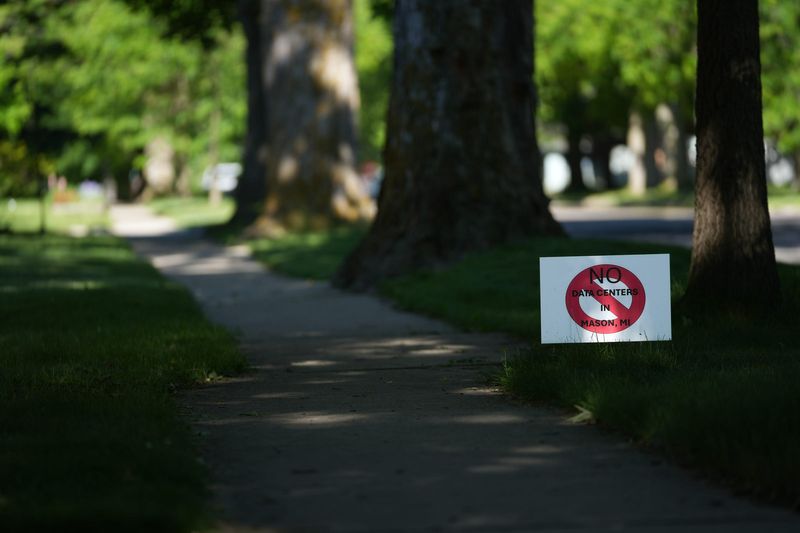
She’s joined the efforts of two significant groups — No Data Centers in Mason and Mason Data Center Facts — to stop the data center project.
Their opposition has included protests against Mason’s now-repealed technology innovation (M-3) zoning district in preparation of any data center proposals and efforts to get Whipple and Councilwoman Elaine Ferris recalled.
Members of No Data Centers in Mason delivered their recall petition signatures on June 30 to Ingham County Clerk Barb Byrum. Byrum this week rejected recall petitions against Whipple, but is still reviewing petitions for a recall vote against Ferris. She must decide by July 22 if there are the required 1,000 valid signatures for the recall effort against Ferris, which could put Ferris on the November ballot. Any recall effort against Whipple would need to start from scratch, with new language submitted to the county’s election commission. Terms for both are set to expire at the end of 2028.
City Councilman Jerry Schaffer, one of 10 council candidates on the Aug. 4 ballot, also has protested.
He attended Vevay Township’s June 10 meeting, where he said many people spoke but never in favor of the 425 agreement that could have avoided an annexation.
While he said township officials made “a very good decision,” he’s uncertain about what will happen with an annexation application because “there’s too much money to back down.”
“It is out of our hands,” said Jon Droscha, another current city councilman who is seeking reelection. “Unless something drastic changes, it is coming.”
He elaborated in an email: “City council doesn’t really have a say on whether a data center comes to Mason. If the land sells, and the developer meets zoning requirements, it cannot be stopped.”
Open-door policies
Stuart has been sending lengthy memos to Mason councilmembers on who she’s talked to since last year and why about a possible data center.
Her timeline in council’s June 15 meeting packet said she officially “met with the Township Supervisor (John Lazet) to discuss that the City believes there will be a utility request” in October 2025.
“The Supervisor was aware of land inquiries in these areas, but not the use, as property owners in the area had shared that inquiries were being made,” she said in the timeline. “At that time, (the supervisor) did not express concerns about the anticipated use of a data center.”
They continued to communicate as council approved in February the new Technology Innovation (M-3) zoning district with noise, screening and other standards for data centers in preparation of any proposals. Council then repealed the already-suspended ordinance in March because of a referendum attempt by community members. A repeal prevented residents from voting on the ordinance, which many considered a welcome mat for data centers.
Between those two events, Bloomfield Hills attorney Alan Greene, of Dykema Gossett PLLC, notified city officials in a letter that his client, who has not been publicly identified, was “evaluating sites for a potential hyperscale data center development within or near the City of Mason.”
Even before the ordinance repeal, the city had received a Feb. 23 utility request for the data center project, and Stuart sent a first draft 425 agreement to the township in April. A second was sent in May with the understanding that starting negotiations would begin at “an estimated $1 Million per year for 30 years for the Township.”
The third draft sent June 1 to the township laid out that negotiations would begin there.
As the township’s June 10 meeting approached, township Treasurer Christopher Lewis “expressed frustration that they did not know the end-user and was not sure if the Township could support the project without knowing the end-user or more information.”
Stuart told him “that the end-user would be willing to meet with any township board members to answer questions,” but her timeline shows no record of that happening before the June 10 township board meeting, when officials officially said no to 425 negotiations.
On June 11, Stuart documented, “representative for the property owner notifies the CM (city manager) that they plan to pursue annexation.”
“I had hoped that the city could partner with the township, but I understand if they are not interested in a 425,” Stuart told the State Journal. “I’m always open to working with the township. They’ve been great partners with us in the past. I would always have a door open, but it would be up to both boards on whether they want to re-enter negotiations.
The Michigan Chapter of the National Electrical Contractors Association and Ingham Intermediate School District already have written letters to Mason supporting the data center project.
“When economic development is thoughtfully planned and responsibly implemented, it can create lasting benefits that extend well beyond a single project or jurisdiction,” Ingham ISD Superintendent Jason Mellema said in a June 10 letter to both Vevay and Mason officials. “The proposed data center represents an opportunity to strengthen that partnership by expanding the resources available to support public services and invest in the future of our region.”
Contact editor Susan Vela at svela@lsj.com or 248-873-7044. Follow her on Twitter @susanvela.
This article originally appeared on Lansing State Journal: Data center proposal in Mason area may be decided by state officials
Reporting by Susan Vela, Lansing State Journal / Lansing State Journal
USA TODAY Network via Reuters Connect
By Susan Vela, Lansing State Journal | USA TODAY Network