

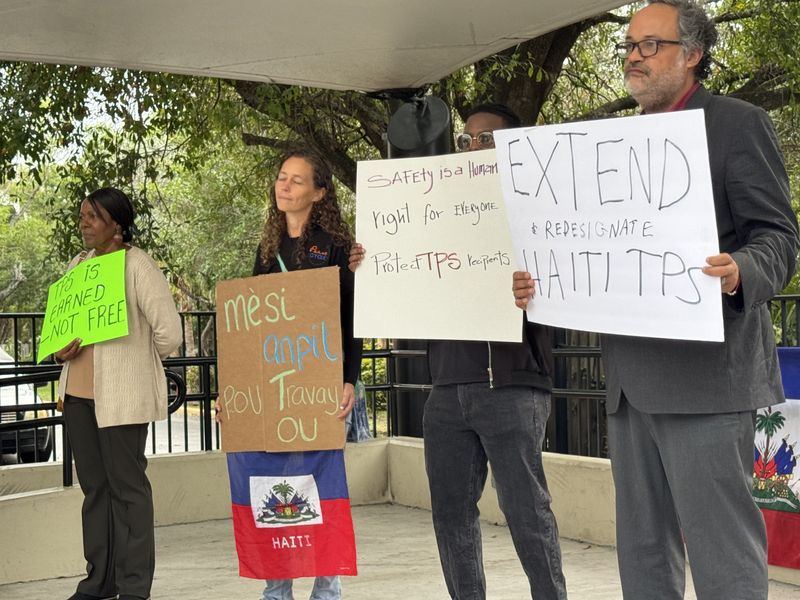
The U.S. Supreme Court has ruled that the Trump administration may revoke the temporary protected status of 350,000 Haitians. This is not the first time a legal challenge to TPS has held Haitians’ future in the balance. In his first term, President Donald Trump attempted to terminate Haitian TPS but was blocked by a U.S. District Court ruling.
With the latest Supreme Court ruling, the return of these migrants to Haiti appears to be the administration’s aim.

Haitian families, who for years have lived under the uncertainty of their TPS renewal, now face a new and more immediate uncertainty. Research on migration-related stress suggests that these consequences may weight especially heavily on Haitian women.
Research in my field helps me examine how it may affect Haitian women’s emotional well-being, mental health and resilience. At the same time, as an international graduate student I have experienced how U.S. immigration and travel policies can affect the lives and opportunities of people from Haiti. I’ve also watched relatives who migrated from Haiti navigate the migration system directly. These experiences have shown me that immigration decisions are rarely just about paperwork. They are also about rent, work, children, remittances and the fear of starting over again.
Many Haitian TPS holders have been living in the U.S. for years, some since 2010 when Haiti was first designated for TPS after the devastating earthquake that killed more than 220,000 people, injured 300,000 and displaced 1.5 million.
Florida is central to their story: Nearly half of the 1.1 million Haitian immigrants to the U.S. live in the Sunshine State, with especially large communities in Palm Beach, Broward and Miami-Dade counties. Over time, Haitian women have built lives and sustained communities as parents, workers, churchgoers, students and caregivers. The court’s ruling now threatens both their families’ stability and the Florida communities shaped by their work, care and participation.
Haitian women as ‘poto mitan’ in the US
Haitian women are the “poto mitan,” the central pillars, of family and community life. Many support children, parents and relatives in Haiti, while working, parenting, paying bills and contributing to their local economies in Florida.
Some may now face painful decisions about their U.S.-born children: Should they take them to Haiti, where they may encounter safety concerns, disrupted schooling and an unfamiliar environment? Or keep their children in the United States, separated from their parents? For many Haitian mothers, children’s well-being is at the center of such decisions. So it’s not surprising that concerns around children’s health and safety weigh so heavily on women in this moment.
Research on Haitian populations in Florida has shown higher levels of migration-related stress among women than men, although the health effects of TPS uncertainty among Haitian women remain understudied. Similarly, broader research into caregiving has found links between prolonged financial and emotional stress and anxiety, depressive symptoms, sleep problems, exhaustion and declining physical health.
These overlapping demands show why immigration decisions, such as the court’s TPS ruling, can affect Haitian women’s mental and physical health far beyond their legal status. Those pressures are compounded by the conditions they and their families may face in Haiti.
What returning to Haiti could mean
For many Haitian women, the prospect of returning to Haiti raises serious safety concerns. Over the past decade, the country has faced repeated natural disasters along with slow recovery, political upheaval, economic hardship, food insecurity and escalating gang violence. Violence and instability have displaced more than 1.4 million people on the island. Schools and hospitals have been disrupted, families forced from their homes, and access to work and essential services has become increasingly limited.
Given these conditions, returning may feel neither safe nor realistic. In this context women and girls face particular risks of sexual and gender-based violence. As a result, parents must consider not only their own safety but also what returning could mean for their children’s security, schooling and ability to remain with their families.
For Haitian women already carrying extensive emotional and caregiving responsibilities, the loss of TPS adds another layer of pressure ― turning an immigration decision into difficult choices about the future of entire families. These women’s strength, leadership and commitment to family are central to their communities in Florida and beyond.
Although the Supreme Court ruling resolved the legal question before the court, it did not remove the uncertainty looming over Haitian families. Instead, it shifted that uncertainty into urgent decisions about safety, work, parenting, family separation and how to remain connected across two countries.
Much of the responsibility for navigating what comes next is likely to fall disproportionately on Haitian women.
Ammicise Apply is a Ph.D. candidate in Community and Public Affairs at Binghamton University, State University of New York. She wrote this piece for The Conversation, an independent news organization dedicated to unlocking the knowledge of experts for the public good.
This article originally appeared on Palm Beach Post: Burden of TPS revocations will fall on Haitian women | Opinion
Reporting by Ammicise Apply, Opinion Contributor / Palm Beach Post
USA TODAY Network via Reuters Connect
By Ammicise Apply, Opinion Contributor | USA TODAY Network
