

By David Thomas and Nate Raymond
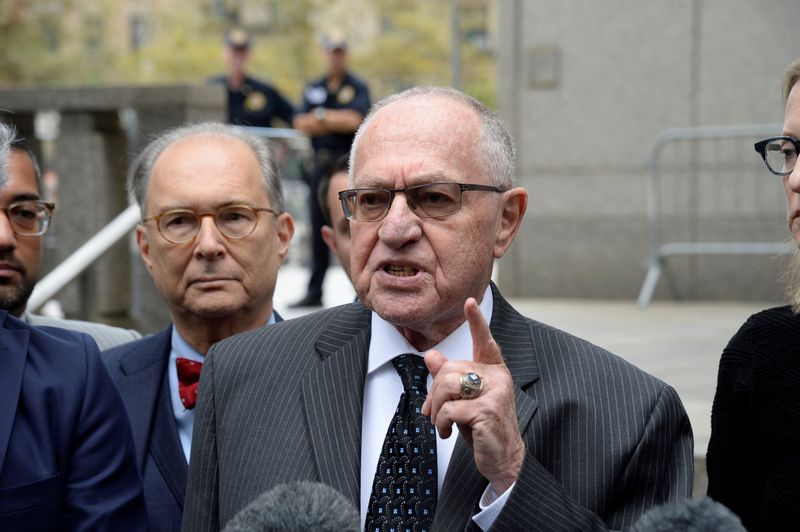
WASHINGTON, June 29 (Reuters) – The U.S. Supreme Court declined on Monday to hear prominent lawyer Alan Dershowitz’s bid to revive his defamation lawsuit against CNN over the network’s coverage of his remarks defending Donald Trump during the president’s first Senate impeachment trial in 2020.

The justices turned away the retired Harvard Law professor’s appeal of a lower court’s ruling throwing out his case against CNN, which is owned by Warner Bros Discovery. In his appeal, Dershowitz had urged the justices to roll back protections against defamation claims that the Supreme Court established in its landmark 1964 ruling in a case called New York Times v. Sullivan.
In Sullivan and subsequent decisions, the Supreme Court said that to win a libel suit, a public figure must demonstrate the offending statement was made with “actual malice,” meaning with knowledge that it was false or with reckless disregard as to whether it was false.
Dershowitz in his petition argued that Sullivan has become “an impregnable fortress that protects media irresponsibility while denying public figures any remedy for egregious misrepresentations.”
‘ACTUAL MALICE’
Justices Clarence Thomas and Neil Gorsuch, who are members of the court’s 6-3 conservative majority, dissented from the decision to not hear Dershowitz’s case, as they reaffirmed their longstanding views that the Supreme Court should reconsider the “actual malice” standard for public figures.
Thomas, who wrote the dissenting opinion, said this standard bears no relation to the text, history or structure of the U.S. Constitution.
“Instead, the founding generation believed that, if anything, public figures had stronger claims for damages when they were defamed,” Thomas wrote.
Dershowitz told Reuters in an email, “The lower courts found that CNN lied about what I argued in the Senate but concluded that I had to prove by clear and convincing evidence that their lie was malicious. I believe that the court will eventually accept my position.”
CNN declined to comment.
Dershowitz was a member of Trump’s defense team in the Senate impeachment trial in 2020 held after the House of Representatives passed articles of impeachment accusing the Republican president of abuse of power and obstruction of Congress. Dershowitz had written a 2018 book arguing against impeaching Trump.
The charges arose from Trump’s attempts to pressure Ukraine to announce an investigation of his Democratic political rival Joe Biden, who went on to defeat Trump in the 2020 presidential election. The Senate voted to acquit Trump, and did so again in his second impeachment trial the following year.
Dershowitz sued CNN over the news outlet’s coverage of his presentation to the Senate during the trial, as he offered an expansive view of presidential power that provoked astonishment among Democrats.
CNN reported that Dershowitz said during Trump’s trial, “if a president does something which he believes will help him get elected in the public interest, that cannot be the kind of quid pro quo that results in an impeachment.” Quid pro quo is a Latin term meaning a favor for a favor.
In his lawsuit, Dershowitz said that this was only part of his remarks, and that CNN repeatedly aired that particular clip to make it seem as if he was “a constitutional scholar and intellectual who had lost his mind.”
‘LASTING DAMAGE’
CNN argued in filings to the Supreme Court that Sullivan was correctly decided, and that reversing or weakening it as Dershowitz requested could cause “lasting damage to a wide range of precedent.” CNN said it aired Dershowitz’s full remarks and interviewed him on air twice after he complained about the coverage.
A federal judge in Fort Lauderdale, Florida, ruled in favor of CNN in 2023. The Atlanta-based 11th U.S. Circuit Court of Appeals also sided with CNN in 2025, finding that Dershowitz presented no evidence that CNN’s reporters and commentators operated with actual malice.
Dershowitz has earned fame as a trial attorney. He has represented many famous clients including financier Jeffrey Epstein, football star O.J. Simpson, televangelist Jim Bakker, boxer Mike Tyson and WikiLeaks founder Julian Assange.
Conservative Justices Clarence Thomas and Neil Gorsuch have signaled interest in revisiting the Sullivan precedent.
The Supreme Court in recent years turned away opportunities to examine Sullivan, including a 2021 denial that drew dissents from Thomas and Gorsuch. Citing a rapidly changing media environment rife with disinformation, they wrote separately that the court should take a fresh look at its precedents that make it harder for public figures to win defamation cases.
The Supreme Court in 2025 declined to hear an appeal by casino mogul Steve Wynn, who also targeted Sullivan in challenging the dismissal of his defamation lawsuit against the Associated Press.
(Reporting by David Thomas and Nate Raymond; Additional reporting by John Kruzel; Editing by Will Dunham)
By David Thomas and Nate Raymond | Reuters | © Copyright Thomson Reuters 2026.
