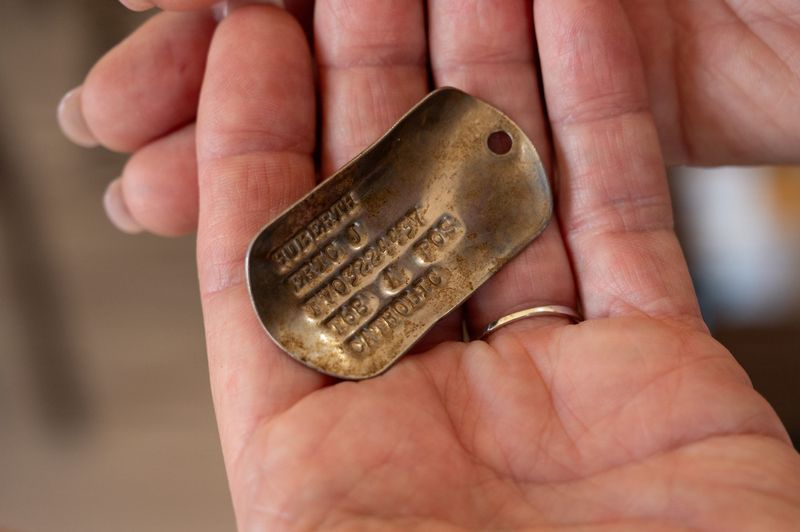
The dog tags found 56 years after a Thousand Oaks Air Force officer’s plane crashed during the Vietnam War came in beautifully crafted shadow boxes.
Almost the moment the metal tags identifying Capt. Eric “Rick” Huberth were presented by an Air Force lieutenant colonel to the two women who knew Huberth as the older brother who took care of them, the frames were discarded. The sisters cradled the tags in their hands and cried.

“We both wanted to feel them. It felt like I was closer to my brother than I had been in 56 years,” Lorraine Larsen said. “It felt like (the tags) belonged to me.”
The May ceremony in North Las Vegas came on the anniversary of the day Huberth went missing in action with no bodily remains ever recovered. It continues a grim drama that centers on the 25-year-old pilot memorialized in a wood sculpture, a worn plaque and a POW/MIA flag at the Thousand Oaks Civic Arts Plaza.
Huberth once lived with his mother and four sisters on the corner of Wilbur and Moorpark roads in Thousand Oaks. He was the eldest child and worked in a Safeway store. He earned a degree in biology at San Fernando Valley State College, now CSU Northridge.
His mother and father had divorced. Huberth took it upon himself to help support the household. Larsen remembers her mother gently scolding him for going against her wishes and paying the electric bill on his own.
“He’d say, ‘Sorry, mom, I took care of it,”” she remembered, noting that he also bought her and a sister their first car — a 1961 Chevy.
“He was the big brother who stepped in to help,” Larsen said. “He was very centered on helping his little sisters and his mother.”
He graduated from San Fernando Valley State and tried unsuccessfully to enroll in a veterinary school, losing his draft deferment status in the process. He enlisted in the Air Force and became a pilot.
“He knew he was going to fly,” Larsen said. “He raced cars and stuff. He had a need for speed.”
Then a first lieutenant, he was sent to Vietnam. According to the Air Force, he flew a dizzying 55 strike missions in six weeks, some as a pilot and some as weapons systems operator.
On May 13, 1970, Huberth and Capt. Alan Trent were sent on a mission to bomb a bridge in Cambodia along the Ho Chi Minh Trail. The aircraft was hit by enemy ground fire, according to Larsen and an Air Force news release. Trent, who was the pilot, tried to pull the jet up. It hit a ridgeline and crashed.
A search and rescue team was sent to the area but was forced to leave because of heavy fire. Both men were reported missing.
All Huberth’s family knew for sure was that he was gone. They thought he may have survived the crash and been captured as a prisoner of war. The scenario was terrifying but so were the other possibilities.
“It was horrible. I was 16 years old. It changed the dynamics of our family immediately,” Larsen said. “The unknown is what is not healthy. Talk about a life change. My mother lost the joy in her life.”
Damaged memorial
In Thousand Oaks, a freedom tree in honor of Huberth was planted at what was then City Hall in 1973 along with a second oak memorialized for Gregg O. Hanson, an Air Force officer who survived being captured during the Vietnam War.
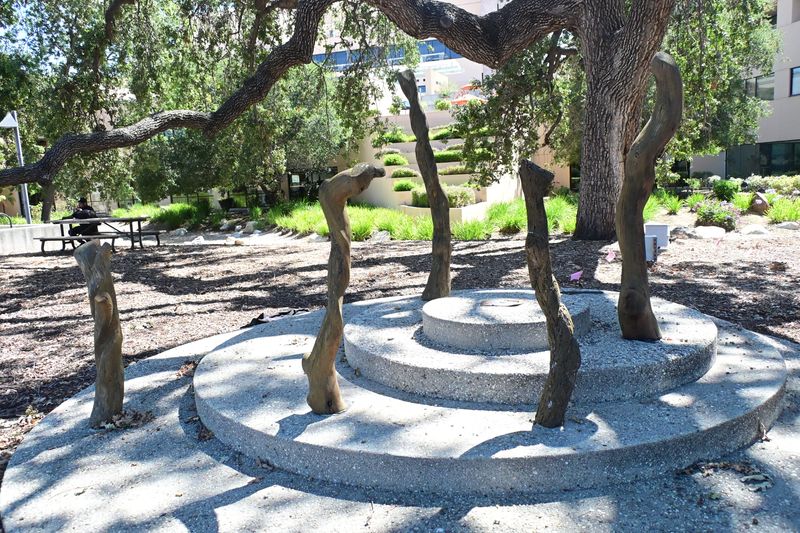
When Huberth’s tree died of a fungal infection, parts of it were used to create a sculpture in the airman’s honor that now is on display outside the Civic Arts Plaza.
The artwork by onetime Moorpark College art instructor Gülhis Celậyir-Monezis, shows pieces of wood carved into twisted ribbons. They sit on circles of concrete, reaching toward the sky. A POW/MIA flag flies overhead.
Parts of the sculpture have been broken or otherwise damaged in incidents, including multiple acts of vandalism. Jonathan Serret, the city’s cultural affairs director, said the damage means the piece no longer looks like it once did.
“It doesn’t reflect what it was intended to reflect,” he said.
William Maple, a Newbury Park resident who designs historical museums, including the National Prisoner of War Museum in Georgia, has become an advocate for Huberth’s sisters and the memorial. He said it hasn’t been properly maintained.
A planned downtown development project involving the Civic Arts Plaza means the structure will ultimately be removed and stored. Maple worries it won’t see light of day again.
“It could be lost,” he said, then citing the words on the POW/MIA Flag; “You are not forgotten.” He thinks maybe the pledge won’t be kept.
“I don’t want that to happen,” he said. “We have a responsibility not to forget.”
Serret said the piece will be removed and stored after ground is broken, possibly in 2028. But when the redevelopment project is complete, the memorial will be displayed again. Its exact location is unknown.
“The intention is that this will be redisplayed out for the community,” he said, emphasizing the importance of the memorial. “It’s intended to be a remembrance of this young man, Capt. Huberth, who gave his life for the country and never came back.”
Lingering uncertainty
The pilot’s dog tags were found earlier this year after decades of searching and at least 11 excavation missions. The family learned of the discovery earlier this year.
Jeanne Huberth, Eric’s mother, died in 2009. Two of the captain’s sisters have died too, leaving only two remaining sibilings, Larsen and Suzanne Huberth. They are both former Thousand Oaks residents who now live in Las Vegas.
At the reunification, one of Huberth’s dog tags was given to each of his sisters, triggering decades-old memories and waves of emotion.
“I did not think it was going to light me up the way it did,” Larsen said. “It was a very powerful moment.”
She said she still has lingering uncertainty about exactly what happened to their brother but sees the IDs as a sign he may have died immediately.
“I want to believe that God was kind enough to take him right away,” Larsen said.
She serves on the board of the National League of Families of American Prisoners & Missing in Southeast Asia. She wants more closure in the form of proof her brother died at the crash site.
Another excavation of the crash site is expected in January 2027. Larsen wants the efforts to continue until actual remains are recovered and sent home. She plans for a burial ceremony at Arlington National Cemetery in Virginia.
“I want the government to understand their responsibility,” she said. “You just can’t send people in harm’s way and not feel responsibility and do everything you can to bring them home.”
Tom Kisken covers health care and other news for the Ventura County Star. Reach him at tom.kisken@vcstar.com.
SUPPORT LOCAL JOURNALISM: To see more stories like this, subscribe.
This article originally appeared on Ventura County Star: Coming home: MIA officer’s dog tags given to family 56 years later
Reporting by Tom Kisken, Ventura County Star / Ventura County Star
USA TODAY Network via Reuters Connect
By Tom Kisken, Ventura County Star | USA TODAY Network