Editor’s note: In celebration of America’s 250th birthday in 2026, TCPalm/Treasure Coast Newspapers takes a look throughout the year at some of our region’s history and landmarks important to all of America.
To understand what Independence Day ― or this era in what’s officially called the United States of America — means, we should review some history, then look ahead with younger Treasure Coast residents who hopefully will celebrate the nation’s tricentennial in 2076.

The words our founders agreed to in Philadelphia 250 years ago remain powerful, though many of us take them for granted, probably much more so than decades, or centuries, ago.
It’s difficult to imagine living in this part of Florida 100 years ago when the Treasure Coast had about 10,000 people, compared to about 690,000 now.
But 250 years ago?
Historic signing had little meaning in these parts
There was relatively little going on locally July 4, 1776, when the Second Continental Congress in Philadelphia adopted the final text of the Declaration of Independence from Great Britain.
Relatively few Native Americans battled the harsh elements in what we now know as the Treasure Coast. Our region’s moniker stems from what happened to 12 ships that departed Havana, Cuba, on July 24, 1715, with gold, silver and other valuables headed to Spain.
Vicious weather took the fleet north toward our region, where shipwrecks cost 700 to 1,000 crew members their lives a week later. At least $400 million worth of jewelry, silver and gold sunk off the coast, TCPalm has reported.
Spanish explorers got native Ais Indians to help salvage valuables to return to Spain, but few outsiders settled here until 1838, when Fort Pierce was established. Florida was not a U.S. territory until 1822, and not a state until 1845.
Anyone here in 1776 would have been clueless about what was happening 1,000 miles to the north. The now two-plus-hour flight or 17-hour drive up Interstate 95 to Independence Hall would have taken weeks by ship or at least one to two months by land, according to various online sources.
What would those inhabitants have thought of the “revolutionary” words Supreme Court Justice Neil Gorsuch describes as the “ideals,” “aspirations” and “hopes” our founders agreed upon:
“ … all men are created equal, that they are endowed by their Creator with certain unalienable Rights, that among these are Life, Liberty and the pursuit of Happiness,” the founders said in part. “That to secure these rights, Governments are instituted among Men, deriving their just powers from the consent of the governed.”
‘Crazy, radical ideas’ take hold
Back then, folks around the world saw these words as insanity.
“Those were crazy, radical ideas in 1776,” Gorsuch noted recently on the Trey Gowdy podcast, noting a British newspaper “said Americans had declared for themselves the unalienable right to talk nonsense. … the idea that we’re all created equal, kings, and, you know, serfs? Of course not.”
“Today, we take them almost for granted,” Gorsuch said, before citing their importance. “They are what binds us together. We are not a nation with a shared heritage or a shared religion, but the declarations are creed. And it takes every generation to recommit to those ideas, to carry that baton, to learn about them.”
A review of Treasure Coast newspapers shows limited coverage ahead of the sesquicentennial of the declaration.
A highlight, in Fort Pierce: A recitation of Rudyard Kipling’s 1897 poem, “Recessional.”
That announcement was overshadowed by local news about mosquitoes, the Vero Beach power plant (now American Icon Brewery) and accusations by the Martin County sheriff his potential election opponent illegally paid 12 constituents’ poll taxes.
Treasure Coast news 50 years ago still connects
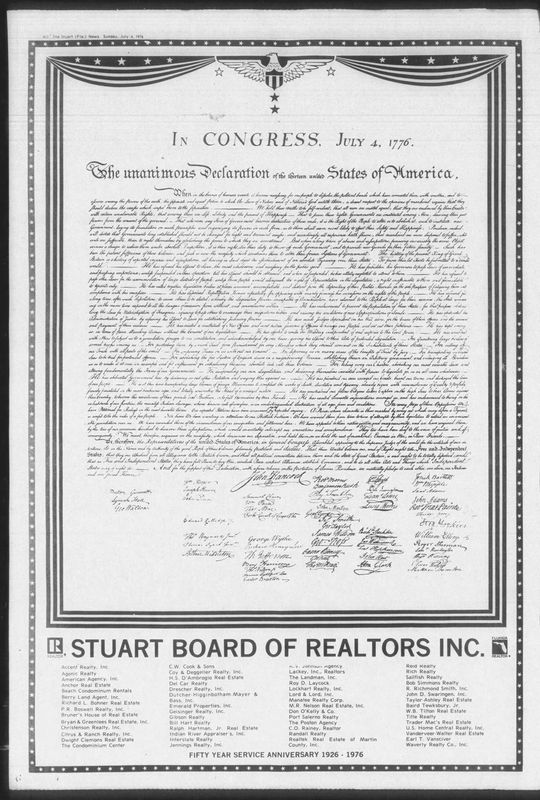
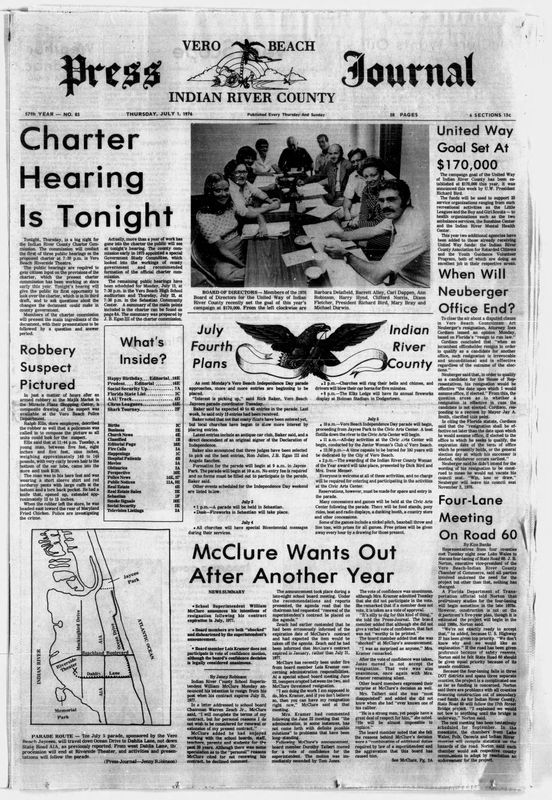
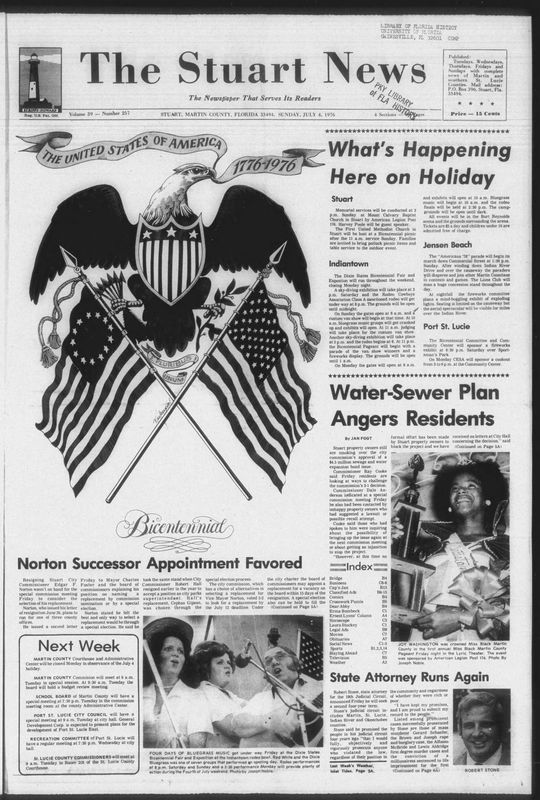
The bicentennial was special, with the Stuart News devoting several pages to the upcoming birthday. Some of the news on the front pages of the various bicentennial editions fascinated me.
Stuart residents were “smoking” after commissioners approved a $4.5 million bond issue to expand water and sewer service.
Indian River County was holding public meetings throughout the year to determine what, if necessary, should be in a county charter to give residents ― as opposed to the state ― more control over countywide government.
In Fort Pierce, an article quoted a Community Action Organization spokesman “threatening” that “area blacks might be militant if provoked by unflattering publicity.”
There also were front-page articles about three professionals who remain on the Treasure Coast:
Bob Stone, who planned to run for another term as state attorney; Art Neuberger, debating when his resignation would be effective from Vero Beach City Council so he could run for state House, and Joe De Salvo, named sports editor of the Fort Pierce newspaper.
Vero Beach bicentennial connections still resonate
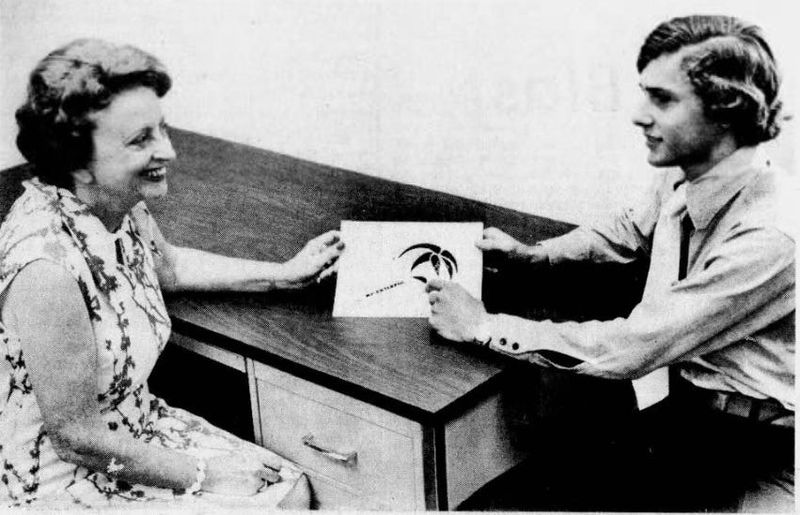
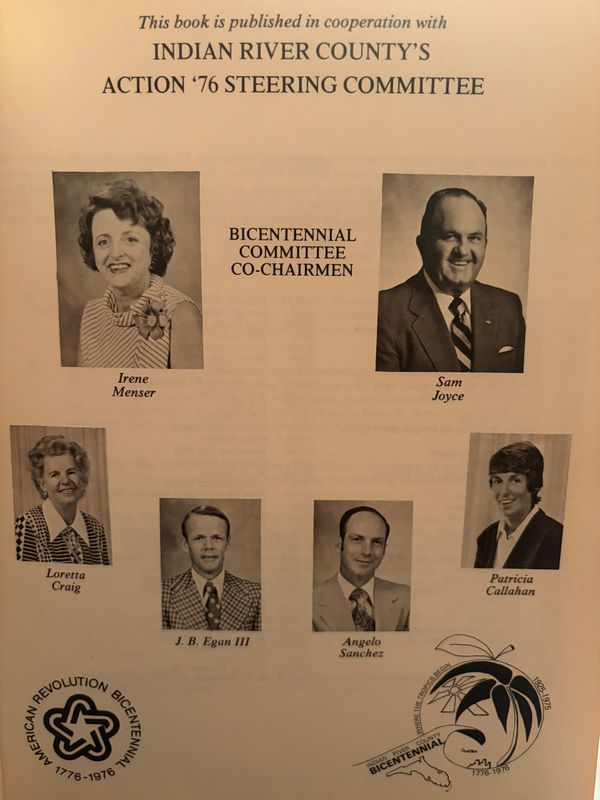
That year, Indian River County’s Action ’76 Steering Committee published a history book and had a logo contest. The bicentennial committee consisted of six members. Only Patricia Callahan, the city-county recreation director at the time, survives.
So does Robert McKay, who won the committee’s logo contest as a St. Edward’s School senior in 1975, the only year he lived in the area. He moved to South Florida, and has been a property appraiser in Hendersonville, North Carolina, since 1989.
In those bicentennial editions, there was no mention of what happened that April 25 in Chicago ― an act of patriotism whose protagonist came to the Treasure Coast a year later as a member of baseball’s Los Angeles Dodgers.
Rick Monday, who served in the Marines, was in the outfield for the Cubs, playing the Dodgers, when he snatched an American flag ― which he has said represents “rights and freedoms” — about to be burned on the field by two protesters.
Monday, a Dodgers broadcaster with a home in Vero Beach, kept the flag for 50 years before presenting it to Baseball’s Hall of Fame, where it went on display May 22 in Cooperstown, New York.
“It is very heartwarming,” Monday said at the dedication. “It’s overwhelming to see the reaction of people that see the display.”
Treasure Coast to hit a million residents
Monday was just 30 years old when he rescued the flag. That’s the same age as Taylor Dingle, a golf professional serving his second term on the Vero Beach City Council.
Recently, I asked Dingle what he thought our area might be like in 2076, when the Treasure Coast celebrates the nation’s tricentennial. That’s when Vero Beach is slated to open a time capsule planted in Riverside Park in 1976, when Indian River County’s population was about 48,200.
(The populations of Martin and St. Lucie counties then, respectively, were 50,400 and 71,700, according to the Federal Reserve Bank of St. Louis.)
“I would imagine, the population will be much greater,” Dingle said as I looked up what appear to be the latest (2020) Florida population projections for 2070, which came from the Florida Department of Transportation.
It projects the three-county Treasure Coast will eclipse a million people (1,036,800) by then, broken up this way:
Indian River County: 255,200, up from 172,799 people, based on 2025 numbers from the U.S. Census Bureau.
Martin County: 234,800, up from 166,272.
St. Lucie County: 546,800, up from 402,449.
“What would that look like?” I asked.
Keeping Vero Beach culture alive amid growth
“Who knows how much development and how far west Indian River County would go in 50 years?” Dingle asked, suggesting ongoing housing projects south of State Road 60 and west of Interstate 95 could yield enough demand to spur the county’s second big-box-type retail area — similar to what’s around the Indian River Mall ― west of the interstate.
I figured that meant Fellsmere, which encompasses 55 square miles from just north of State Road 60 to the Brevard County line. The city, whose population is 5,000-plus, is expected to have 75,000 people by 2050, its city manager told me in 2019.
To Dingle, the prospect of living in a city like Vero Beach in 2076, largely built out now, but with people magnets like the beach, downtowns and the Three Corners entertainment district is daunting.
How will an extra football stadium full of people head from west to east?
“Hopefully by then, maybe we’ve got some other mode of transportation … jetpacks or flying cars (or other things),” he said, suggesting the area could be unrecognizable, but he hopes the character of the community remains the same.
That character, he said, means a small-town atmosphere where people know each other and where our worst problems are parking and airport noise.
Preserving our communities’ cultures and feel is top of mind among Treasure Coast Generation Z-ers I spoke with.
Take Tori Malone, president of Vero Beach High School’s Class of 2026, heading to George Washington University to study neuroscience and play volleyball.
“I can hope that Vero and this county will still keep its charm, its friendliness and its natural beauty,” she told me, citing things like beaches, sea turtles, concerts and farmers markets. “You can’t really get this small-town community, beach feel anywhere else in the country.”
She wonders, however, what impact technology could have. For example, how friendly would a farmers market be with self-checkout? Technology found on cellphones, she said, has helped students cheat on tests, a potential harbinger of how they could act in their careers.
On the flip side, “(Technology) is definitely going to advance this country in a lot of ways,” said Malone, who hopes to use it to seek cures for such neurodegenerative diseases as Alzheimer’s and Huntington’s by doing research with the National Institutes of Health. The goal: preserving people’s quality of life.
Can technology help St. Lucie County solve challenges?
Vanessa Tabana, Lincoln Park Academy’s salutatorian, has similar career goals, but starting at Florida State University.
“I think technology has the potential to do great things for society, but if its power is put into the wrong hands, it could very well be our downfall,” she said in an email. “We should use technology to help us create and maintain more sustainable practices than the ones we use today that are destroying our planet.”
The lifelong Port St. Lucie resident remembers when her city had “more greenery” and fewer people. And while she enjoys living there, she doesn’t plan on returning.
“With the population multiplying rapidly over the past few years, (Port) St. Lucie will become a major city in the next 50 years,” she said. “I’m not entirely opposed to this, as I do like seeing us on the map. However, for future residents, it won’t be such peaceful living, but rather more hustle and bustle.”
Tabana’s classmate, Tasnim Akther, a Fort Pierce resident and LPA’s valedictorian, plans to attend the University of Florida and stay in the state, perhaps in a rural area, after becoming an obstetrician-gynecologist.
She said she’s hopeful communication technology can solve numerous issues, spurring public transit, reducing necessity for cars and thus contributing to cleaner air, land preservation, job creation and significant savings. Vehicle alternatives will be important as cities further urbanize.
“Fifty years from now, I hope St. Lucie County will preserve the wildlife and prioritize the natural beauty of the land over development,” she wrote, noting many wetlands have been victimized amid suburban sprawl. “I hope that we can blend development and nature in a way that creates a sustainable Florida, whether that is expanding protected waters or restricting deforestation.”
Newfield a model for western development?
Kyle Derrenbacker, 22, has similar hopes about his lifelong home, but with a different perspective.
“I want Stuart to stay the way it was as I kind of grew up,” he said, adding he knows the area will grow, which the recent graduate of the University of Florida thinks is good.
He returned to Martin County, taking his first job as an assistant builder with Mattamy Homes. He’s working on Newfield, a new urbanist community in Palm City expected to have 4,200 homes on 3,400 acres.
It’s just down the road from where he played baseball for many years.
“I used to drive on that road, like three, four, five times a week, and now seeing it all get developed is, is kind of cool,” Derrenbacker said. “Part of me kind of struggles with, like not wanting to see it get developed and like you like the nature and things like that, but I think Newfield in particular is doing a really good job of developing, but still keeping the environment at the forefront.”
Newfield will preserve 2,000 acres, which is important to Derrenbacker. He grew up fishing on the St. Lucie River, cherishing wildlife.
As he looks to 2076, he’s optimistic.
“The water is just brown all the time,” he said, noting “it’s not necessarily a pretty thing to look at. But, you know, hopefully, those issues get solved. I mean, 50 years down the road, I’ve got to hope they’re fixed by then.”
I hope so, too, though my review of old newspapers show how some issues seemingly last forever: the lagoon health, growth, affordable housing.
An article inside the pre-bicentennial Press Journal reviewed pros and cons of selling Vero Beach’s electric operation, which in the 1926 newspaper was touted as being essential to the city.
For decades, Vero Beach residents debated whether to sell the power operation, before Florida Power & Light Co. acquired it in December 2018.
While Britain’s King George III could have made a decision overnight, ideas in our country can take a while to be executed partly because of our founders’ ideals — freedom of speech, elections, questioning government.
For better or worse, that’s something we can all celebrate.
This column reflects the opinion of Laurence Reisman. Contact him via email at larry.reisman@tcpalm.com, phone at 772-978-2223, Facebook.com/larryreisman or Twitter @LaurenceReisman.
If you are a subscriber, thank you. If not, become a subscriber to get the latest local news on the latest local news on the Treasure Coast.
This article originally appeared on Treasure Coast Newspapers: Florida past, present, future linked to 250-year-old words | Opinion
Reporting by Laurence Reisman, Treasure Coast Newspapers / Treasure Coast Newspapers
USA TODAY Network via Reuters Connect

By Laurence Reisman, Treasure Coast Newspapers | USA TODAY Network