Fifty years ago, Doug Bechler witnessed one of Detroit’s greatest sporting events, even though he probably shouldn’t have.
Bechler was a 16-year-old Detroit Tigers fan and a baseball nut living in Pigeon, in Michigan’s Thumb region. He was also just like every Tigers fan during the summer of 1976 – spellbound by the boyish charm, theatrical antics and pitching virtuosity of Mark “The Bird” Fidrych, a lanky rookie with a mop of blonde curls just five years Belcher’s senior.

So when the New York Yankees visited Detroit on June 28, 1976, for a momentous game on ABC’s national “Monday Night Baseball” telecast, Belcher borrowed his dad’s car. Actually, it was a van, a white Plymouth Voyager with a thick, green stripe that looked like a peak ’70s leisure-suit belt. He and his best friend, Sheldon Miller, hopped in and made the two-hour drive to Tiger Stadium on a hot and humid night.
One problem. They didn’t have tickets.
They knew they might be out of luck, especially after they arrived.
“It was just wall to wall people,” Bechler said. “And there was, I don’t know, there was just this unprecedented enthusiasm.”
The official attendance was 47,855, and by some estimates 10,000 people were turned away when the ticket window closed an hour before the 8:40 p.m. first pitch. When Bechler arrived, around 6, there wasn’t a single ticket to be found.
Then he remembered something. He had sent letters to each team requesting their media guides, which contained information about picking up will-call tickets. He figured the Tigers had set aside extra tickets for the Yankees.
“So I went up and I talked to this guy at will call,” Bechler said. “And I said, ‘By chance, are there any tickets that the Yankees have returned that won’t that be used for tonight’s game?’
Celebrate the Tigers’ 125 epic seasons with a new book!
“And he looked at me and he said, ‘Well, young man, you’re in luck.’ He said, ‘I have a pair that are going to go unused.’”
Box seats. Four rows behind the Yankees’ dugout. About $12.
“And we just couldn’t, you know, we just couldn’t believe it,” Bechler said. “I mean, we were in the fourth row and we were just floored. I mean, the place is packed.”
He wasn’t the only one who couldn’t believe it.
“The usher, man, he took a hard look at our tickets,” Bechler said with a laugh.
When he got to his seat and he saw Fidrych for the first time in person, Bechler was mesmerized the same way 18 million ABC viewers were that night. The same way the Yankees were. The same way even the broadcasters were.
You won’t believe what this guy does
ABC used a three-person rotation in the broadcast booth, with each taking three innings as the play-by-play announcer while the other two chimed with observations. Bob Prince led off, followed by Bob Uecker, then Warner Wolf.
Wolf is the only surviving broadcaster from that game. He’s 88 and still does a sports report Monday mornings from his home in Florida for WOR-AM (710) in New York.
Uecker was famous from his appearances with Johnny Carson on “The Tonight Show.” He was one of broadcasting’s biggest stars and also served as the Milwaukee Brewers’ radio play-by-play announcer.
Sports broadcasting was still in its infancy in the ’70s and there was little preproduction prep for the announcers. Luckily, Uecker had gotten wind of The Bird a week earlier, when the Tigers were in Milwaukee. Fidrych didn’t pitch then, but Uecker learned enough to give Prince and Wolf the lowdown as they drove to Tiger Stadium.
“He said, ‘Now, you won’t believe what this guy does,’” Wolf said. “‘He talks to the ball after each pitch, he rubs down the mound after each pitch, and he goes over and shakes the hand of the shortstop after each out.’ He said, ‘This game is going to be a sellout.’”
Sure enough, the trio encountered 50,000 people as they arrived at Michigan and Trumbull. Fidrych was 21, had a 7-1 record in 10 appearances – including seven complete games – and owned the American League’s second-lowest ERA at 2.18.
“And so we go to the production meeting,” Wolf said, “and the producer says we’re going to open the show and feature Ken Holtzman, who’s the pitcher for the Yankees. And we said, ‘Now, wait a minute, wait a minute.’
“I said I think we’d be missing the story here. I told him what Uecker told me and the producer said, ‘Well, nobody’s ever heard of Mark Fidrych.’ And I said, ‘Well, they will after this game.’ He said, ‘No, we’re going with Holtzman.’ ”
Holtzman was a 30-year-old former All-Star and a three-time World Series champ with Oakland who’d thrown two no-hitters. He was a soft-throwing left-handed technician with pinpoint control who worked fast. He was also the complete opposite of Fidrych, showing zero emotion on the mound. But he was a Yankee and a “big name,” according to the producer.
“So I remember the next week, before next week’s game,” Wolf said, “I said to the producer in the producer’s meeting, I said, ‘Hey, by the way, second-guessing now, shouldn’t we have had teased Fidrych instead of Ken Holtzman?’ He said, ‘No, we only feature big names.’ ”
On some level, it was understandable. The Yankees have always been baseball’s darlings, and they were leading the American League East. They would go on to win the pennant but get swept by the Cincinnati Reds in the World Series.
Meanwhile, the Tigers were hot, but they were still in fourth place in the AL East, 11 games back. They finished fifth in the six-team division, at 74-87. And Fidrych was largely anonymous to most people outside of Michigan.
He had an auspicious debut May 15, when he took a no-hitter into the seventh inning against Cleveland in his first major-league start, which happened to be NBC’s backup national game of the week on a Saturday afternoon.
But to most of the country he was still an unknown and unheralded rookie: a 10th-round pick who had pitched just one inning through mid-May. But now he was catching fire and was about to be introduced to the country on baseball’s biggest televised stage.
One of the funniest guys
The broadcast opened by highlighting Yankees centerfielder Mickey Rivers, who was on a 20-game hitting streak. After a short description of players on both teams, ABC got to Fidrych as he warmed up on the mound.
“And on the mound is this young man by the name of Mark Fidrych,” Prince said. “And I guess the pictures can tell most everything, Bob Uecker. But there’s a lot about him that we maybe don’t understand.”
That was Uecker’s cue. The former big-league catcher perfectly set up Fidrych’s style and character on the mound.
“I’ll tell you, this is one of the funniest guys probably that I’ve seen come along in baseball in a long time,” Uecker said. “Got outstanding stuff, though, Bob. He’s won seven, lost one. I haven’t seen a pitcher as young as Mark Fidrych be able to keep the ball down.”
Uecker mentioned Fidrych’s elite sinker and slider he kept low in the zone, his exceptional control and his willingness to come in high and tight on lefties, being sure to end with the entire reason people would be glued to their TV sets.
“And you’re going to see a lot of antics from this young right-hander tonight,” he said.
Rivers led off the game with a groundout to first baseman Jason Thompson. As left-hander Roy White came to the plate, Wolf explained Fidrych’s nickname as ABC showed a strange, orange knockoff version of PBS’ Big Bird, possibly for copyright reasons.
“Fidrych, known as a character, they call him the Big Bird because they think he resembles the fellow on ‘Sesame Street,’” Wolf said.
After White fouled a low slider off his foot, there was enough of a break for Uecker to explain Fidrych’s antics.
“When he gets set to go to his delivery,” Uecker said, “you’ll see him mumble a couple of words to the ball. And what he is doing, he’s telling the ball where he wants it to go.
“If he throws a slider, fastball, that sinking fastball, if he’s trying to hit the outside, that’s what he – we’ve got a good shot of him right there talking. And it’s disturbing to the hitter because you can hear him, too.”
The Yankees never complained about Fidrych’s talking or gestures as he frequently extended his arm and pointed the ball at the plate. But Bechler, only steps away, noticed something interesting about the Yankees in the on-deck circle.
“That was really intriguing to me because they were visually locked in to Fidrych,” he said. “You could tell that they were studying him. This is the first time they had faced someone like this, right?”
Same as he always was
This was a first for Fidrych, too. He was a kid who’d grown up an hour outside of Boston, in the small town of Northborough. Even when he got to the big leagues, he didn’t know who many prominent players were. He’d never heard of Yankees All-Star catcher Thurman Munson (who missed the game with an injury), or former Yankees slugger Roger Maris, who broke Babe Ruth’s single-season home-run record. in 1961
At least he’d heard of Ruth. But when one reporter brought him up, Fidrych flexed his competitive disdain for the Bambino and the Bronx Bombers.
“What has he done lately? He’s gone. [Expletive] him,” Fidrych said in “Go Bird Go!” the 1976 book written by Free Press reporters Jim Benagh and Jim Hawkins.
But that night against the Yankees was different. Bechler and his family attended half a dozen games each year. But the primetime national broadcast and the local buildup for the game turned Fidrych’s outing turned the game into a transcendent sports moment that, according to Bechler, contained “literally a buzz” that thrummed through the night’s humid air.
“You could tell it wasn’t just a regular game,” he said. “People, when you looked around, people were standing all the time. Nobody really wanted to be seated, to sit. There was just like a jumping electricity in the ballpark. And you could tell that you were experiencing something that was very, very different.”
Bruce Kimm was Fidrych’s de facto personal catcher that season. They’d been batterymates the previous season with Triple-A Evansville; when Milt May got hurt early in the season, Kimm was called up. Manager Ralph Houk wisely reunited him with Fidrych.
Kimm has never given himself credit for helping Fidrych. But the veteran catcher, who was in his eighth year of pro ball and would go on to coach in the majors for decades (including a stint as the Chicago Cubs’ interim skipper in 2002), had to be a calming influence on a young, excitable pitcher who worked at a blistering pace.
That night, though, Kimm insisted Fidrych was unfazed by everything around him.
“He was pretty much the same as he always was,” said Kimm, now 74. “It didn’t matter who he faced. I think he wanted to do well. I think that night was just, more or less for him, he was going out there and he was going to beat whoever he was facing.”
Can you say that again?
If there were any nerves on Fidrych’s part, they were seen briefly right before the bottom of the first inning during ABC’s pretaped introductions of each player, which had them say their name, position and hometown.
While every other player stood, Fidrych sat in a chair, laid back with his cap slightly pushed back as he chewed a massive wad of gum.
“Good evening,” he said with a little smile before he ran into trouble.
“I’m Mark Fidrych from Northborough, Machachusetts,” he said before he quickly corrected himself.
“Chusetts,” he said, not bothering to relive the horror of trying to pronounce the entire name of the commonwealth, “and I’m pitching for the Detroit Tigers.”
At least Fidrych was in good company with his verbal faux pas. There was so little prep for the announcers that throughout the game Fidrych’s name was often mispronounced as Feedrich and Feedrick. The correct phonetic pronunciation is FID-rich.
Caitlin Clark before Caitlin Clark
Something the broadcast did get right was the number of people Fidrych was drawing to ballparks as word of his unique style spread.
“They average only 18,000 and they’ve got nearly 50 (thousand) tonight,” Wolf told Prince.
As the Tigers’ 1977 media guide noted about Fidrych: “In his third professional season, The Bird became talk of baseball world 1976, capping meteoric rise by winnning [sic] Rookie-of-Year Award, leading league in ERA, complete games, fielding. Hottest drawing card in Tiger history, started 29 times before crowds totalling [sic] 901,239 for average of 31,077.”
This game was a key reason behind his burgeoning fame that led to box-office hysteria and lured even more fans to Tiger Stadium [51,032] for his next start, the following Saturday night. As Joe Falls accurately summed up the growing Fidrych fanaticism in the Free Press: “Saturday night will be the greatest happening around here since last Monday night.”
Kimm retired to his native Iowa and said Fidrych’s drawing power is similar to that of a fellow Iowan.
“We filled ballparks and I always compare it a little bit to the Caitlin Clark effect in basketball, where she pulls in the whole world whenever she plays,” he said. “They want to see her do well, and The Bird did that for Major League Baseball in 1976 because he packed it in everywhere we went. I mean, it was a playoff atmosphere in a regular-season game.”
The hole truth
In the second inning against the Yankees, Fidrych made his only real mistake when he left a slider out over the plate to Elrod Hendricks, who homered to right center to tie the score at 1. It was the only run Fidrych would surrender.
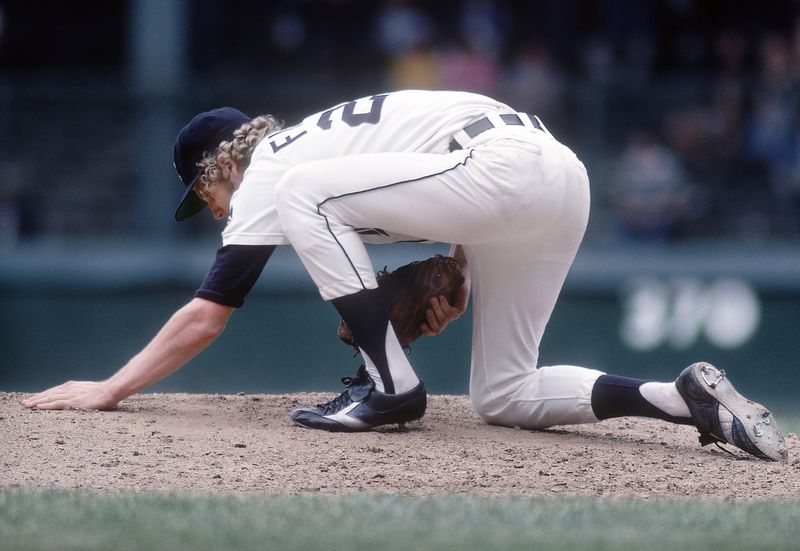
The third inning started with ABC showing Fidrych bending down and patting the dirt on the mound, then airing Wolf’s taped interview with Fidrych explaining his manicuring process.
“I’ve always done that,” Fidrych said, “just because I like to start and dig my own hole, because the other person digs their own hole for their feet to feel comfortable to land and all that. I want my own hole the way I land, so I don’t get into another person’s rut, or whatever, you know, that way.”
Even though each of the three announcers had called hundreds, if not thousands, of games, they were genuinely enthralled by Fidrych’s eccentricities.
“Yes, I thought it was genuine,” Wolf said recently. “He was only [21] years old and he did it in every game, you know? He was an emotional guy. No, I don’t think it was an act at all.”
Not a single person who knew Fidrych won’t tell you his antics were as real as his talent. He pitched hard and fast, he kept the ball low and had great movement on it. He didn’t strike out a lot of hitters, but he induced ground balls that ended innings quickly and got his fielders off their feet.
Kimm, who played three more seasons with the Tigers, Cubs and Chicago White Sox – said the Tigers’ strategy with Fidrych was to go with his strengths instead of attacking hitters’ weaknesses.
“So you watch players pitch now and it looks like from the get-go they’re trying to strike every hitter out,” he said. “And our game plan was to go right after the hitter and try to make him hit the ball, you know? Keep the pitch counts down, but go after them.”
Fidrych never struck out Rivers, but he retired him in all four at-bats by inducing grounders to end his hitting streak at 20 games.
In the ninth inning, the Tigers held a four-run lead. Fidrych retired leadoff hitter Chris Chambliss with a great 0-2 slider that brought forth a prophetic pronouncement from Wolf: “And the fans are standing for Fidrych. He may be your starting All-Star pitcher for the American League.”
When he induced Graig Nettles into a grounder for the second out, the crowd roared like he was closing in on a no-hitter in the seventh game of the World Series. Fidrych bounced around the field on his way back to the mound.
He faced Oscar Gamble to close out the game, but gave up a long single off the wall in center, where Ron LeFlore slipped and nearly hit an exposed pipe by the 370-foot marker. (Yes, an exposed pipe. Don’t forget this was a stadium notable for having a flagpole in fair territory.)
After a long delay as the Tigers checked on LeFlore, Hendricks came to the plate as the crowd returned to its frenzied state with a “Let’s go, Mark!” chant.
“What’s getting me,” Prince said, “is he’s giving me duck bumps and I’ve watched over 8,000 ballgames.”
Fidrych hadn’t walked a batter, but he started off 3-0 against Hendricks. He came back with two strikes down the middle. Then he threw a sinker down the middle that Hendricks hit to second baseman Pedro Garcia for an easy 4-3 putout.
Fidrych ran off the mound, gave Kimm a bear hug, then started shaking the hand of every player he could find on the field. He even shook hands with an umpire.
“It’s over!” Wolf exclaimed. “And the Tigers act like Fidrych has just won the seventh game of the World Series.”
“He has!” Prince shot back. “He’s won seven in a row. He is some kind of unbelievable. Young Mark Fidrych.”
The Tigers won, 5-1, behind Fidrych’s phenomenal performance that improved his record to 8-1. His final pitching line: seven hits, one earned run, no walks, two strikeouts, one homer in 34 batters faced over nine innings. Time of game: 1:51.
A curtain call and a birthday party
What happened next was almost as unreal as the game itself. Fidrych had a habit of literally sprinting off the mound and into he dugout. After he thanked his teammates and the ump, he ran to the dugout and into the clubhouse.
But the fans were going nowhere. They demanded a curtain call. Bechler remembered it went on for about 10 minutes before Fidrych returned in his white socks and waved to the crowd.
“And he was just, it was not about him at all,” Bechler said. “It was just all about him being a part of this team and that sort of thing. And it was just crazy. It was simply crazy. And he came out and the place went wild.”
Kimm said it was veteran outfielder Rusty Staub who had to explain what a curtain call was to Fidrych in order to have him return to the field.
“Oh it was exciting, especially after the curtain call where he went out on that field,” Kimm said. “I mean it was exciting, man. Oh, man, it was something. We beat the Yankees. It’s a long season but it’s still the Yankees and they were on a hot streak.”
When Fidrych returned for his curtain call, Uecker conducted an interview with Fidrych, sweat dripping from his long curly hair. Uecker asked Fidrych if he was ever worried about the Yankees.
“Well, I don’t know, everything’s just new to me,” he said. “So I just come out as hard as I can come out after people. And then I have the D. Those guys are doing two-thirds of the work and I’m only doing a third by pitching, you know? They got me the runs and all that other stuff.
“And the people come out and try to get my adrenaline going. What can I ask? I couldn’t ask for not much more.”
Kimm still watches a replay of the game from time to time, not that he needs much reminding of Fidrych and his one amazing season he had – which featured a start for the American League in the All-Star Game in Philadelphia, a runner-up finish in the AL Cy Young vote and the AL Rookie of the Year Award – before a freak knee injury shagging fly balls in spring training the next year ruined his career.
“He was special,” Kimm said. “And when you have somebody that’s that special for that year in ’76, you want to do good for him.”
Long after the game, and even after Fidrych’s curtain call and interview, fans didn’t want to leave Tiger Stadium. Bechler and Miller faced a long drive home. They didn’t care.
“You didn’t want to leave because there was a buzz,” Bechler said. “And then once you got outside in front of the ballpark, people were still out there. No one wanted to go to their cars.
“Yeah, people were just milling around, you know? It was like a big birthday party.”
Bechler and Miller finally left their prime seats and walked around the stadium’s Corktown neighborhood for a while. If they were older, they might have gone to a nearby bar – Nemo’s or maybe the Lindell A.C.
But they were just teenagers, so they made their way back to the Plymouth Voyager.
“We had a two-hour drive and it was late,” Bechler said. “But it was just one of the most memorable things that you could imagine.”
Contact Carlos Monarrez at cmonarrez@freepress.com and follow him on X @cmonarrez.
This article originally appeared on Detroit Free Press: Mark Fidrych gem vs Yankees still wows 50 years later
Reporting by Carlos Monarrez, Detroit Free Press / Detroit Free Press
USA TODAY Network via Reuters Connect
By Carlos Monarrez, Detroit Free Press | USA TODAY Network