During peak usage, a potential Amazon data center in Sunbury would be the largest user on the regional water system that serves the area. But a Del-Co Water Co. official said the system has the capacity to handle it.
That was just some of the information local experts shared on data center water and energy consumption during a special Sunbury City Council meeting June 25 at Big Walnut High School. The meeting was the first of three information sessions related to data centers that the Delaware County city is hosting after passing a moratorium on data center development in April.

Brian Coghlan, chief operating officer for Del-Co Water Co. Inc., said the state’s largest rural water system already serves several data centers but none are hyper-scalers, the largest type of data center, like the proposed Amazon facility.
The Columbus Zoo and Aquarium is Del-Co’s current largest user of the systems 58,000 customers, but it uses less than 1% of the system’s water supply, Coghlan said.
In winter months, the entire Del-Co system uses about 13 million gallons per day, but that number jumps to 28 million gallons per day in the summer, Coghlan said. Del-Co can accommodate up to 40 million gallons per day, he said, but he did not specify how much water the Amazon facility would need during the hottest days and weeks of the year.
Get more Delaware County news: Subscribe to The Dispatch’s free weekly Delaware County newsletter, The Delaware Dispatch.
Coghlan knows residents are concerned that a data center could affect water quality. In general, he said, PFAS, or forever chemicals, aren’t created in the closed-loop water some systems data centers use. But if there are forever chemicals already in the water, he said the concentrations can be higher once the water leaves the pipes.
He said Del-Co recommends the city do baseline monitoring at the onset of any data center facility.
When asked by a council member and later through a resident’s submitted question if Del-Co would prioritize residents over the data center in a drought or other water shortage, Coghlan said supplying residents is the company’s first priority, along with fire protection. But he didn’t offer specifics on how that would work.
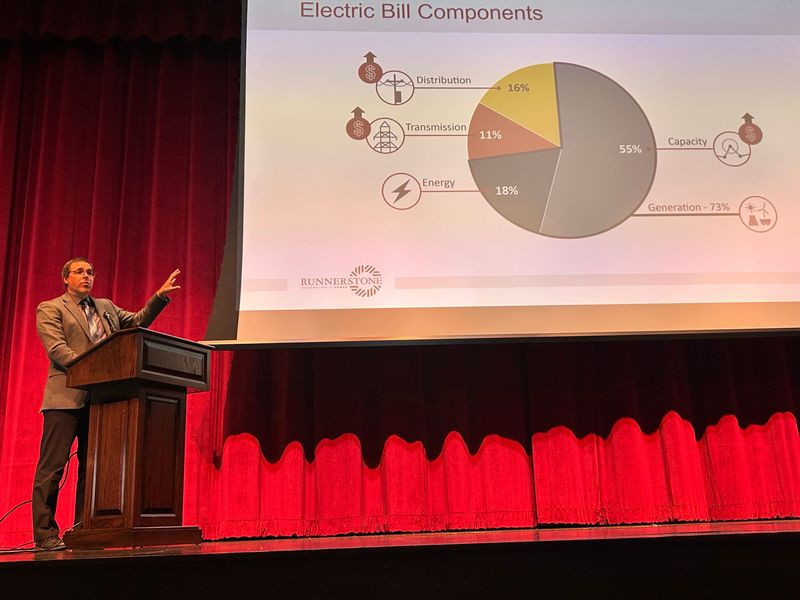
John Seryak, managing partner at the Worthington-based energy consulting firm Runner Stone Power, said energy costs have been driven up by capacity and transmission costs and not necessarily because of the proliferation of data centers. American Electric Power’s transmissions costs have tripled over the past 10 years, he said.
Seryak said data centers should pay for their transmissions upgrades up front, so costs aren’t passed along to everyday customers.
Onsite power generation, such as a natural gas plant, would help keep costs down, he said.
Neighbors Dani Marsch and Katherina Sonntag, who live in Harlem Township, about 5 miles from the Amazon site, said they left the meeting feeling worse than when they arrived.
“It’s more transparent how big of a strain it will be on everyone,” Sonntag said. Marsch added, “I definitely think they are not prepared for what they’re allowing to come through.”
The meeting came after Sunbury enacted a data center moratorium, which remains in effect until Jan. 31, to allow city administrators and council members time to review and study federal, state and local laws and learn from third-party experts about the booming industry. Additional meetings will be held on noise, land use, economic development, community benefits and other environmental and health issues.
The moratorium was the result of Sunbury residents forcefully pushing back against a proposed $2 billion Amazon Data Service data center campus that is looking to locate inside the city’s newly formed technology park, which includes more than 1,300 acres on the city’s southeast side, generally between State Route 37 and Vans Valley Road.
Sunbury and surrounding area residents have cited concerns over loss of habitat for local wildlife, negative health effects, constant noise from the low hum of servers, tax breaks for one of the wealthiest companies in the world and loss of Sunbury’s rural character.
Sunbury residents are part of a growing statewide opposition against data center developments, which have faced criticism about their drain on local resources, including the amount of power and water they require.
A growing number of local governments have enacted moratoriums to pause data center developments.
Ohio has the sixth most data centers in the country – 224 throughout the state – with 139 of those in central Ohio, according to a list of all current and under-development listings provided by Data Center Map, a global data center directory. Some are small enough to fit inside office buildings. Meta’s New Albany data center, which the company is expanding, is built on 766 acres ‒ more than one square mile.
Conserve Ohio, a grassroots group working to block most data centers, is collecting signatures for a constitutional amendment that would ban large data centers across the state. But the group announced June 22 that it will not submit the more than 413,000 signatures needed to make the fall ballot by the July 1 deadline. The group is now targeting the 2027 ballot.
Delaware County and eastern Columbus suburbs reporter Maria DeVito can be reached at mdevito@dispatch.com and @mariadevito13.dispatch.com on Bluesky and @MariaDeVito13 on X.
This article originally appeared on The Columbus Dispatch: Sunbury Amazon data center would be Del-Co’s biggest water user
Reporting by Maria DeVito, Columbus Dispatch / The Columbus Dispatch
USA TODAY Network via Reuters Connect

By Maria DeVito, Columbus Dispatch | USA TODAY Network