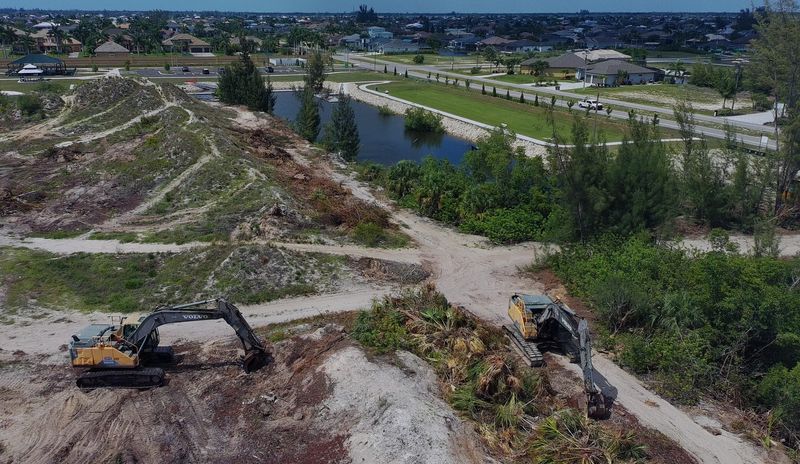
Development has resumed on the Seven Islands development after mangroves were removed from the property without a permit.
Work paused on the development after an Army Corps of Engineers agent advised the developer, Gulf Gateway Resort & Marina LLC, to momentarily stop further construction.

Sarah Flynn, a spokesperson for the developer, confirmed work resumed on the 47-acre property on June 19.
In an emailed statement on June 17, Flynn said the developers intended to clear only the non-native invasive species on the property, and the mangroves were removed by accident. The Army Corps of Engineers confirmed the mangroves were not approved for removal.
According to Flynn, the developer intended to protect the mangroves with upland seawalls that were included on the original permit application. Gulf Gateway Resort & Marina LLC already has a restoration plan in place for the uprooted mangroves, she said.
Mangroves expert: Repercussions for unpermitted mangrove removal
Ryan Ishley, an arborist for Joshua Tree, a tree care company, said the penalties for unpermitted removal of mangroves in Florida usually are no “slap on the wrist.”
Ishley has worked with mangroves in Southwest Florida for over 20 years, and he’s partnered with the Florida Department of Environmental Protection and the Army Corps of Engineers on cases where landscapers remove mangroves without a permit, either knowingly or unknowingly.
“The important part is getting a professional out to the property before any clearing begins, especially a property that size,” Ishley said. “Verifying if there’s mangrove out in the shoreline prior to doing anything is very important.”
Ishley said reviewing the property typically happens at least six months before construction begins. If there are mangrove on the property, they can be trimmed or altered, as long as landscapers follow Florida’s strict rules and regulations.
Under Florida law, without a permit, mangroves can’t be trimmed to under 6 feet, and mangroves over 16 feet can only be trimmed by 25% annually. So, completely uprooting the mangroves altogether without a permit could have extreme consequences.
“You want to do it right,” Ishley said. “You definitely don’t want to do improper pruning, or you definitely don’t want to remove mangroves because there’s some big fines and stipulations that comes along with it.”
According to the Florida Department of Environmental Protection, penalties could include restoring the entire area or paying a $100 to $250 fee for each mangrove illegally trimmed or altered.
The Army Corps of Engineers will decide any fees or requirements for replacement by looking at the site’s history and calculating the square footage of mangroves, Ishley said.
“The mangroves, no matter what, they have to be replaced in some form or another,” Ishley said. “The public needs to be aware of the cost of not pulling a permit or having a professional out to your property.”
The Seven Islands development
On Jan. 21, Cape Coral City Council unanimously approved a Seven Islands development agreement that would sell the 47-acre property to Gulf Gateway Resort & Marina LLC for $20 million.
The agreement allows the development of nearly 1,000 residential units, a 10-story hotel, 45,000 square feet of commercial space and a 39-slip marina.
The development has faced controversy in the past, with some residents raising concerns over traffic and environmental impact.
Mangroves in Southwest Florida
Mangroves support a healthy ecosystem and serve as natural defenses from strong winds and flooding during extreme storms, according to the Florida Department of Environmental Protection.
“The mangrove itself is just such an important species to the ecosystem,” Ishley said. “If it goes away little by little, we’re going to have more erosion, we’re going to have less birds, the fish population is going to be lower.”
Reach reporter Vanessa Norris by emailing vnorris@news-press.com
Do you have an opinion about this topic? Send us a letter to the editor or guest column at mailbag@news-press.com or letters@naplesnews.com.
Please support local community journalism and stay informed about Southwest Florida news by subscribing to The News-Press and Naples Daily News; download the free News-Press or Naples Daily News app, and sign up for daily briefing email newsletter, food & dining and growth & development newsletters here and here.
This article originally appeared on Fort Myers News-Press: Seven Islands work resumes in Cape Coral after erred mangrove removal
Reporting by Vanessa Norris, Fort Myers News-Press & Naples Daily News / Fort Myers News-Press
USA TODAY Network via Reuters Connect
By Vanessa Norris, Fort Myers News-Press & Naples Daily News | USA TODAY Network