The Indiana Republican Party officially added two hot-button topics to their party platform June 20 — eliminating property taxes and closing primaries — as the Indiana General Assembly appears poised to reconvene with a more conservative make-up next year.
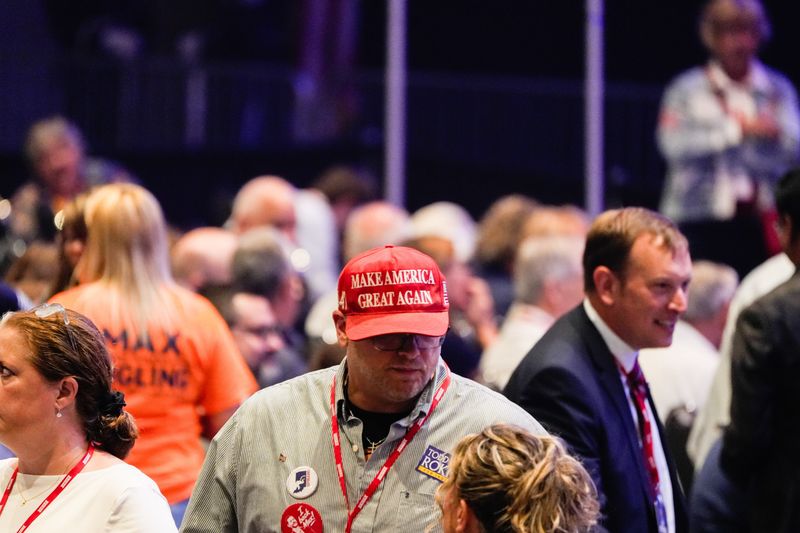
Both issues have generated buzz on social media recently, and the closed primary question has become a core tenant of Republican nominee Max Engling’s campaign for secretary of state. But the policies’ inclusion in the GOP’s platform marks a major step forward for their advocates, signaling that the Republican-controlled legislature may take the issues up next year.

The revised platform comes as the state Senate prepares to welcome a slate of Trump-endorsed newcomers who knocked out powerful incumbents in the primary and readies for a potential leadership battle. In such a dramatically different state Senate, it’s possible that more moderate Republican senators will feel increased pressure to pass legislation that appeals to the party’s base.
The ball is already rolling on property taxes. Rep. J.D. Prescott, R-Union City, created a website this month to advocate for a bill he introduced last legislative session that would eliminate property taxes in favor of a 7% tax on services like landscaping or haircuts.
“No one should feel like they are renting their home, land, or business from the government forever,” the text of Prescott’s website, which pledges to reintroduce the bill next legislative session, reads.
Could Indiana become a closed-primary state?
The official adoption of the closed primary issue could bolster efforts to make the proposal a reality after previous attempts have failed.
In 2025 and 2026, lawmakers tried and failed to pass a bill that would have created a formal process to join a party before being allowed to vote in the primary. Currently, anyone can vote in Indiana primaries, so long as they choose the party whose candidates they voted for the most in the previous general election. But the little-known law is difficult to enforce and makes Indiana’s primaries functionally open.
Calls from the GOP to change that grew when some Democrats shared that they had crossed party lines to support Sen. Spencer Deery, R-Lafayette, in the Republican primary against the Trump-endorsed Paula Copenhaver. Deery’s three-point win led several politicians to speculate if the outcome could have been different in a closed primary system.
The idea spread quickly: just a few weeks after the idea reentered the public consciousness, a newly formed political advocacy group calling for closed primaries gathered more than 1,000 signatures. Lawmakers have expressed interest in exploring the issue next year, too.
In the text of the party platform, the Indiana GOP argues that both parties should be able to pick nominees “without interference” from voters who may lean toward a different political party.
“Closed primaries preserve the integrity of the electoral process, strengthen party accountability, and ensure that Republican candidates are chosen by Republican voters who support the party’s platform and values,” the platform reads.
Critics have said that the proposal could disenfranchise voters in the political minority, such as Republicans in the solid-blue Marion County or Democrats in one of Indiana’s many red cities and counties. Members of both parties have crossed over to vote in the opposing party’s primary to have more influence over picking their elected officials, arguing that in areas where the general election is not competitive, primaries offer the only opportunity for political minorities to have a voice. The runner-up for the GOP nomination for secretary of state, Knox County Clerk David Shelton, is a prime example, as he voted in Democratic primaries when southern Indiana was blue.
No more property taxes?
In a section outlining Republican policy initiatives, a single line in the party platform suggests lawmakers should work to eliminate property taxes as early as the next legislative session.
“In the pursuit of eliminating property taxes,” the platform reads, “we direct the General Assembly to take up the measure in the next general session.”
The property tax issue was a cornerstone of Gov. Mike Braun’s first year, but a reform package got watered down in the state Senate. The result was a complicated new law that earned the reproach of some members of the GOP, including Lt. Gov. Micah Beckwith, as well as local governments and schools that got their budgets squeezed. And while Braun boasted that the bill would reduce property taxes for two-thirds of homeowners in 2026, it was cold comfort for the Hoosiers who saw their bills go up.
But axing the tax completely would have consequences. Since schools and local governments rely on property tax revenue as a funding source, those bodies would either have to dramatically reduce services or institute a different type of tax to cover the difference.
Prescott’s proposal addresses the conundrum with a 7% tax on services, which he argues would put more of the tax burden on consumers who can afford to pay for extra services rather than homeowners. It would also remove local government tools like school referendums and tax increment financing districts.
If successful, such a law would make Indiana the sole U.S. state without property taxes, though the push is far from unique. Several states have renewed conversations around property tax relief since tax bills ballooned after the pandemic drove up property values. And while the issue appears to be top-of-mind for many Hoosiers, Indiana already ranks among the lowest for average annual property tax bills.
Contact breaking politics reporter Marissa Meador at mmeador@indystar.com or find her on X at @marissa_meador.
This article originally appeared on Indianapolis Star: State GOP demands end to property taxes, pushes closed primaries in new platform
Reporting by Marissa Meador, Indianapolis Star / Indianapolis Star
USA TODAY Network via Reuters Connect
By Marissa Meador, Indianapolis Star | USA TODAY Network