Orion Township — A top U.S. House leader heard from Michigan aerospace industry players Thursday about the need for the federal government to provide financial certainty to the aerospace industry so the U.S. can stay competitive in the space race with foreign rivals such as China.
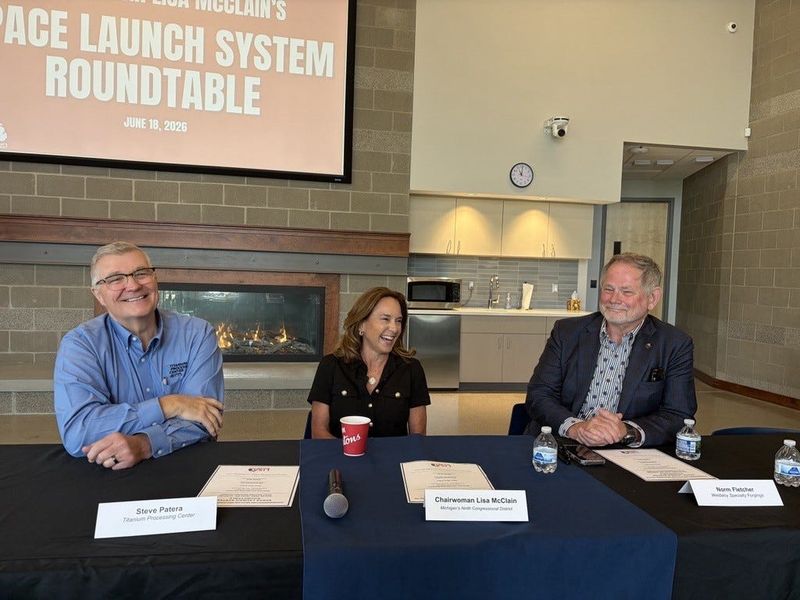
U.S. Rep. Lisa McClain, R-Bruce Township, chair of the House Republican Conference, met in Orion Township with about a dozen executives from Boeing and Michigan-based aerospace suppliers about the need for consistency in Washington policy. The administration of President Donald Trump laid out a budget proposal in May that sought to cut key parts of NASA’s moon program.

“We have to have continuity of purpose,” McClain said in an interview after the meeting. “Everything can’t change continually, because they’re making large investments, long-term investments. They need to know that we are going to be good partners on that.”
The president’s proposed 24% reduction in NASA’s current $24.8 billion budget threatens to cancel major science programs affecting thousands of researchers worldwide. It would upend active contracts defended for years in Washington by an array of established NASA contractors and overturn missions and programs in which U.S. allies play key roles, such as the European Space Agency, Canada and Japan.
The move came after Trump in 2025 vowed to return NASA to its glory days by reviving efforts to return U.S. astronauts to the moon and envisioned an eventual mission to Mars.
Steve Patera, the vice president of sales for the Titanium Processing Center in New Baltimore, said there is a push to bring production of titanium sponge, a material frequently used in aeronautics, back to the U.S. The Russians and Chinese dominate that sector.
But building a sponge plant is costly and time-intensive, Patera said. Because the aerospace industry is a major consumer of titanium, he said the titanium industry would be affected by any sudden shifts in the aerospace sector.
“Our industry is like a roller coaster. It does very well when the aerospace industry does well, but if the aerospace industry falls off, it drops off,” Patera said.
Norm Fletcher, the director of marketing and communications for Warren-based Weldaloy Specialty Forgings, said quick delivery to the company’s customers is crucial. Government agencies need to work with the industries they regulate to make sure manufacturers can get their business done, he said.
“Everything that we do is based on making stuff, whether it’s cars or rockets or whatever,” Fletcher said. “The agencies … have to work with industry to make sure that they could get done what they need to do.”
Boeing did not make an executive available for an interview.
The meeting between McClain and the Michigan manufacturing executives came amid a Trump administration budget proposal that would make a $6 billion cut in the space agency’s 2026 budget, but boost the Mars-focused agenda pushed by billionaire SpaceX CEO Elon Musk.
Trump’s proposed 2026 budget would cancel NASA’s over-budget Space Launch System, a gigantic rocket built by Boeing and Northrop Grumman, and its Lockheed Martin-built Orion crew capsule after their third mission in 2027 under the agency’s Artemis program.
Nearly all parts of NASA face deep cuts except for its human exploration portfolio, in which the administration proposed a $1 billion boost for “Mars-focused programs.” This major shift in the Artemis mission leans toward Musk’s vision to send humans to Mars for the first time.
McClain didn’t directly comment on whether she’s concerned about the implications of the proposed NASA cuts for the future of the giant rocket program.
“Boeing is a phenomenal company and can figure out how to get done what they need to get done,” she said.
On the proposed NASA budget’s focus on a Mars mission and its centering of SpaceX’s vision, McClain praised it as a strategy by Trump to keep the U.S. as a leader in space technology and ahead of rivals such as China.
“I want that to be done in the United States, and I want the United States to be the leader in space technology,” McClain said. “That is what I applaud President Trump and I agree with him on, because if we let China win this space war, who knows what’s going to happen. China is not our friend.”
jcardi@detroitnews.com
Reuters contributed.
This article originally appeared on The Detroit News: Michigan GOP leader seeks stable space policy in race to beat China
Reporting by Julia Cardi, The Detroit News / The Detroit News
USA TODAY Network via Reuters Connect
By Julia Cardi, The Detroit News | USA TODAY Network