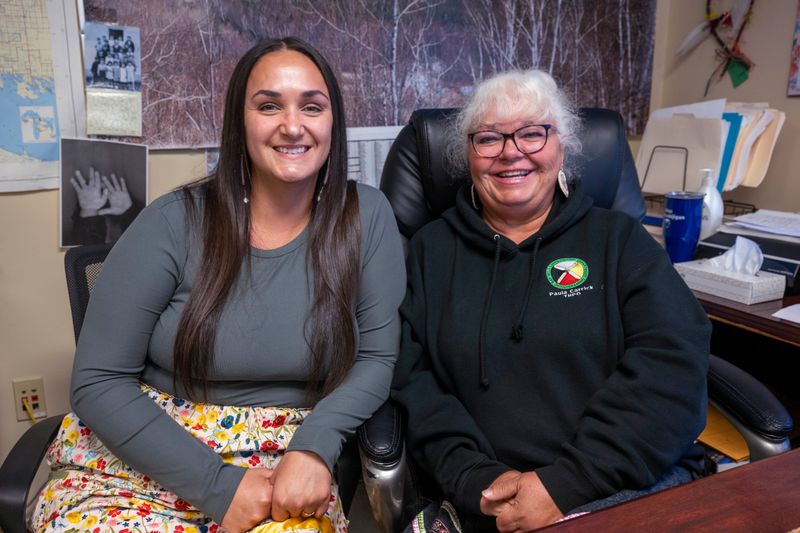
Kayla Perron likes to say she grew up in the history department of the Bay Mills Indian Community, the small office that handles historic preservation for the tribe based in Michigan’s Upper Peninsula.
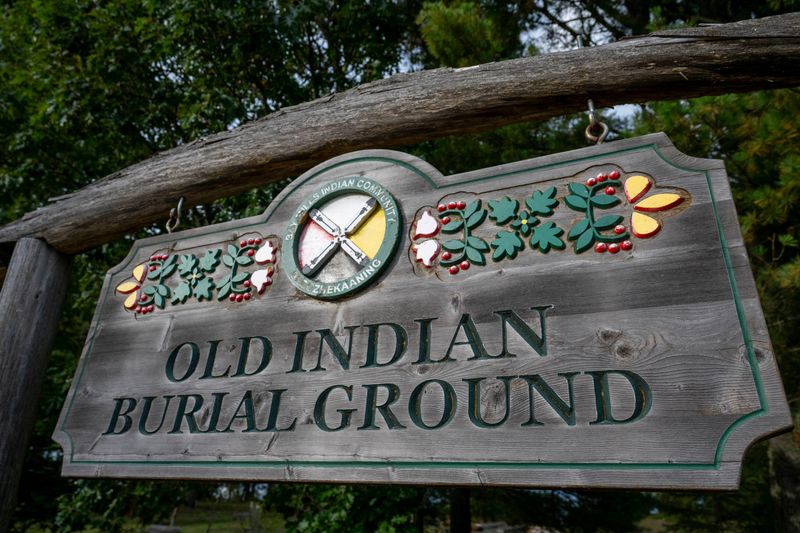
“She used to come here as a little girl,” said her aunt, Paula Carrick, who will pass on the role of tribal historian to Perron at the end of this year. “We had her running through the woods chasing looters trying to dig up our burial grounds.”

Perron will be the third woman in her family to work in the Bay Mills history department since its creation in 1995, following in the footsteps of Carrick and her mother, Wanda.
“It was always kind of in the back of my head,” Perron said about running the department. “My mom and her (Paula) brought this from the ground up … it felt like this was a piece of us.”
Perron has her work cut out for her.
As the Bay Mills tribal historic preservation officer, she will protect the tribe’s sacred sites and oversee the repatriation of ancestral remains and burial objects.
She’ll do it in a fraught national policy environment where next year’s funding is never guaranteed.
Perron’s office is primarily funded by the Department of the Interior through the National Historic Preservation Act, legislation passed in the 1990s that authorized Native American tribes to assume historic preservation duties on their lands.
That funding doesn’t cover travel or supplies for repatriation consultations.
“If (the funding) doesn’t pay for it, how will I do this work?” Perron said.
In 2025, the Department of the Interior froze annual grants to departments like the one in Bay Mills for months, putting Perron’s job in jeopardy. She wondered, “will our department exist? Will our tribe pay out of pocket, or will we have to close?”
A proud legacy
Carrick and her sister Wanda began the Bay Mills history office in 1995 after volunteering to perform research for a book by Michigan State anthropologist Charles Cleland, later published under the title “The Place of the Pike (Gnoozhekaaning)” — after the name of the community in the Anishinaabemowin language.
“We wanted to keep it our history,” Carrick said. By 1998, they had brought home “nine ancestors taken from sacred burial ground” from the Smithsonian Institution.
To help all tribes with repatriation, Carrick was involved in the creation of MACPRA, the Michigan Anishnaabek Cultural Preservation and Repatriation Alliance, in 2000.
Before then, Carrick said, “It was like we were fighting over the same ancestors.”
With the support of the other 11 federally recognized tribes in Michigan, and two recognized at the state level, Carrick brought home ancestral remains from the University of Michigan, Michigan State University and the Grand Rapids Public Museum.
Outside of Michigan, she has also worked on repatriations from Harvard’s Peabody Museum and the Field Museum in Chicago.
“In the beginning, it was hard for all of them,” she said. “They all fought us because they didn’t think it was our right to have our ancestors back.”
But, little by little, “they were willing to open the doors a little more.”
Perron said she’s encouraged that modern museums and cultural institutions appear to be more understanding of the importance of repatriating Native artifacts: “I do see a bit of a shift.”
But she warned: “I’m not saying everything is fairytales and rainbows.”
The next generation
Perron has fond memories of “always being in the woods” with Carrick and her mother when she was a child.
“They were always protecting sacred sites or trying to find them,” she said.
And she remembers the reburial ceremonies, welcoming back ancestors whose remains were taken from sacred ground decades earlier.
“She (Perron’s mother) had me be the one who physically put them back in their resting places,” Perron said. “As a kid, I remember saying, well, I want to grow up and work with my mom. I want to work in this office.”
Now, after years running after-school cultural programs in Bay Mills with her husband, Perron has returned to the history department.
Perron’s new role as the tribal historic preservation for Bay Mills comes with many responsibilities, but watching her mother and aunt shoulder them over the years has prepared her well.
“One of the things I take away from my mom is that she’s a doer. She doesn’t sit idly,” Perron said.
She hopes to combine that quality with her aunt’s encyclopedic knowledge of Bay Mills genealogy and willingness to “take up space.”
Tackling a big job
The first step in her repatriation work, Perron said, will be getting up to speed on the office’s ongoing projects.
She’s taking over at a time when handling each museum’s consultation request is akin to drinking from a fire hose.
“Honestly, it’s overwhelming. They might send you a file with a thousand things and you have to stay on top of all of that,” she said.
To complicate matters, some of the items that come across Perron’s desk don’t fall under federal law because they’re held in Canada, or in private collections.
“Just because they don’t fall under federal funding, doesn’t mean they have the right to hold these things,” Perron said.
Even local historical societies might not be required to return looted objects to tribes like Bay Mills, if they don’t receive federal funding.
Meanwhile, repatriation isn’t the only responsibility under Perron’s purview. It’s her job to protect the tribe’s burial grounds, burial mounds and other sacred spaces, as well.
“We have a huge problem in this area with looting,” she said. “With the onset of tourism, there’s more people in our woods, in our space.”
She also makes sure developers and government agencies are following the federal laws that keep them from disturbing sacred sites and burial grounds.
For Carrick, the job comes down to a simple credo: “Take care of your ancestors.” And her community puts that into practice. “Everyone takes care of the graves once a year. We rake, cut flowers.”
Carrick is confident as she hands off the reins to her niece.
“(Kayla) has the love, and I suppose you gotta have the love to learn the history, respect our ancestors and get them home,” she said.
bwarren@detroitnews.com
This article originally appeared on The Detroit News: For Kayla Perron, preserving her tribe’s history is a family affair
Reporting by Ben Warren, The Detroit News / The Detroit News
USA TODAY Network via Reuters Connect
By Ben Warren, The Detroit News | USA TODAY Network