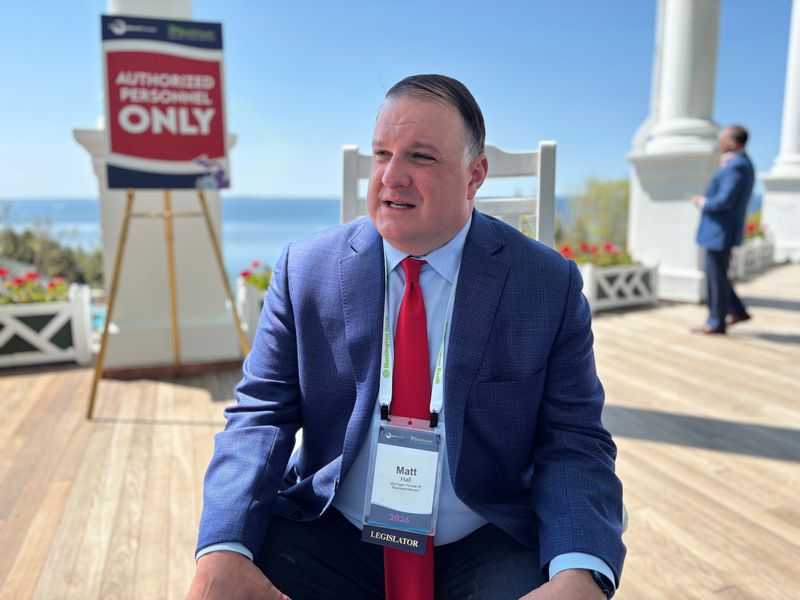
House Speaker Matt Hall said he thinks Michigan got a raw deal when the Canadian government agreed to finance a $4.7 billion bridge over the Detroit River without a dime of American taxpayer money.
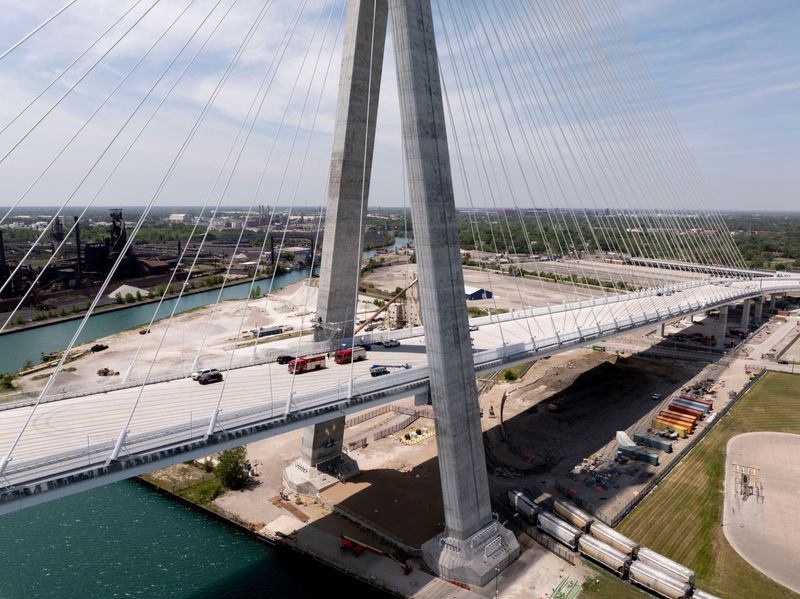
And Hall’s rationale for holding out for a better deal appears to be one reason why the long-awaited Gordie Howe International Bridge connecting Michigan and Ontario is not open to traffic this week.

Welcome to 2026, when a foreign ally’s already agreed-upon full financing of a piece of critical infrastructure benefiting Michigan is questioned.
The powerful Michigan Republican lawmaker has staked out a position that the GOP governor who helped him win control of the House (Rick Snyder) negotiated a bad deal 14 years ago after the Legislature refused to get involved in building a new publicly-owned bridge to Canada.
“I’m very happy to see that the opening of the Gordie Howe bridge has been delayed,” Hall said last Thursday as plans to open the bridge this week were falling apart. “I’m looking forward to a future when the Gordie Howe bridge opens. But this was a very bad deal.”
Hall’s position is baffling veterans of the Detroit River bridge wars.
“I don’t know what to make of it other than somebody is encouraging him to take this stance — let the Legislature have one more shot at it,” said Kirk Steudle, the former director of the Michigan Department of Transportation.
If anyone knows a thing or two about how the Gordie Howe International Bridge came to be, it’s Steudle.
He was the director of MDOT from 2006 to 2018 — an eternity in state government’s executive ranks — under Republican Gov. Rick Snyder and Democratic Gov. Jennifer Granholm. He had a front-row seat to the fight over building a new span as the privately owned Ambassador Bridge nears the century-old mark.
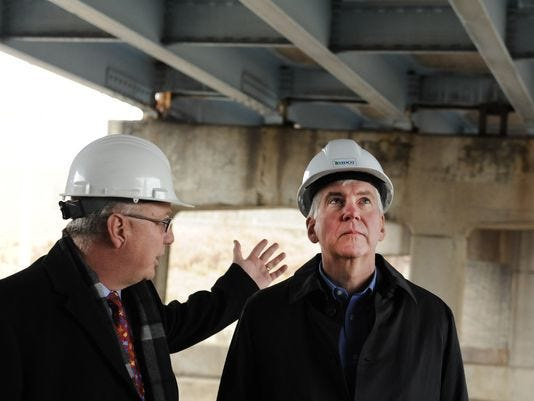
Snyder effectively did an end run around the Michigan Legislature in 2012 when he signed an interlocal government agreement with Canada that ensured Canada would cover the cost of constructing the bridge, reimbursing MDOT for its expenses for design, engineering and acquiring land in Detroit for the bridge, customs plaza and highway connection to I-75.
For nearly 20 years, MDOT employees have been keeping track of every hour spent on the bridge project — and submitting the bills to the government of Canada for reimbursement because of the handcuffs the Michigan Legislature placed on them.
And now Hall wants a better deal.
Why Hall is balking about Gordie Howe bridge deal
Hall’s argument centers around how Canada will recoup its investment through tolls.
The Canadian public corporation that runs the bridge, the Windsor-Detroit Bridge Authority, has not divulged how many years of toll revenue it will take to repay Canada’s debt. But some Canadian officials close to the bridge project have said it could take as many as seven decades, a timespan that makes Hall conclude “we’re never going to have revenue from the bridge.”
“That’s a bad deal,” said Hall, a Kalamazoo County Republican who is as close to President Donald Trump as any Michigan House speaker has been to a president.
The House speaker has been projecting a stance that there’s a better deal to be had, that the Gordie Howe bridge is some kind of boondoggle and now the Canadians should share half of the toll revenue up front, effectively doubling the years it takes to recoup their investment on a bridge built to last 125 years.
“I would support efforts to try to get 50-50 on the toll revenue,” Hall said.
Hall’s attempt to renegotiate the deal Snyder forged with the Canadians is ironic because his rise to power was aided by Snyder’s personal wealth and ability to raise money in 2024 for House Republicans, resulting in Hall getting his hands on the speaker’s gavel.
Snyder defends the Gordie Howe bridge deal he negotiated
In an interview, Snyder defended the deal he struck with Canadians to build a new span, saying it’s a “great deal for nearly 10 million Michiganders” and only “a bad deal” for the Moroun family, owners of the Ambassador Bridge that will face competition for truck traffic for the first time in its 97 years of existence when the Gordie Howe span opens.
“The only party that benefits from the bridge being closed is the Morouns. Period,” Snyder said Tuesday. “… It’s harming other Michiganders and Canadians for every day the bridge stays closed.”
Snyder, an accountant by trade, takes the view that bridge crossings are a public asset, not something to be squeezed for profits.
“When else have you heard us worry about getting revenue from a bridge?” Snyder asked. “The point of governments building bridges is not about making money, it’s about providing infrastructure to allow for the efficient movement of goods, services, helping our citizens, creating jobs and creating friendship.”
Hall has also latched onto the fact that the price tag of the bridge has risen over the years. The irony in that is that American politicians caused some of that inflation. They demanded that Americans be employed on the project. Then they demanded that domestic steel be used on the American side of the bridge.
And the U.S. government refused to pay for its own customs plaza, which had a price tag of $250 million in 2018 and has purportedly ballooned since then. The Canadians paid for that, too, seeing it as another necessary cost of their nation’s most important infrastructure project.
“At the end of the day, (the customs plaza) would be paid for by the state of Michigan through tolls, or tolls that they forego in the future to settle their liability,” said Dwight Duncan, a longtime Canadian politician and former chair of the Windsor-Detroit Bridge Authority board.
Michigan Legislature spurned a new bridge to Canada
Hall’s effort to insert himself into the controversy comes after his predecessors in the Legislature “took themselves away from the table,” Steudle said.
“Their stance was we don’t need this, we don’t need this, we don’t need this,” Steudle said of a new bridge.
The Legislature’s position, namely the position of a majority of Republican senators who swatted away Granholm and Snyder’s efforts to partner with Canada on a new bridge, was in effect adopting the position of the Ambassador Bridge’s owners.
For years, trucking mogul Manuel “Matty” Moroun and his son, Matthew, held a firm grip on the Michigan Senate, finding sympathy from pro-business conservatives that any attempt to build a bridge with taxpayer money would disrupt their business of running the busiest border crossing in North America — and the only privately owned one.
After hitting the wall in the Capitol, Snyder cut the Legislature out of negotiations. Attempts by the Morouns to challenge the legality of Snyder’s move flamed out in state and federal courts.
And then the bridge got built, without much of a peep from the Legislature — until now.
“While we’d rather get the debt paid off sooner than later, Michigan didn’t put any money in it. So I’m not sure why Michiganders — or you can say Michiganians — would expect that we would be able to collect some of this toll revenue before (the debt) got paid off,” said Brad Williams, a longtime lobbyist for the Detroit Regional Chamber who now runs the public affairs consulting arm of the Clark Hill law firm.
Williams argues that most state legislators and members of Michigan’s congressional delegation are more receptive to the Gordie Howe bridge opening now that it’s been constructed — and they didn’t have to appropriate a dime from the state treasury.
“The speaker’s out on an island on this one,” Williams said. “… Legislators want to be part of that legacy, creating an icon for the state — and it cost us nothing.”
Ironically, some lawmakers were trying to get invited to a ribbon-cutting ceremony on June 12 in Windsor that was scuttled, according to a source with direct knowledge of the jockeying for photo opportunities on the new span.
Hall’s position exposes one weakness in Snyder’s bridge deal
But Hall’s attempt to jockey for a different deal also underscores one of the inherent risks of Snyder’s fateful decision to bypass lawmakers: The Michigan Legislature, as an institution, has no skin in the game.
What happens in the future when Michigan lawmakers face an unforeseen issue related to the bridge they didn’t take part in constructing? Will they feel any obligation to be part of a solution?
It’s a question that has been nagging Dennis Muchmore for years. Muchmore was Snyder’s chief of staff in 2012 when the governor forged the crossing agreement with Canadian leaders, cutting the Legislature out of the deal.
Muchmore, the consummate Lansing insider, is also an institutionalist. He believes strongly in the concept that the governor proposes, the Legislature disposes.
He said he has long worried about the Legislature being absent from the responsibility of the Gordie Howe International Bridge’s stewardship in the same way lawmakers set policy affecting operations of the Mackinac Bridge or Blue Water Bridge, both publicly owned critical infrastructure.
“Sometimes the Legislature is an obstruction and other times they’re a long-term benefit to you when you get them on track,” Muchmore said.
Hall relishes his uncanny ability to be an obstruction. And right now, he’s following the White House’s track in using the bridge as leverage in trade negotiations with Canada.
“I think it’s smart that they’re pausing and they’re working to make a deal,” Hall said June 11 at his Capitol press conference. “And I have a lot of confidence in our ambassador, Pete Hoekstra, and in Commerce Secretary (Howard) Lutnick and the president to make a great deal that’s going to make this a true, equal partnership.”
clivengood@detroitnews.com
This article originally appeared on The Detroit News: House Speaker Matt Hall wants a better deal than a free bridge | Livengood
Reporting by Chad Livengood, The Detroit News / The Detroit News
USA TODAY Network via Reuters Connect
By Chad Livengood, The Detroit News | USA TODAY Network