

Nearly four out of 10 parishes in the Archdiocese of Detroit had budget deficits last fiscal year as some parish communities grapple with maintenance costs for aging buildings or undergo capital projects.
The deficits, many of which are detailed on the archdiocese’s website as it undergoes a major restructuring, highlight the financial constraints parishes are facing amid declining church attendance and membership. It is one of the reasons Archbishop Edward Weisenburger gave for reviewing the parishes and deciding which would stop holding masses.

About 39% of parishes in the Archdiocese of Detroit had budget deficits in the 2024-25 fiscal year, according to data from parish workbooks on the archdiocese’s website. More than $18 million in parish debt and $94 million in unfunded maintenance are tying parish finances to buildings and past decisions “instead of present evangelization and ministry,” according to the archdiocese’s restructuring website.
“When a significant portion of parishes are consistently unable to cover their operating costs, it limits their ability to invest in ministry, maintain their facilities, and serve their communities effectively,” said the Rev. Mario Amore, executive director of parish renewal for the Archdiocese of Detroit, in a statement Tuesday.
Four out of 10 parishes in the archdiocese having a deficit is “high,” but it’s “not unheard of,” said Matt Manion, the David Grenon Family Faculty Director at the Center for Church Management at the Villanova School of Business in Pennsylvania.
“I have worked with other dioceses that have had that high a percentage … and they needed to go through restructuring because it’s not sustainable,” Manion said.
Parish officials said the shortfalls come from a range of capital updates. A Lake Orion parish had a parking lot project that affected its budget. A Detroit parish is replacing its roof and has other expenses.
Parishes with shortfalls were spread out across Metro Detroit, according to a Detroit News analysis. And not all of the parishes were older; some had newer facilities. Twenty-one of 209 parishes in the archdiocese had payable loans ranging from $3,701 to $2.45 million as of June 30, 2025. Amore said payable loans represent outstanding loan balances that a parish owes to the Archdiocese of Detroit.
In the 2024-25 fiscal year, 13 parishes in the archdiocese had budget deficits of more than $250,000. The one with the highest deficit was St. Joseph Parish in Lake Orion at $1.02 million.
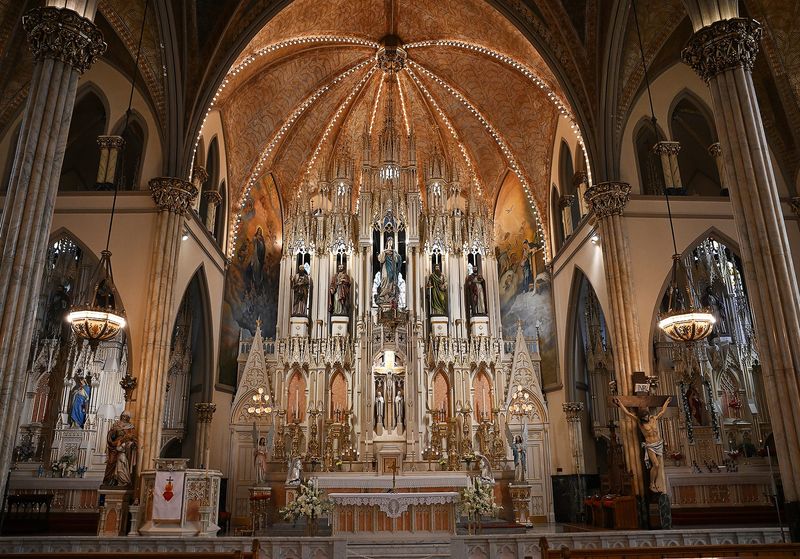
Mother of Divine Mercy Parish in Detroit, which includes Sweetest Heart of Mary Church and St. Josaphat Church, had a smaller deficit of $292,850 last fiscal year. Marianne Peggie, operations manager for Mother of Divine Mercy, said her parish has to make repairs every year to address issues such as boilers going down and roof leaks. Windstorms have also destroyed trees in the parish’s cemetery over the last few years, and it costs thousands of dollars to cut up and remove the trees.
The parish is gradually replacing the roof at Sweetest Heart of Mary Church, and the project contributed to the deficit, she said.
But Peggie said the parish has a consistent income, one example being that the parish holds 90 weddings a year.
“We just … have a nice way of trying to make up for any deficits,” she said.
What it means for parishes to have deficits
The archdiocese’s restructuring plan, announced last fall, comes as parishes are facing declining attendance. About two-thirds of its parishes have fewer than 600 weekly Mass attendees, according to the archdiocese. In the next five years, more than three-quarters of its parishes are projected to shrink.
Sacraments such as baptism and First Communion have also experienced a dramatic decline in the past 25 years, according to the archdiocese, which serves roughly 900,000 area Catholics.
Manion, who previously worked for the Catholic Leadership Institute, an organization that works with the archdiocese on the restructuring, said that, in general, it’s “not a good thing” for a parish to have a deficit. Most parishes don’t have large capital expenses every year, he said. If a parish has a deficit driven by a large capital expense that it had saved for, “that’s not a problem,” Manion said.
“If it’s an ongoing deficit, because you’re not bringing in … enough gifts or other revenue to cover your ongoing expenses, that’s not a sustainable ministry model,” he said.
Parishes that are continuously running a deficit may be facing declining revenues and increasing expenses, Manion said. Employee health care costs have been a major source of higher costs for many parishes nationally in recent years, he said.
The Archdiocese of Detroit’s Amore said the financial challenges facing archdiocesan parishes are driven by “a combination of factors.” Declining Mass attendance over the past two decades has directly reduced offertory collections, which are the primary source of revenue for parishes, he said. At the same time, operating costs, including staffing, utilities, insurance and building maintenance costs, have continued to rise, he said.
Many parishes also support aging facilities that require ongoing spending.
“These compounding pressures have made it increasingly difficult for a significant number of parishes to balance their budgets in any given year,” Amore said.
Metro Detroit parishes explain their deficits
Jim Kean, the pastor of St. Joseph Parish in Lake Orion, which had a Mass count of 2,147 in 2024, one of the largest in its planning area, said his parish saved up for a parking lot project, which cost around $900,000.
The $1 million shortfall listed by the archdiocese “looked like it was a deficit of a million dollars, but in effect it was an even exchange from the savings,” Dean said.
Kean said the parish, which has “very strong Sunday attendance,” has a large parking lot that needed to be redone. He said St. Joseph replaced about two-thirds of the parking lot. The parish plans to replace the rest of the lot later.
St. Joseph Parish is “definitely in the black,” Kean said.
“As a parish, we operate with easily a half million dollars of cash flow per month, and we have no problem meeting those demands,” he said.
Peggie of Mother of Divine Mercy Parish said having a budget deficit as of June 30, 2025, doesn’t affect the parish’s sustainability. She also noted that Mother of Divine Mercy is a growing parish with a Mass count of 481 parishioners in 2024, one of the highest Mass counts in its planning area, according to the archdiocese’s restructuring website.
Some Detroit area parishes are paying off debt
Debt “doesn’t have to be a problem” for a parish, Villanova’s Manion said. Most parishes take out a loan to do a capital project, such as constructing a new building, he said.
“The question is: Are they servicing their debt? Are they paying, you know, on time?” Manion said. “If they’re paying it on time, it’s not an issue at all. If they’re not paying the debts, that’s a problem.”
St. Mary Parish in Wayne had about $1 million in payable loans, according to parish workbooks. But the Rev. Sean Bonner, the pastor at St. Mary, said the amount has since decreased to just under $750,000. The parish has been making its debt payments, which are $10,000 a month, he said.
“While I always say it’s not the biggest check I sign every month, it’s the most difficult check I sign every month,” Bonner said.
Bonner, who has been at the parish since 2017, first serving as an associate pastor and then as the administrator and pastor, said the parish built a new activity center in 2000 and 2001. It borrowed money for that effort and some other projects, he said.
“And they ran into some financial difficulties over the years and were not able to pay down all of … the loan that had been borrowed ― in fact, it actually grew quite a bit, because interest will do that,” Bonner said.
In 2018, the parish entered into a troubled debt repayment plan with the Archdiocese of Detroit, the pastor said. At the time, the parish had about $5 million in outstanding debt. As part of the troubled debt repayment plan, the archdiocese set aside $3.5 million in debt. The parish became responsible for $1.5 million in active debt, which accrues interest, and it’s paying that debt down.
From 2015 through 2023, the archdiocese worked with parishes that were unable to meet all of their debt payments and renegotiated certain loans or outstanding debts through a debt restructuring process, Amore said.
In most cases, the debt was divided into a “pay” note, which the parish could continue paying, and a “held” note, which the parish did not have to pay unless the parish closed or merged and the property was sold. To date, there are nine remaining with “held” notes, Amore said.
The debt that’s part of the Troubled Debt Restructuring plan isn’t accruing interest, and the parish only has to make payments on it under certain conditions, Bonner said. For example, if the parish sold property, the proceeds of the sale would go toward the parish’s $3.5 million in debt.
“I think the whole idea for the diocese … when they entered in the negotiation for the TDR (troubled debt repayment) was to give us hope,” said Bonner, adding that when the parish had $5 million in debt, “there was no hope we were ever going to pay that off.”
As part of Pope Francis’ declaration of 2025 as a Jubilee year, Bonner said the Archdiocese of Detroit had a debt-payment plan for parishes. For any payments that parishes made toward the principal of their loans, the archdiocese doubled those payments, he said. Because of this, St. Mary paid about $250,000 off the principal of its loan.
Bonner said his parish is doing “OK financially.”
“Obviously, we’re not rolling in money, but we’re able to meet our obligations,” he said, “and we’re able to balance our budget, but we’re doing the best that we can.”
asnabes@detroitnews.com
Staff Writers Ben Warren and Aniah Thomas contributed.
This article originally appeared on The Detroit News: Four in 10 Archdiocese of Detroit parishes face budget deficits
Reporting by Anne Snabes, The Detroit News / The Detroit News
USA TODAY Network via Reuters Connect
By Anne Snabes, The Detroit News | USA TODAY Network
