


Michigan residents are helping uncover where bats roost, one observation at a time.
By Michigan Department of Natural Resources
From tree cavities and trunks to bridges and barns, bats are settling into a variety of summer roosts across Michigan. Just as they did last year, residents can help scientists better understand where these important mammals are living, by sharing information about the bat activity they see around their homes and communities.

The Michigan Department of Natural Resources and Michigan Natural Features Inventory are asking the public to report bat roost locations through the Michigan Bat Roost Monitoring Program.
Providing the information is easy. The online form asks for basic information such as the date and time when you saw bats using the roost, whether the location is on public or private land, the type of structure (house, barn, bat box, etc.), and how many bats you observed using the roost. There also is an opportunity to share photos.
This project focuses on summer roosts — places where bats rest and raise their young during the warmer months. Bats typically use summer roosts through August or early September. As temperatures cool in the fall, many species move to winter roosts, called hibernacula, where they hibernate until spring. Reports of summer roosts can be submitted at any time, even if the observation occurred earlier in the year.
How does this information help?
During the first year of the program, community members submitted over 130 bat roost observations from 52 counties across the state. The reports are helping researchers identify where bats are raising young and sheltering during the summer months.
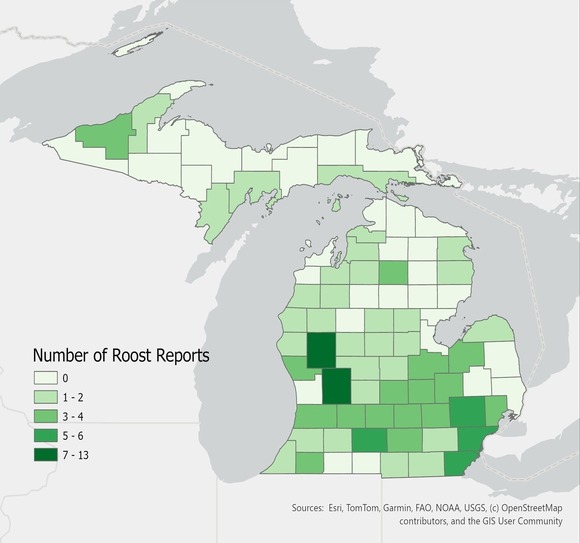
Community scientists submitted 130 bat roost reports from 52 Michigan counties during the first year of the Michigan Bat Roost Monitoring Program in 2025. Map provided by Michigan Natural Features Inventory.
The 2025 results showed that the counties with the most reported summer roost observations were Kent and Newaygo (between seven and 13 reports each) and Calhoun, Monroe, Oakland and Wayne (between five and six reports each). Now entering its second year, the program invites residents to continue reporting bat roost locations to help support bat conservation and monitoring efforts in Michigan.
“Summer bat roosts are critical places where bats rest, raise pups and shelter during the season,” said DNR bat specialist John DePue. “However, these are some of the least understood parts of the bat’s life cycle. By learning more about where bats are roosting, we can better support conservation and management efforts for these species.”
Michigan is home to nine bat species, five of which are listed as threatened or endangered in the state. Bat populations declined sharply after the arrival of white-nose syndrome, a disease that has killed millions of bats across North America.
While many people associate bats with caves, summer roosts are often found in trees, bat houses, barns, bridges and other structures. Around sunset, people may notice bats repeatedly flying in and out of the same location as they leave to feed on insects.
Bats play an important role in Michigan ecosystems and agriculture by consuming large numbers of insects, including mosquitoes and agricultural pests. The public plays an essential role, too, in helping wildlife researchers have more robust information to inform their bat research.
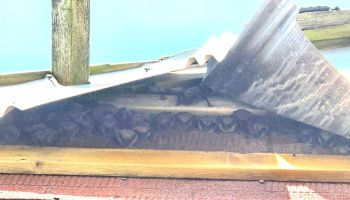 “People are often surprised by how much they can contribute just by paying attention to the wildlife around them,” said Nicolette Sexton, research assistant with Michigan Natural Features Inventory. “Reports from the community help us better understand where bats are roosting and how we can support these important species across Michigan.”Respect the bat’s life cycleIf bats are found in an attic or other building, report the observation but please hold off on trying to move or exclude them during the summer maternity season, when young bats may be unable to fly. Instead, wait until late summer to install a one-way exclusion device which allows the bats to leave on their own but prevents their return to that location.Learn more about Michigan bats — species, threats, conservation efforts and other information — and report roost locations at Michigan.gov/Bats. “People are often surprised by how much they can contribute just by paying attention to the wildlife around them,” said Nicolette Sexton, research assistant with Michigan Natural Features Inventory. “Reports from the community help us better understand where bats are roosting and how we can support these important species across Michigan.”Respect the bat’s life cycleIf bats are found in an attic or other building, report the observation but please hold off on trying to move or exclude them during the summer maternity season, when young bats may be unable to fly. Instead, wait until late summer to install a one-way exclusion device which allows the bats to leave on their own but prevents their return to that location.Learn more about Michigan bats — species, threats, conservation efforts and other information — and report roost locations at Michigan.gov/Bats. |
