Elmer the mastodon, dead for at least 10,000 years, is on the move.
For his old and new homes, this is an appropriately big deal.

Oakland Community College and the Cranbrook Institute of Science announced Tuesday, June 16, that the 15-foot-long skeleton will be relocated from OCC’s Highland Lakes campus in Waterford to Bloomfield Hills, with the precarious process of disassembly starting in the next week.
“We’ve been really proud to have him,” OCC Chancellor Peter Provenzano Jr. told the Free Press, but after 44 years on display, it’s time for Elmer to make tracks.
Officially a long-term loan, Provenzano said, the arrangement is the start of a partnership with Cranbrook that might include curated exhibits on OCC campuses.
Cranbrook gets an important prehistoric artifact − the second mastodon skeleton displayed in Michigan, and still one of only a few − and an attraction.
“From a business perspective,” said director Lucy Hale, “Elmer will help bring audiences back to the museum, because they’ll be able to see something new.”
It’s likely the last stop for Elmer in a six-decade journey touched by eager amateurs, generosity, terrorism, COVID-19, and America’s best-known brand of household glue.
Officially, he’s called the Groleau-White Lake Mastodon, in honor of the construction company that unearthed him and the eventual township where he expired all those millennia ago.
Around OCC, he’s mostly just been Elmer, after the milky white paste slathered on to keep his bones from drying and cracking.
Professional paleontologists now use specialized adhesives for that task, but given enough time, everything changes.
The Highland Lakes campus, for instance, is going extinct.
Finding the official fossil
On a cloudy Monday in March 1968, a crew from Groleau Brothers was working on what would become a restaurant parking lot along M-59 between Elizabeth Lake and Williams Lake roads.
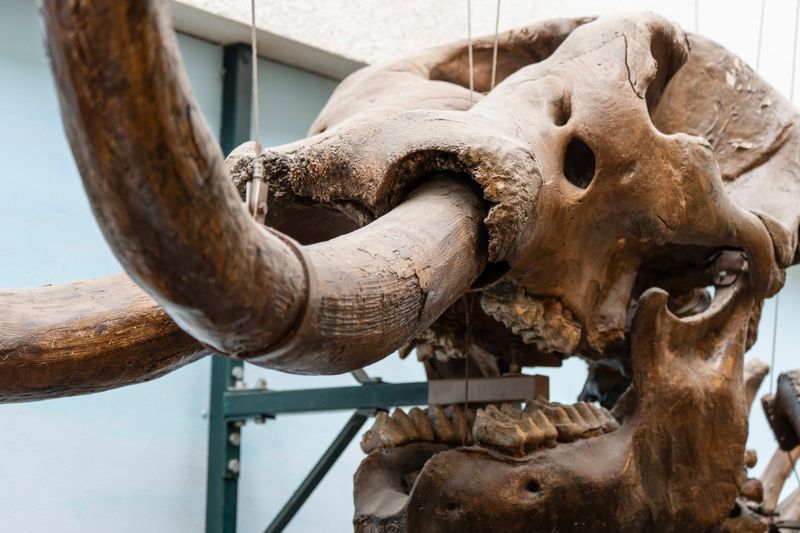
At an unrecorded depth beneath the surface, it exposed what would wind up being most of Elmer’s skull, a left forelimb, a shoulder blade, some vertebrae and a few ribs − “roughly one-third,” said Cranbrook curator of collections Cameron Wood, of the full creature.
While the American mastodon, or Mammut americanum, is Michigan’s state fossil, that much of a specimen rarely turns up. As with most prehistoric museum displays, much of the rest of him was cast in plaster or fiberglass, based on pieces of 5½-ton adult male mastodons found elsewhere.
Groleau donated the fossils to OCC, the nearest college, and threw in $500 to help with preservation.
Thirteen years later, things started to come together.
An accomplishment, and a puzzle
Dr. Jeheskel “Hezy” Shoshani was an Israeli-born Wayne State University professor who loved elephants and anything related to them. He founded what’s now the Elephant Research Foundation, edited an official journal called Elephant, and kept a groundhog-sized distant elephant relative called a rock hyrax as a pet.
Starting in September 1981, he taught a class called Mounting a Mastodon at OCC Highland Lakes. Some 50 students took it across three semesters, and by the time it concluded, they had by-gosh mounted a mastodon.
Unlike most similar exhibits, built from the ground up, Elmer is largely suspended from the ceiling by steel cables. In the absence of ribs and legs on his right side, he stands with his left side facing spectators against a backdrop of a 50-foot-long mural. Painted by students, it depicts what Waterford might have looked like during his era, with wolves, bison and giant beaver among the species.
The students imagined him sinking into a bog, with his rear section hanging above the first floor of a building called Levinson Hall and most of him on the second floor.
He rests on plexiglass slabs that the housekeeping department took special pains to dust before the announcement of his move.
Shoshani’s time at OCC ended when the project did. Having ventured on to study bush elephants and teach in Africa, he was, alas, killed in 2008 when terrorists bombed a public minibus in Addis Ababa, Ethiopia.
He is remembered in a plaque on the first floor. Elmer looms above it, an achievement and also a challenge:
How do you move a dangling mastodon?
Outliving its usefulness
Elmer used to be a point of pride throughout the OCC realm.
These days, Provenzano said, “I’m not sure how many know him beyond this campus” − and Highland Lakes is both diminished and disappearing.
Post-pandemic, more than 50% of OCC students take their classes online. The western-most of the school’s five campuses has always been the least busy, Provenzano said, and a chunk of it has already been sold to Waterford for a new community center.
By the fall of 2027, Highland Lakes is supposed to be closed. The Orchard Ridge campus in Farmington Hills will welcome the nursing and dental hygienist programs at one end of Levinson, the last occupied classroom building.
At the other end, there’s Elmer.
Moving a delicate fossilized skeleton is not easy or cheap. Hale plans to launch a $130,000 fundraising campaign to cover Elmer’s transportation and the refurbishing of his new habitat, alongside some existing mastodon bones from the Cranbrook collection and a furry, lifesized mastodon reproduction.
Provenzano had been contemplating his options, all of them difficult and space-consuming, when he left for a Disney World family vacation in April 2025. When Wood first texted him, he was on line for a ride at Animal Kingdom.
“Hey, we know you have this mastodon,” Wood wrote, and the rest is ancient history.
A late hello before goodbye
Elmer’s first stop at Cranbrook will be in the prep lab, where visitors can peer through windows as the scientists and technicians work.
Getting him there will involve museum staffers, a Bloomfield Hills exhibit company called Through the Learning Glass, and a fair amount of improvisation.
“It’s essentially like taking apart your favorite Lego,” Wood said, “if your Lego was the size of a small moving van and a little bit fragile.”
Deconstruction is expected to take at least three days. After restoration and rebuilding, Elmer should be ready to greet the public again by next summer.
A few days before the announcement, he had what was likely one of his last visitors at his old stomping grounds.
Three-year-old Kane Tamer arrived on the shoulders of his dad, Jake, 32. They’re from Pinckney, and they were waiting for Samantha Tamer − mom, wife and dental hygiene student − to finish for the day.
Kane was wearing shorts, cowboy boots and an orange T-shirt. In one hand, he had a juice pouch, and in the other he held a plastic dinosaur, an allosaurus that growled and lit up with the press of a button.
“Look how big that is!” he said, gaping at Elmer. Then: “Look how big his feet are!”
Look what’s too massive to miss, and too arresting to ignore. Look what’s coming to Cranbrook, getting a new lease on life.
Reach Neal Rubin at NARubin@freepress.com.
This article originally appeared on Detroit Free Press: Cranbrook is getting a mastodon, and it’s a mammoth project
Reporting by Neal Rubin, Detroit Free Press / Detroit Free Press
USA TODAY Network via Reuters Connect
By Neal Rubin, Detroit Free Press | USA TODAY Network