Brendan Sorsby deserves your support. Brendan Sorsby deserves every chance to confront what is clearly a serious addiction, to overcome that addiction and to put his life and, eventually, football career back on track.
He does not deserve that chance in college, in 2026. It appears he’s going to get it anyway.

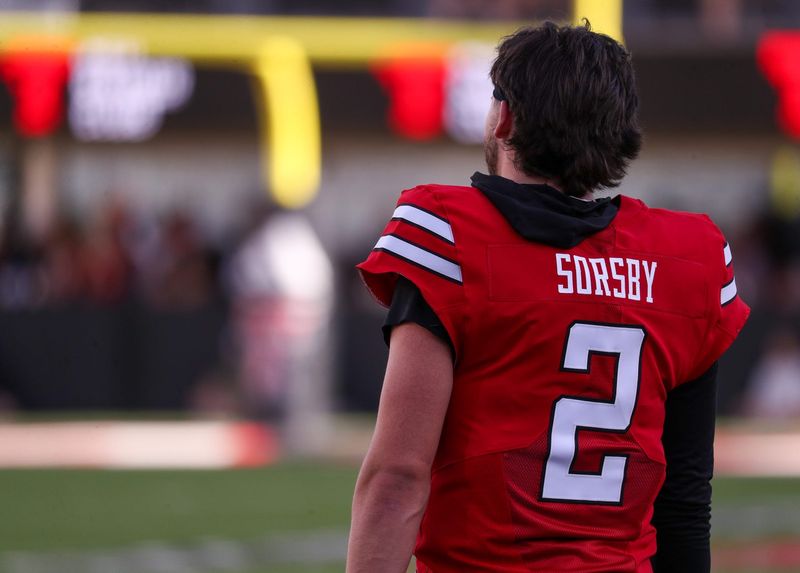
Sorsby, the former IU quarterback who transferred to Cincinnati and then again last season to Texas Tech, was granted a temporary injunction in a Texas court Monday morning against the NCAA, restoring Sorsby’s eligibility. The association had ruled Sorsby permanently ineligible after his gambling activity came to light earlier this year, activity covering what an ESPN report characterized as “thousands” of bets. Crucially, some were placed on Indiana games while Sorsby remained a Hoosier.
Gambling is an addiction, as sure and as devastating as any other. Sorsby has sought treatment for his and, particularly given he now must battle it in the public eye to a degree most in his position do not, his action merits both credit and support. We should all hope he continues on his path to recovery.
All that accepted, let’s be clear: This case is not a symptom of a broken system desperately needing reform, and Sorsby is not a victim of that brokenness.
There has always — always — been a bright white line for athletes gambling on sports, that you can under no circumstances do so on your own team, and Sorsby crossed it. That he apparently will not be punished for that, at least in any meaningful way, represents a grave threat to the precedent of competitive integrity, and it immediately becomes ammunition in the effort to roll back fairly won and long overdue reforms benefiting college athletes across the country.
Brendan Sorsby eligibility decision difficult to understand on precedent
One of the highest-profile transfers to move through the football transfer portal last winter, Sorsby landed in Lubbock on a deal reportedly as rich as $5 million for next season. His arrival immediately elevated Texas Tech, the reigning Big 12 champion, to a place among college football’s most serious national title contenders in the coming season.
That made the news of his betting activity and subsequent punishment perhaps the most consequential storyline of the offseason. Monday’s news means it will reverberate much further into the future.
“This court finds that the Applicant has demonstrated that he will suffer a probable, imminent and irreparable injury,” presiding judge Ken Curry wrote in his decision, in part, “if this Court does not issue this temporary injunction.”
Curry, it should be noted, is not a Texas Tech alumnus. In fact, Curry presided over the case after the judge initially assigned to it (himself a Tech alum) recused himself.
It is still near impossible to square this decision with established punishment for Sorsby’s actions. Are we really supposed to believe Pete Rose just needed to find a more sympathetic court?
Sorsby is still expected to serve a two-game suspension at the start of next season. Nearly all prior treatment of athletes and coaches gambling on their own teams suggests that punishment incredibly generous. Even without the muddiness of tribal loyalties, successful restoration of Sorsby’s eligibility is both a stunning and a dangerous outcome.
This is not the product of college sports’ brokenness
In a statement to ESPN, veteran attorney Tom Mars said Monday he had “never been as shocked and surprised by a court ruling.” The NCAA, providing its own statement to the Lubbock Avalanche-Journal, roundly criticized the decision it said could have “damaging, far-reaching and broadly destabilizing ramifications.”
The association hasn’t won a lot of arguments lately. It should win this one.
Sports make hypocrites of us all at some point. Those tribal loyalties lead us to positions and opinions we later regret.
Basic competitive integrity cannot be so compromised, certainly not for the short-term aim of winning. That’s all this end achieves.
“This whole situation is the outcome of a broken system,” Cody Campbell, a prominent Texas Tech booster and one of the leading voices for Congressional reform in college athletics, told USA TODAY’s Matt Hayes. “I’m doing everything I can to fix it, while Texas Tech does everything it can to navigate the chaos.”
That logic doesn’t hold up at all.
Roster churn, player tampering, financial upheaval in college athletics — these are all the products of the broken system to which Campbell refers.
And while yes, his alma mater (Campbell played offensive line for the Red Raiders) benefits from those outcomes, in no small part because of Campbell’s support, he is also outspoken in his desire to see legislative action restore some measure of calm and common sense.
This has nothing to do with that. The precedent for gambling on your own sport and, most importantly, your own team, is long established. It is no way a product of college sports’ stormy present.
Monday’s decision threatens to intensify that storm.
Brendan Sorsby eligibility case highlights hypocrisy in college sports’ gambling fight
Spare little sympathy for those in charge of college athletics, who willingly got into bed with plenty of partners directly benefiting from the dramatic expansion of sports wagering.
Tune into any college football or basketball broadcast next season, and you’re likely to spot gambling partners and their odds mentioned somewhere. Open any number of sports-specific apps on your phone on a college football Saturday, and you’ll find betting lines attached to each game. Just last week, DraftKings announced a partnership with Pat McAfee for McAfee’s eponymous television show, directly linking a prominent sportsbook to one of ESPN’s most recognizable personalities and a prominent member of the network’s “College GameDay” cast.
For full disclosure, USA TODAY Co. uses BetMGM, another prominent online sportsbook.
There is a plausible future where we talk about these apps the way society discussed cigarettes when I was young: targeted toward a younger demographic, marketed to minimize risks and emphasize short-term enjoyment, and similarly addictive.
Never before has it been so easy to gamble on sports in this country, and the house is not in the business of losing money. Which is why Sorsby should be commended for speaking publicly about and seeking treatment for his addiction, and why he deserves our support as he does both.
In part because, yes, the wider institutions around him are complicit. Gambling is ever present in modern sports.
Neither is this an exclusively Brendan Sorsby issue, nor an exclusively college sports issue. There have been other, similar stories involving college athletes, and other sports forced to take similar actions. Next season, for example, will be the first in which no team in England’s Premier League features a gambling company as its primary shirt sponsor.
The climate still does not excuse individual behavior, anymore than a wet road grants a driver freedom to ignore the speed limit. Right and wrong were clear, from beginning to end.
Brendan Sorsby eligibility decision likely means only bad long-term outcomes
Dismissing that now creates the conditions for two outcomes, neither of them good.
The first: That this becomes a centerpiece argument for Congressional action that rolls back pro-athlete reform.
On Monday, NCAA President Charlie Baker released a pointed statement via Twitter calling again for “targeted intervention from Congress” and saying in part, “When you have schools and deep-pocketed supporters willing to look the other way on the glaring integrity threat of betting on your own team — and judges whose rulings effectively strip away our ability to stop them — only Congress can equip the NCAA to apply this common sense rule to everyone fairly and consistently.”
The NCAA’s arguments in recent years have struggled to hold water because of the inherent weakness of the association’s position. Manipulating an argument meant to serve a collective good (that athletes deserve more rights and more say in college athletics) for individual benefit directly undercuts that argument.
In many ways though, that’s the better outcome here. Baker’s statement foreshadows the second, much more dangerous consequence.
Sports are nothing without competitive integrity. If we cannot safely assume outcomes were reached fairly, then we can have no confidence in them at all. What, then, is left after that?
That’s the nightmare scenario. We need not reach that extreme for the consequences of Monday’s decision to remain grave.
The more we use the NCAA’s relative legal weakness to open and then exploit unjustifiable loopholes in the system it now struggles to govern, the easier it becomes for opponents of legitimate reform to roll that reform back. Campbell talks about a broken system, yet Texas Tech is now an accomplice in breaking it further. That worsens the collective outlook, particularly for athletes seeking legitimate redress.
Brendan Sorsby is a victim. He is the product of an environment steeped in hypocrisy, one in which many of the same people decrying the unwelcome symptoms of college sports’ turbulent decade will happily turn around and use that turbulence to their own ends. Sorsby deserves our support, as he grapples with and, hopefully, ultimately overcomes his addiction.
That does not mean he deserves to play football for Texas Tech this fall. There still must be certain absolutes, the line he crossed among them. Otherwise, we will lose our trust in the most basic tenet of sports — that they are being played and decided fairly — and without that, nothing else matters.
Want more Hoosiers coverage? Sign up for IndyStar’s Hoosiers newsletter. Listen to Mind Your Banners, our IU Athletics-centric podcast, on Apple Podcasts, Spotify or wherever you get your podcasts. Watch the latest on IndyStar TV: Hoosiers.
This article originally appeared on Indianapolis Star: Allowing Brendan Sorsby to play at Texas Tech would set a dangerous precedent in college sports
Reporting by Zach Osterman, Indianapolis Star / Indianapolis Star
USA TODAY Network via Reuters Connect
By Zach Osterman, Indianapolis Star | USA TODAY Network