

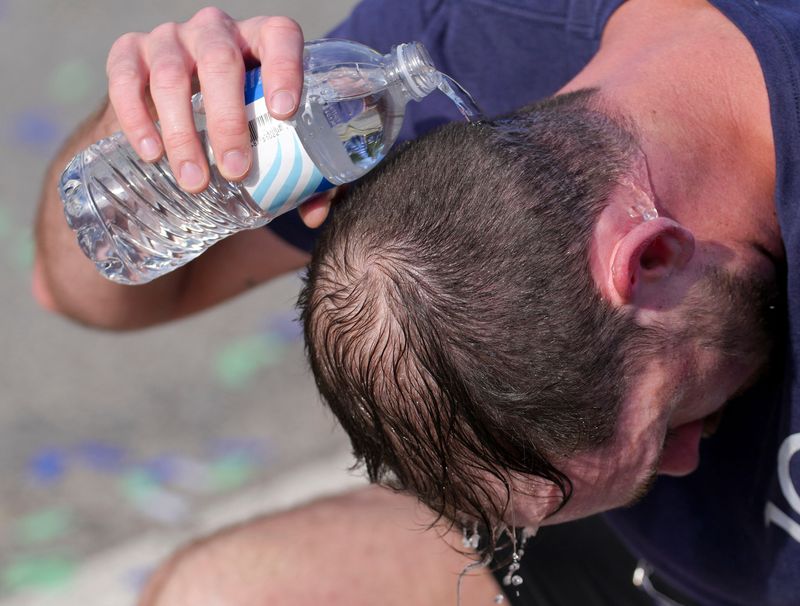
It’s going to be hot this summer at the 2026 World Cup, especially at Hard Rock Stadium in Miami Gardens, Florida.
It seemed like fans hoping to cool down had reason to be more heated when FIFA banned refillable plastic water bottles from being brought into stadiums, citing safety concerns for the last-minute policy change.

But then on June 5, FIFA announced it was changing course and will now allow fans to bring one factory sealed, disposable, 20-ounce water bottle into any stadium hosting World Cup matches in the venues in the U.S. and Canada.
World Cup 2026 COO Heimo Schirgi explained what was allowed and not allowed in a video posted early Friday evening.
Weather is one of the biggest concerns for this World Cup with only five of the 16 host stadiums having a roof. Last summer’s Club World Cup in the United States had players, coaches and fans complaining about the blistering heat, with at least one team even opting to have substitutes stay in the locker room during the game rather than the bench.
Shop for tickets to World Cup games in Miami
Hard Rock Stadium, home to the NFL’s Miami Dolphins and college football’s Miami Hurricanes, is among the stadiums without a roof, and though a roof canopy protects fans from the South Florida sun, it doesn’t cover every section of the stands. The Dolphins bench is positioned in the section of the stadium that’s protected most by the shade in the afternoon, while opponents and fans seated behind them are more exposed to the elements.
Temperatures for matches in Florida are expected to be among the most severe across the tournament. According to the National Weather Service, Miami’s average high from June 15 (the date of the first of seven games slated for Hard Rock Stadium) to July 18 (when the bronze-medal game will be played) is 83-84 degrees, though the University of Miami puts those averages at 96-98 degrees. AccuWeather predicts a high of 88 degrees for Miami’s World Cup opener, though it also calls for a 77% chance of rain.
What is FIFA water bottle policy?
Prior to the June 5 flip, FIFA said its biggest concern was safety and not giving fans something to hurl at others, possibly incurring injury.
“FIFA is committed to protecting the health and safety of all players, referees, fans, volunteers, and staff,” soccer’s governing body told Reuters in a statement. “FIFA made the decision to prohibit bottles to prevent risk and injury to players and attendees.”
According to FIFA’s Stadium Code of Conduct updated June 2, items prohibited from stadiums include “bottles, cups, jars, cans or any other form of closed or capped receptacle that may be thrown or cause injury, as well as other objects made of glass or any other breakable material or especially hard packages or hard thermal boxes.” It also states “for the avoidance of doubt, reusable water bottles may not be brought into the Stadium.”
But the clarification on June 5 makes an exception during the hot summer months in the Northern Hemisphere.
According to The Athletic, as of May 12, that section read: “For the avoidance of doubt, empty, transparent, reusable plastic bottles, up to (1 liter in) capacity, may be brought into the Stadium.”
Hard Rock Stadium already prohibits fans from bringing in refillable water bottles, but its standard carry-in policy does allow fans to bring in factory-sealed, plastic bottles of 20 ounces or less.
FIFA water bottle policy change was controversial
This will be the first time World Cup matches will feature a mandatory three-minute cooling break around the 22nd minute of each half. The irony of on-field water breaks while banning bottles for fans hasn’t been lost on the Free Lions supporters group, which provides resources for traveling England fans.
“For all of the effort they are going to with ‘drinks breaks’ for the players, this is such a strange, late change,” the group posted on social media. “In all of our discussions, free water availability in stadiums was a key one and we were assured by FIFA that this would be the case, and that fans will have the ability to bring their own water bottle.”
Before the change, politicians were taking FIFA to task over the water bottle ban.
New York City mayor Zohran Mamdani, whose city is playing host to several games including the final on July 19 at MetLife Stadium in northern New Jersey, told The Athletic he was “concerned” about the change and that he would reach out to FIFA for an explanation. Toronto mayor Olivia Chow called the move a “pure money grab” in an interview with CTV News.
“Why do you need to buy a water bottle when you can just carry your water in. It is cheaper that way and it is good for the environment,” Chow told CTV News. “It is outrageous. They are just trying to make more money. They are already making billions of dollars. Stop it.”
World Cup schedule for Miami
All times Eastern.
Contributing: Sarah Perkel and Samantha Neely, USA TODAY Network
This article originally appeared on Palm Beach Post: FIFA bans, then allows water bottles at World Cup, much to fans’ relief
Reporting by Dan Rorabaugh and Jesse Yomtov, USA TODAY NETWORK – Florida / Palm Beach Post
USA TODAY Network via Reuters Connect
By Dan Rorabaugh and Jesse Yomtov, USA TODAY NETWORK – Florida | USA TODAY Network
