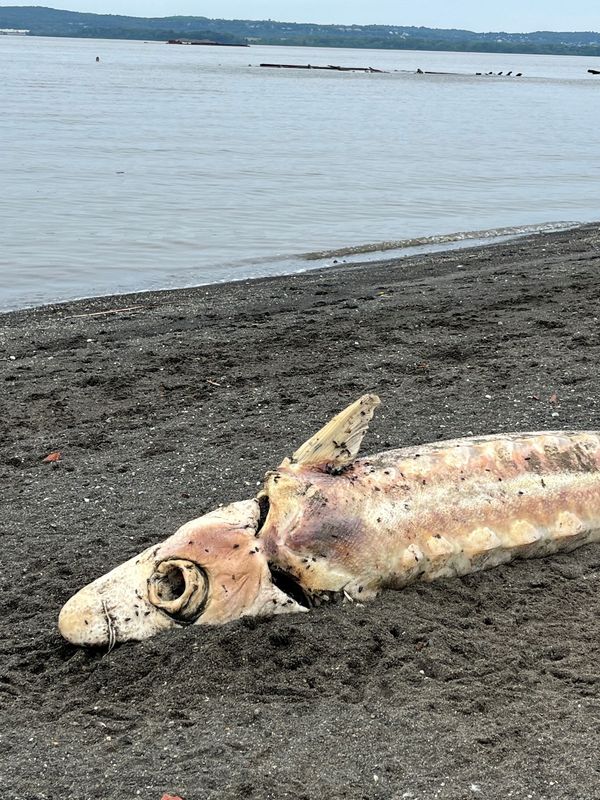
Mike Fitzgerald hesitated. He feared the large, white object stranded on a beach along the Hudson River could be a dead body.
It was surrounded by vultures. So, Fitzgerald grabbed his binoculars.

He spied what some call “the dinosaur of the sea,” a fish that can grow as long as 14 feet, weigh up to 800 pounds and has been around since the beginning of time. The Atlantic sturgeon. Female sturgeons were so prized for their caviar, the sturgeon were nearly fished out of existence. In 2012, it was put on the endangered species list.
Fitzgerald’s daily walks on the beach along the Hudson in Haverstraw are rarely so eventful. He’s spotted bunker jumping out of the water. That’s about it.
“It has those bumpy scales on its back,” Fitzgerald said. “It looks kind of prehistoric. I’ve never seen anything like this before.”
Following the clues
The retired biology teacher took photos and sent them to the state Department of Environmental Conservation, which tracks sturgeon deaths through marine life incident reports.
“Based on the trauma to the head shown in one of the photos, the likely source of mortality is a strike from a vessel,” state officials told the USA TODAY Network.
Sturgeon spend much of their life — they can live up to 60 years — in the ocean but make their way to freshwater to spawn this time of year.
“Spawning is actively taking place now in freshwater portions of the estuary,” the state says. “Unfortunately, some will die along this journey.”
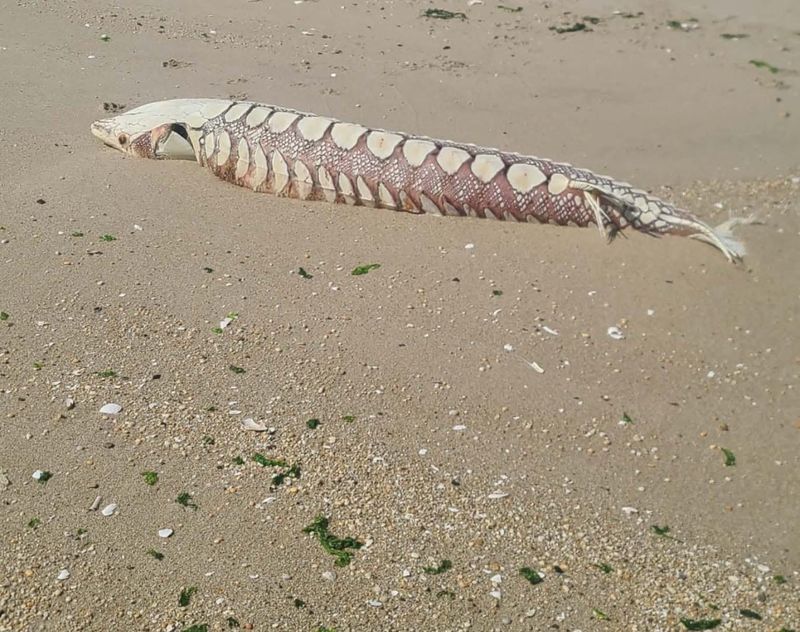
And not just in the Hudson. A sturgeon measuring nearly 5 feet washed up in Sandy Hook, on the southern New Jersey coast on Wednesday, June 3. The beach is along Raritan Bay, which connects with the Hudson. It’s unclear how that sturgeon died. State officials have not even confirmed that it is, in fact, a sturgeon.
A history of boat strikes
All of this got us to thinking.
During the construction of the Gov. Mario M. Cuomo Bridge more than a decade ago, fears of work boats striking and killing sturgeon prompted Riverkeeper and John Lipscomb, its boat captain then, to urge the state to use more caution.
The state tallied over 100 sturgeon deaths during the three years the bridge was under construction, far more than previous years, the USA TODAY Network reported in 2015.
Federal officials at the National Marine Fisheries Service were unconvinced boat strikes were the cause, saying it was impossible to determine if there was a surge in sturgeon deaths. Lipscomb called that a “lame response.”
And state officials suspected that the increase in reported deaths might have to do with the sturgeon’s inclusion on the endangered list.
Riverkeeper proposed the state encase boat propellers in cages during the construction, use jet propulsion or force boats to slow down.
The environmental watchdog’s advocacy for the sturgeon continues.
Last year, Riverkeepers from New York and Delaware sued New York, New Jersey and Delaware to prevent commercial fishing operations from capturing and killing Atlantic sturgeon by snatching them up in their nets.
David Stormer, Riverkeeper’s habitat restoration director and fish expert, said in discussions with other states during the litigation, boat strikes come up again and again.
“We have heard from states that many of the dead sturgeon reports that they receive come from vessel strikes actually,” Stormer said. “That is both surprising given the magnitude of fishing operations where their fishing gear interacts with sturgeon but also perhaps some phenomenon that is emerging related to the major causes of sturgeon mortality.”
Stormer could not provide statistics showing an uptick in boat strikes. And the DEC did not respond to a request for the latest sturgeon death totals based on incident reports.
The DEC did note, however, that a recent stock assessment by the Atlantic States Marine Fisheries Commission (ASMFC), the interstate body that manages the sturgeon, has identified vessel strikes in rivers as “a high priority research recommendation.” And the DEC is participating in the Hudson River Foundation’s Sturgeon Net Conservation Benefit Program to get a better idea of sturgeon migration and their interactions with vessels.
Why are sturgeon being hit?
Stormer says several factors could be contributing to the deaths. For one, Stormer says, sturgeon have historically been known as bottom dwellers but in recent years it’s become clear they spend more time near the surface of the water or the upper half of the water column than previously believed.
“And that puts them in the direct path of ships, fishing boats and recreational vessels that are traveling up and down the river,” Stormer notes.
Sturgeon gather in the deep river channels frequented by recreational boaters and large commercial ships to feed, rest and spawn. Boats and ships travel a lot faster than the lumbering sturgeon, limiting its response time.
And, Stormer says, some studies have shown the sturgeon exhibiting unusual behavior, like leaping.
“If you have a sturgeon that is erratically leaping out of the river that could occasionally result in interacting with a boat or being struck by boats,” Stormer said. “There’s even reports of sturgeon landing inside small vessels. Can you imagine?”
Why make the leap?
They could be avoiding predators, removing parasites or engaging in buoyancy control, Stormer says. The sturgeon swallow air to fill their swim bladder.
Or, Stormer said, they could leap to communicate their availability to potential mates, the sturgeon’s way of showing off that beach body.
“It’s a very muddy, murky environment in some of the areas where sturgeon spawn and so they might be communicating with one another that, you know, it’s time to make babies.”
What can be done?
Stormer has a few ideas.
Studies should track sturgeon movements or their hot spots and determine where they intersect with vessel traffic.
“This will help identify periods of elevated strike risk and inform time-specific protective measures,” Stormer said.
Seasonal restrictions could limit the speed of boats of ships or they could be rerouted. Real-time advisories could go out to local mariners, regulatory authorities and conservation organizations to promote awareness.
Similar protective measures were proposed in 2023 after a dozen whales turned up dead along New York’s Atlantic Coast. Marine scientists say the whales may have wandered into shipping channels in search of bunker or menhaden. Both have been in greater abundance since New York’s coastal waters have become cleaner and healthier.
Thomas C. Zambito covers energy, transportation and economic growth for the USA TODAY Network’s New York State team. He’s won dozens of state and national writing awards from the Associated Press, Investigative Reporters and Editors, the Deadline Club and others during a decades-long career that’s included stops at the New York Daily News, The Star-Ledger of Newark and The Record of Hackensack. He can be reached at tzambito@lohud.com
This article originally appeared on Rockland/Westchester Journal News: What’s killing the Hudson River’s Atlantic sturgeon? Follow the clues
Reporting by Thomas C. Zambito, New York State Team / Rockland/Westchester Journal News
USA TODAY Network via Reuters Connect
By Thomas C. Zambito, New York State Team | USA TODAY Network