When the Beamans bottomed out: First of a series
MENLO ― Guthrie County Deputy Jason Gray took the call last August and checked on the empty yellow house across the railroad tracks in Menlo, where Todd and Bonnie Beaman had lived more than 20 years with their four kids.

A stench lingered, flies buzzed in the windows and several dogs could be heard barking inside.
A day later, after obtaining a warrant, Gray entered the house, finding trash and dog waste everywhere. The smell so overwhelmed him that his eyes watered.
“I had to have my shirt up under my nose just to find somehow to breathe,” he would later testify in court, describing his role in what soon became a much wider investigation.
Until Gray’s discovery, few paid attention to stark world in which one close-knit family of people with disabilities lived, largely alone and ostracized, in west central Iowa.
Over the next nine months, their story would unfold with traumatic consequences. Woven through it were familiar themes ― unmet needs, a social safety net with gaping holes, and punishing, costly outcomes ― that a Watchdog investigation found are becoming more and more common for the state’s most vulnerable.
Family’s distress, strife escalate
About a month after Gray’s discovery of the appalling conditions, a cadre of local officials in Audubon, 45 minutes to the northwest, were just coming to grips with an alarming and similar menagerie of problems in another house belonging to members of the same family.
They all had disabilities, all lived on a shoestring, and all had become a public health and safety concern. People in the town of 2,000 complained and authorities were called. But until that September, no one inquired more deeply.
Police were more than familiar with the Beamans: In Menlo, they’d logged 13 calls for assistance since May 2023 for domestic disturbances, welfare checks and neglected dogs, incident reports show.
Police logs show similar calls also began that year in Audubon, where Charlie Beaman, the youngest daughter among the family’s four grown kids, shared a house with her brother and new husband. Police responded at least 22 times through August 2025 to reports of domestic disturbances, fights and various medical or mental health problems.
People at local businesses complained to police that Beaman’s husband, Joshua James Walker, 30, smelled so bad they feared he would make others sick. One person reportedly saw feces falling off him at the local Dollar General store, court records show.
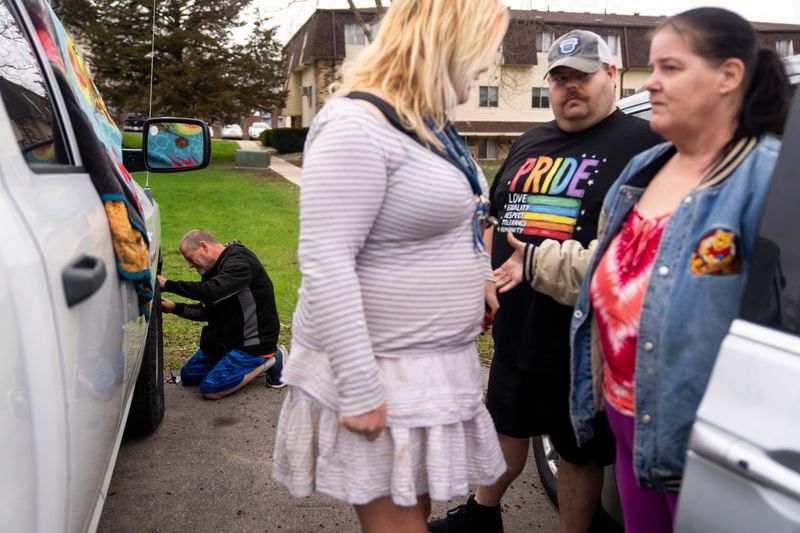
The Audubon house had become a tinderbox. All seven members of the Beaman family — Charlie and Joshua; siblings Sarah, Rex and Steven; and parents Todd and Bonnie — were living there by then, leaving the Menlo house empty.
Authorities were called twice one August day ― first after Charlie was injured with broken glass during a fight with her husband and later when a brawl broke out between him and her parents.
In mid-September, Charlie, in a fit of anger after another fight with her husband, allegedly kicked her father into a ditch on the side of a highway and injured him with a torn pop can. A week later, a state adult protective worker was called to investigate a complaint that the oldest Beaman daughter, Sarah, 33, who has cerebral palsy, narcolepsy and mental and intellectual disabilities, was living in the filthy home packed with dogs, her parents, siblings and her sister’s violent husband, court records show.
“Bonnie told Joshua he had to leave the home and not come back until he calmed down,” the protective worker investigating noted in an assessment. “Joshua left the home and hadn’t come back and no one in the family had heard from him.”
Despite several calls by Beaman family members about Joshua in Audubon, police never charged him with domestic violence or in connection with fights he had with other family members.
Todd and Bonnie said that when Tammy Dorscher, the adult protective worker, spoke to them about problems in the Audubon home, she did not offer the family services or resources. Instead, they said, Dorscher told them that because Sarah had said she didn’t feel safe around Joshua, they had to get her out of there, court records show.
Bonnie and her children all had IQs below 70, meaning they all were within the threshold for intellectual disabilities. Todd’s IQ was only slightly higher. He also was experiencing heart and kidney failure and had quit his job in 2008 to go on Social Security Disability Insurance. Bonnie hadn’t worked since Sarah, her oldest and most needy child, was a baby.
With SSDI benefits, Todd and Bonnie had an annual income of less than $15,000. Supplemental Security Income and SSDI payments for siblings Sarah, Steven, Charlie and Rex brought in just under $43,000 more. The parents said they stretched that money, as legal payees for their kids, to cover payments on the two homes, food, utilities and a $600-a-month loan to purchase the one van they all relied on.
Todd and Bonnie felt backed in a corner: If they did what Dorscher wanted, taking the family’s only vehicle and returning to their longtime home Menlo, they could keep Sarah and her brother Steven, also a dependent adult, safe. But Charlie and their other son Rex, who also had disabilities, would remain at risk when Joshua came back.
The parents said, and police records showed, Joshua had been involved in several physical altercations with family members before and they feared violence would break out again.
Rex also had been arrested in 2019 for possessing child pornography his parents said was sent to him by a federal agent in an undercover sting. Because of his disability, his mother said, Rex was allowed to serve four years in a federal prison in Michigan instead of a possible 20. Court records show he was supposed to stay away from Sarah for a time under the terms of his parole. But he was prone to seizures and unable to drive, so he couldn’t live on his own.
A ghastly scene brings arrests, state action
Audubon police Officer Melissa Mower would eventually admit in court that, until the end of September last year, she’d opted not to file any criminal charges in connection with the disturbances at Charlie’s home.
Family members, she said, were always combative and full of strong emotions when police were involved. She said she thought it was “best to keep a distance for their own safety.”
But Mower would testify that the turning point came when the family itself had become a public health threat. When she realized the house didn’t have a working sewer line, violence was escalating and there were allegations that both people and animals were being abused, she worked with others to round up a team to go and investigate.
The scene they found Sept. 30 in the house on Washington Street would be well-documented in adult protective assessments, court filings and testimony. To every official who played a role that day, and was eventually asked to be a witness in a forthcoming guardianship case involving Sarah, it was unforgettable.
Police Chief Sean Staples and Brian Juelsgaard, the local public works director, attempted to go upstairs, but the overpowering odor from dog waste and urine made them turn back, gagging, a video taken as evidence shows.
“Love what they’ve done with the place,” one could be heard saying to the other.
“Oh, my God, that was bad,” Staples said.
Trash, urine and dog feces covered much of the main floor, and Dorscher noted there appeared to be no safe place to even sleep. In the basement, the team found a layer of human waste deep enough to soak shoes, left from a long-broken sewer line.
Dorscher wrote in her assessment that Sarah wore the same black tank top and purple jeans she’d been seen in 12 days prior and her mother also was dressed in the clothes she’d been wearing then. The daughter’s sandy hair appeared dark and greasy and her pants were stained with what looked like excrement, the assessment said.
Authorities learned Joshua, a 30-year-old from Indianola who had met Rex at the Fort Des Moines Correctional Facility as he was being released from prison, moved into Charlie’s two-story house in summer 2024 after he and Charlie got married.
Bonnie said she and her husband didn’t know “until it all went down” that Joshua had been convicted in 2014 at age 17 of indecent exposure. He also had a history of sexually inappropriate behavior, court records showed, that sent him back to prison before he met Rex and Charlie.
On the morning of Sept. 30, Bonnie finally filled out paperwork to have her son-in-law committed for 72 hours on a mental health hold. Police took him away ― but later came for her, her husband and three of their children, as well.
Stretched to the end of their tether
On the afternoon of Sept. 30, after seeing the Audubon house, police moved to arrest Bonnie. Seen on a video later shown in court, the fiercely protective mother yells, “This is not OK!” and, “I’m not going anywhere!” as she clings to her husband.
Charlie had been arrested that morning on an outstanding warrant involving the earlier fight with her father on the side of the highway.
Todd and daughter Sarah, both narcoleptic, collapsed.
When medics took Sarah in an ambulance to the local hospital for an examination, she erupted in fear and anger. The authorities had taken her dog June and separated her from her brothers, the people who always calmed her down.
“I tried to get out of the ambulance and they wouldn’t let me,” she told the Register. “I tried again and they wouldn’t let me leave.”
Police and city officials explained the house was being condemned. The dogs inside, malnourished and suffering from fleas and other maladies, were taken to a shelter.
“Twelve to 17 dogs were removed from the house, one of which had to be euthanized because of an untreated wound on its side,” criminal filings said. “Two deceased animals were also left in the residence. It was determined that the home was unfit for human habitation.”
Steven, the 30-year-old son who was considered dependent but higher functioning than his sister Sarah, was allowed to stay with his father.
In October, once the dust of that chaotic day settled, Joshua and Rex were both charged with violating the terms of their probations as sex offenders. Rex was returned to jail and was later charged with additional offenses in Audubon.
Todd, 57, was charged with criminal offenses similar to those alleged against his wife: dependent adult abuse and animal neglect.
Charlie also was charged with two counts of animal neglect.
Todd and Bonnie objected to how others portrayed their situation, as if they just let it happen. They said they had been doing what they could with little help from anyone and no effort from police to remove Joshua from their daughter’s home. They said they never gave anyone permission to enter the Audubon home and they weren’t shown a warrant.
But it didn’t matter. The authorities and a judge agreed the situation could not go on.
Family split apart as parents deemed unfit
What played out after that day was what Iowa legislators envisioned when, three decades ago, they passed a law allowing the state to take emergency action to protect vulnerable adults who cannot fend for themselves.
The Iowa Department of Health and Human Services, with permission from a judge, took custody of Sarah from her parents, requiring her to have 24/7 supervision. They placed her in the care of group homes, first in Creston, then in Mount Ayr, over the following six months.
The DHHS found her parents were responsible for denying her and her brother Steven critical care and failing to provide them appropriate shelter.
A judge tapped an aunt from Des Moines, the wife of Todd’s brother, to be Sarah’s temporary guardian and heard testimony on who should be her permanent caregiver.
Swensen, the county attorney, and the DHHS agreed it should not be her parents: “The state feels Bonnie and Todd are not suitable guardians,” Swensen told Judge Justin Wyatt.
Witnesses called to testify recalled a house of horrors in which Sarah slept in a recliner surrounded in filth.
“I’ve been to a lot of homes and this is the only one where I almost threw up,” testified Jotham Arber, executive director of Audubon County Public Health.
Todd and Bonnie asked Beverly Wild, an elderly attorney who had helped them with guardianship of their children more than 15 years prior, to represent them again and try to get their daughter back.
But West, struggling to hear, asked few questions of most of the witnesses in the hearing.
When questioned by West, Beverly Foley, an adult-protective manager overseeing the case for the DHHS, acknowledged she had not talked to Sarah, had not visited her in the group homes and knew nothing about failure there to provide her special medication she needed for narcolepsy.
Then West called to the witness stand her own live-in companion, a retired doctor who had medical expertise but had never treated Sarah nor seen the conditions inside the Audubon home.
Kelly Bast, the doctor, tried to make the case that Sarah was better off at home with family that best knew how to handle her multiple medical and behavioral issues than in a group home far from everyone who loved her.
What authorities were doing to her, he would say later, was “cruel and unusual punishment for her parents’ crimes.”
No one who testified that day told Wyatt, the judge, that in the not-too-distant past, Sarah’s life ― and the lives of her family ― had been much different with the help of programs and services that Iowa expanded decades ago to act as a safety net for people just like them.
After what had happened that September, they would never be the same.
Dependent adult abuse in Iowa has skyrocketed as more of the state’s most vulnerable adults have been left with caregivers unwilling or unable to meet their needs. The number of Iowans added to the state’s Central Abuse Registry climbed 50% in just the last five years. That was before the historic cuts enacted by Congress in July 2025 that will reduce spending on Medicaid, the federal-state insurance program for the poor and disabled, by an estimated $800 billion to $1 trillion over nine years. What will happen to Iowa’s most vulnerable? Here’s the story of how one isolated family fared after failing to receive much-needed support.
Next in the series: The Beamans get their day in court, but not the chance to tell their side of the story.
Lee Rood’s Reader’s Watchdog column helps Iowans get answers and accountability from public officials, the justice system, businesses and nonprofits. Reach her at lrood@registermedia.com, at 515-284-8549, on Twitter at @leerood or on Facebook at Facebook.com/readerswatchdog.
This article originally appeared on Des Moines Register: With little help in Iowa town, disabled family’s life deteriorates
Reporting by Lee Rood, Des Moines Register / Des Moines Register
USA TODAY Network via Reuters Connect



By Lee Rood, Des Moines Register | USA TODAY Network