Legal representatives for Lakeland’s proposed data center canceled their meeting with the city’s Development Review Committee scheduled for June 3, city spokeswoman Larry Little said.
The Wednesday meeting was canceled after the development team received Lakeland city staff’s 13 pages of comments on the conceptual plan, Little said.

“The next steps of the process are for the applicant to review the DRT comments, determine how they wish to proceed, and decide whether to submit additional information, to apply or seek further clarification from City staff,” Little wrote in an emailed statement.
What is Lakeland’s Development Review process?
Brian Rewis, Lakeland’s director of community and economic development, said all buildings constructed in the city other than single-family homes are required to go before the city’s concept-level plan review. This includes a plan for three buildings to house a 600,000-square-foot data center.
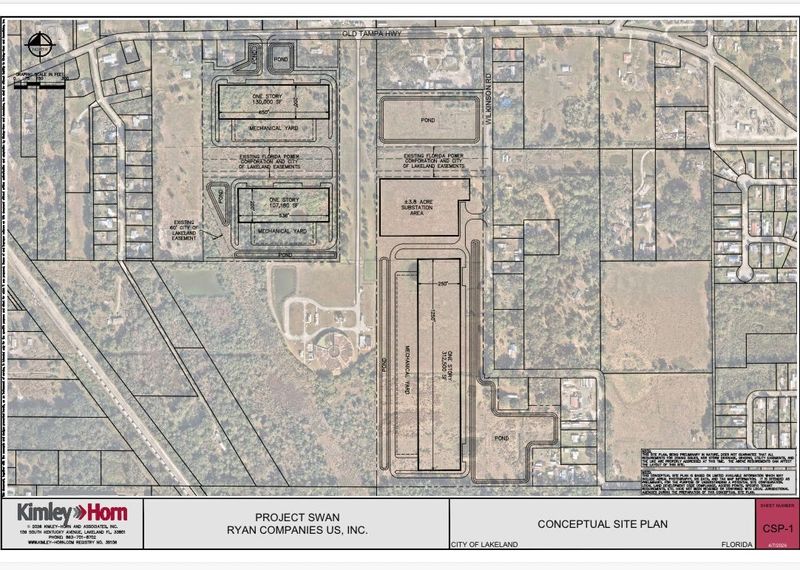
During these reviews, city staff from eight different departments ask technical questions about the “conceptual earliest ideas” of the developer, in this case Kimley-Horn filing on behalf of Ryan Companies U.S. Inc.
“Concept plan review is not an approval or denial step,” Rewis said. “It is a completion step. An applicant applies, we review any level of detail they provide to us, the city.”
The departmental representatives ask questions about the proposed idea, its feasibility and what challenges the applicant might face. Those departments include:
The city staff questions often begin with information provided on the May 5 conceptual site plan filed by Kimley-Horn. The one-page form does not provide any specific details on expected power or water usage by the data center. “With this particular applicant, that much, much more detail about the electric and water utility demands of the proposed development will be required,” Rewis said. “We do not have that at this point.”
Generally speaking, Rewis said applicants who provide more detailed concept plans get more useful feedback from city staff and suggested action items to address.
City staff generally provide the applicant, Kimley-Horn and Ryan Companies U.S. Inc, with written feedback on the questions, concerns, potential hurdles and challenges the developer faces within 48 hours of the meeting.
“What will come out of this concept plan review is mostly a lot of questions from our team about what are the demands, what are the impacts and how do you propose to address them,” he said. “There’s just a lot of unknowns we can’t respond to at this point. ”
City staff sent the proposed data center’s team a 13-page report on “Project Swan” with many questions regarding electrical usage and fees, fire prevention concerns, flood plain management, stormwater management and requests for more details on anticipated water and wastewater usage.
Do developers always come back after review?
Potential developers are highly encouraged to submit concept site plans to the city, Rewis said, as it’s generally considered a low-cost way to vet whether a project is even possible.
“We as an organization, particularly the development reviewing departments, have to respect the applicant, the owner and the developer in this case,” he said. “The same as we respect the folks who might oppose what that owner and developer are proposing to do.”
Not all concept site plans move forward. Rewis said it’s fairly “often” that a problem or issue arises, sometimes more complex or costly than a developer anticipated.
One example is the proposal for a Murphy’s gas station at the former Hooter’s South Lakeland location at 3437 S. Florida Ave. Rewis said there are significant traffic challenges on that corner, which caused the proposed developer to step back from the plan.
Minimum 5-month process for data center’s first approvals
After the city’s Development Review Committee gives its report, it’s up to the developer whether to move forward.
“It is largely in the applicant’s hands at that point. They decide on their timeline whether and under what circumstances they want to proceeed to the next steps,” he said.
Given the properties Ryan Companies U.S. Inc wants to build in are split between Lakeland and Polk County, one of the first steps forward would be an application for voluntary annexation.
In addition to voluntary annexation, the developer will have to request a land-use designation and zoning be applied to the property, Rewis said.
The forms must be filed on or before the first day of a month (Month 1) to be scheduled to be considered by the city’s Planning and Zoning Board the following month (Month 2-3). Lakeland residents can attend the Planning and Zoning board’s first meeting to hear the proposed plans from the developer and give public feedback.
City staff review the proposed development and make a staff report, giving a recommendation on whether it should be approved, approved with specific conditions or denied. This report is presented at the Planning and Zoning Board’s next monthly meeting (Month 4) where members may vote.
If the city’s Planning and Zoning Board gives its immediate approval, the developer’s request for future land use designation and zoning will go before the City Commission at its next meeting (Month 5). There is a first reading, then a second reading with a public hearing where residents can provide input on the plans with any relevant substantial testimony on its impacts.
“I wish that I could comfort the public that there will be — if this applicant chooses to move forward or any other applicant for a data center chooses to move forward in our city — there will be ample opportunity for full public hearings with relevant competent substantial evidence and testimony from anybody who wants to attend and speak, or email in their comments.”
Rewis said public comments, whether testified to in person or emailed, become part of a public record that the Planning and Zoning Board members, then city commissioners, can base their decisions on.
“Their comments, advocacy, their opposition to this use was not ineffective,” Rewis said. “But it will be more effective if it is repeated when there is an explicit opportunity for that input to be on-the record for a proposal, for a project that has applied for some action.”
As of June 2, Kimley-Horn and Ryan Companies U.S. Inc. have not filed an application for annexation, land use or zoning with the city. So the city’s minimum five-month process for basic approvals under the best conditions has not started.
This article originally appeared on The Ledger: Lakeland data center developer cancels review meeting. What’s next?
Reporting by Sara-Megan Walsh, Lakeland Ledger / The Ledger
USA TODAY Network via Reuters Connect