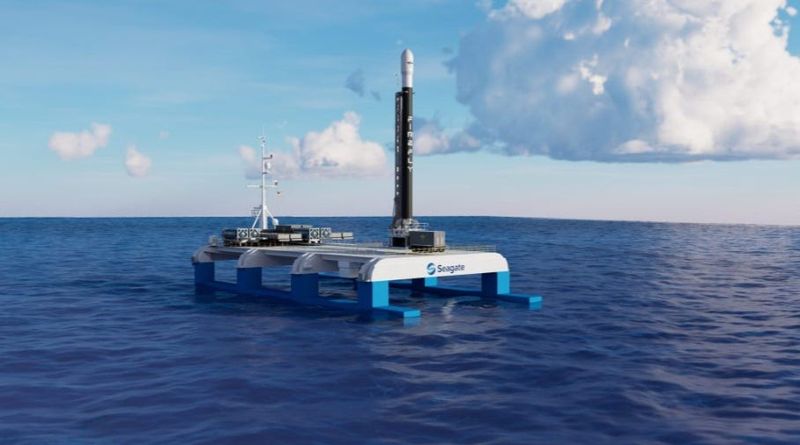
Within days, prototype construction work should begin on Seagate Space’s floating platforms that may someday launch Firefly Aerospace and Vaya Space rockets skyward off the Florida coastline.
While SpaceX and Blue Origin deploy ships that serve as offshore landing platforms for rocket boosters, Seagate Space aims to launch rockets from sea. Co-founder and CEO Michael Anderson said his early-stage company’s strategy will serve as a “pressure relief valve” of Florida-shored alternative launch sites as Cape Canaveral rocket traffic continues to increase.

On Tuesday, June 2, the Space Florida board of directors approved a $270,000 Seagate Space equipment purchase agreement to help construct a prototype module at Port Tampa Bay. This “building block” of a launch-ship ballast system will help lead to a full-scale “proof of concept” mission, per the board presentation.
Founded in 2025, Seagate Space is based out of spARK Labs by ARK Invest in St. Petersburg. Anderson said this module is a test-bed version of a ballast unit that will lie underwater in one of the pontoons, housing pumps and electrical controls engineered to offset wave motion during launch.
He said he hopes Tampa crews start cutting steel within a week or two, finish the structure in 30 to 45 days and complete the project in less than 90 days. Best-case scenario, he said Seagate Space’s inaugural offshore launch may occur toward the end of 2027 or early 2028.
“We’ve got to get this one done so we can go build a full ship. We have a number of deals in the pipeline that we’re negotiating on,” Anderson said.
As part of the $270,000 agreement, the company committed to assemble its advanced-hardware infrastructure, demonstrate its technical capabilities, and maintain its main business operations in Florida for at least the next five years, Space Florida Interim Chief Investment Officer Ronald Lau said.
Seagate, Firefly to develop Alpha rocket launch platform
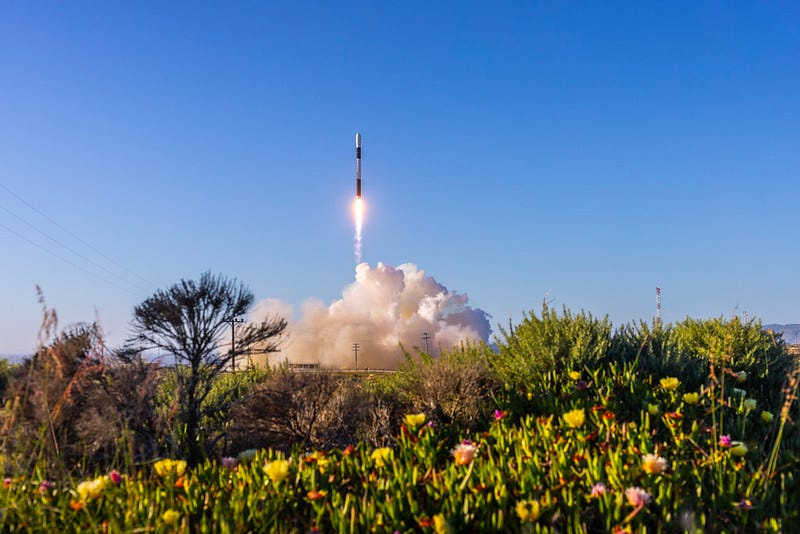
In April, Seagate Space entered an agreement with Texas-based Firefly Aerospace to develop an offshore launch platform for the company’s liquid-fueled Alpha rocket. Standing 96½ feet tall — or nearly half the height of a SpaceX Falcon 9 — this two-stage rocket is engineered to launch nearly 2,300 pounds of payload into low-Earth orbit.
“Firefly is committed to advancing global responsive launch capabilities for our nation and our allies, and partnering with Seagate Space gives us an advantage in delivering resilient, deployable offshore capabilities,” Adam Oakes, Firefly vice president of launch, said in a press release.
“Seagate’s offshore platform aligns with Firefly’s rapid-launch philosophy and allows us to access additional orbits and mission profiles previously out of reach for our government and commercial customers,” Oakes said.
Anderson said launch-platform ships will be made of modules resembling the size and shape of 40-foot shipping containers — or “built to go into a 40-foot shipping container.” That way, they can be prefabricated inland and transported via truck, rail or sea to waterfront sites for assembly. He said the company’s first launch platform will require about 25 shipping containers’ worth of modules.
“So that lets us scale up, scale down, serve larger rockets like Alpha, do smaller rockets like some of the other partners that we’re working with — or even suborbital applications — without completely redesigning the asset,” Anderson said.
“It works pretty well with this industry, which is new and evolving and figuring out how to interface with maritime assets. If we would just put all our chips into one single ship design, it would be very difficult for us to be that nimble,” he said.
Seagate also partnering with Cocoa-based Vaya Space
In another partnership announced in November 2025, Vaya Space and Seagate Space have agreed to pursue offshore launches of Vaya’s Dauntless hybrid-engine rocket.
Vaya Space and Phantom Space are slated to share Launch Complex 13 at Cape Canaveral Space Force Station.
“Launching Dauntless from sea expands our ability to deliver mission-optimized orbits and complements our operations at Launch Complex 13 by giving customers even more ways to get to space,” Vaya Space CEO Kevin Lowdermilk said in a press release announcing the Seagate Space partnership.
“This expansion into the Gulf also opens up access to sun-synchronous orbit access for small satellite missions, increasing flexibility in both launch schedule and orbital targeting,” Lowdermilk said.
In terms of upcoming demand, Col. Brian Chatman, who commands Space Launch Delta 45, told FLORIDA TODAY the Cape might host upwards of 500 launches per year by 2035.
In record-breaking fashion, five different types of orbital rockets by SpaceX, NASA, United Launch Alliance and Blue Origin launched in April from Florida’s Space Coast.
For the latest news from Cape Canaveral Space Force Station and NASA’s Kennedy Space Center, visit floridatoday.com/space. Another easy way: Click here to sign up for our weekly 321 Launch space newsletter.
Rick Neale is a Space Reporter at FLORIDA TODAY, where he has covered news since 2004. Contact Neale at Rneale@floridatoday.com. Twitter/X: @RickNeale1
Space is important to us, and that’s why we’re working to bring you top coverage of the industry and Florida launches. Journalism like this takes time and resources. Please support it with a subscription here.
This article originally appeared on Florida Today: Tampa space company to build floating launchpads for Firefly, Vaya rockets
Reporting by Rick Neale, Florida Today / Florida Today
USA TODAY Network via Reuters Connect