As the weather gets warmer, and admittedly it has gotten hot fast, as is usually the case here in Northeast Florida and Southeast Georgia, our thoughts turn to getting outside and enjoying nature. One of the things many people enjoy is exploring our beaches to see what they can find.
Along with the vast amounts of wind, surf and sand, the beaches also hold a variety of marine life. There are the sand fleas, the surf clams or coquina, all the fish and bird species that call the area home, and there is also evidence of past marine life, sharks, that left their teeth behind for us to find.

Where and when we find shark teeth depends on several factors, both modern and ancient. Shark teeth accumulate on certain beaches depending on their geologic history, the coastal erosion in the vicinity and a set of complex ocean hydrodynamics. While sharks naturally shed thousands of teeth in their lifetimes, they only collect in high numbers when these forces combine to concentrate them.
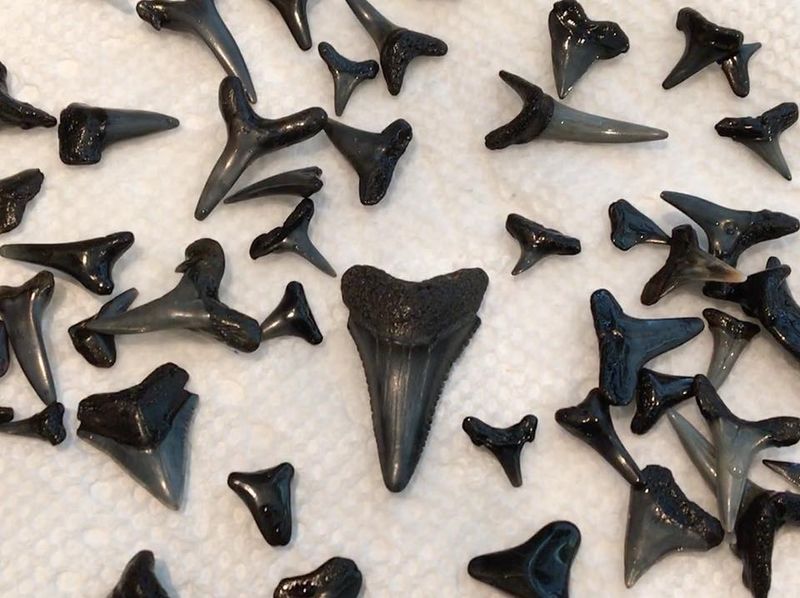
Most shark teeth found on beaches today are not recently lost modern teeth which are white and rarely found, but they are dark, often black, or brown, and are the fossilized remains that are anywhere from 10,000 to 20 million years old.
Millions of years ago, areas like Florida, Southeast Georgia and the coastal Carolinas were submerged under warm, shallow prehistoric seas teeming with sharks. When these sharks died, their cartilaginous skeletons disintegrated (remember that sharks do not have calcified bones), while their dense teeth settled to the ocean floor where some fossilized.
The process where shark teeth are fossilized takes a minimum of 10,000 years and occurs when the tooth absorbs minerals and becomes heavy and dense. Fossilized shark teeth can tell you much about where they originated based on their color. When phosphate replaces the original material, the teeth commonly turn black or gray. If the area is rich in iron, the teeth can take on more earthy tones like red, orange or brown. Manganese can cause a more striking blue, purple or tan coloration, while silica or calcite will appear as areas of white or translucent minerals that sometimes fill the pore spaces.
Beaches with a massive collection of teeth are typically adjacent to areas where these teeth were deposited. In Northeast Florida, beaches like Amelia Island and Ponte Vedra Beach are prime spots for finding shark teeth. In Southeast Georgia, the best places to find shark teeth are Jekyll Island, Tybee Island and spoil islands along the Savannah River.
Water acts as a natural excavator and sediment conveyer. Waves and tides constantly erode underwater sedimentary rocks and coastal cliffs, breaking them down and releasing the trapped fossils. Strong storms and rough surf aggressively churn up the ocean floor, pulling deeply buried teeth out of the sediment and pushing them toward the shore. That process has been occurring for millions of years, so many of the teeth were deposited long ago.
Beaches have been characterized as a river of sand. The ocean currents and wave action function like a conveyor belt, using currents to sort and drop sediment along with anything mixed into the sand depending on its weight and shape along the beach face. The gentle slopes and specific wave patterns on certain beaches allow the water to carry these heavy teeth forward but lack the strength to wash them back out to sea, trapping them on the beach.
Today, human activity plays a huge role too, with beach nourishment projects moving sand onto eroding shorelines, accidentally delivering thousands of buried prehistoric teeth directly to the beach. If you can find an area where the pipe delivering the sand onto the beach was located, you have a much greater chance to find larger shark teeth.
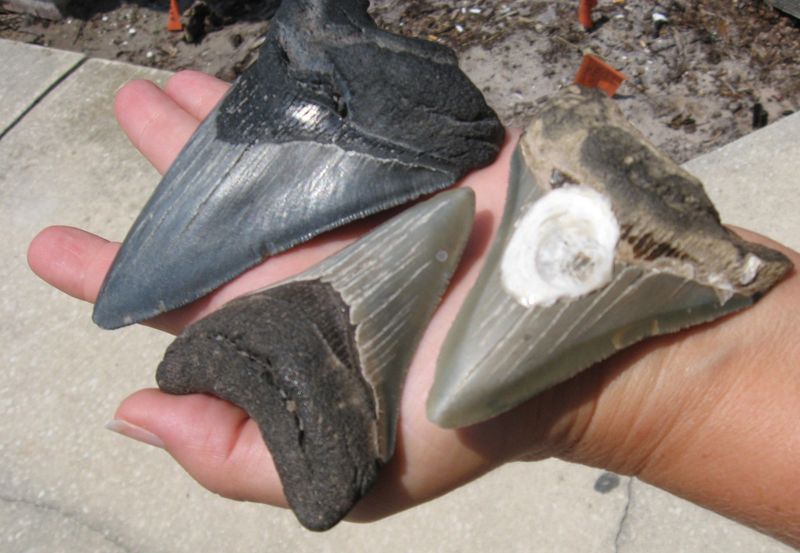
And while smaller shark teeth are relatively common, and easier to find with some experience and training on how to spot them, you can find large, intact megalodon teeth that are a rare treasure. Most well-preserved megalodon teeth are found in coastal riverbeds, and may require scuba diving where the conditions better protect fossils from the effects of erosion. I once found a nice megalodon tooth while scuba diving in the Santee River in South Carolina.
For most of us, the best time to hunt for shark teeth is at low tide, immediately following a storm with strong coastal winds. Scan the shell deposits right at the water line, looking for small, shiny black triangles that contrast with the tan sand. Once you catch on to what to look for, it is surprising how many you can find.
Glad you asked River Life
My 6-year-old grandson recently asked me over dinner about why there are so many species of fish. I tried to explain that fish are the most diverse group of vertebrates because they evolved over millions and millions of years and inhabit the ocean, which is 70% of the Earth’s surface.
This immense amount of evolutionary time and the extremely diverse and expansive habitat resulted in countless unique ecological niches or roles for each species to occupy. I am not sure he fully understood the concept of time and niches, but he nodded and moved on. He is like most people in that we have difficulty understanding large numbers, especially when it comes to eons of time, enormous amounts of money and endless possibilities. But we try.
River Life runs the first Tuesday of each month in The Florida Times-Union. Email Quinton White, professor emeritus and former executive director of Jacksonville University’s Marine Science Research Institute, with questions about our waterways at qwhite@ju.edu. For more on the MSRI, visit ju.edu/msri.
This article originally appeared on Florida Times-Union: Shark teeth you find on the beach are 10,000 to 20 million years old
Reporting by Quinton White, Special to Jacksonville Florida Times-Union USA TODAY NETWORK / Florida Times-Union
USA TODAY Network via Reuters Connect