When I was in elementary school in New York many years ago, a springtime carnival on the playground featured music-syncopated cakewalks: Children promenaded in a circle over numbers chalked on the asphalt and when the music stopped, the adult-emcee drew a number and if you happened to be standing on that number, you won a cake baked by one of the moms active in school functions.

These cakewalks, fondly remembered by many from childhood school days in various parts of the country, are very different from the cakewalks that entertained Gilded Age hotel guests in Palm Beach.
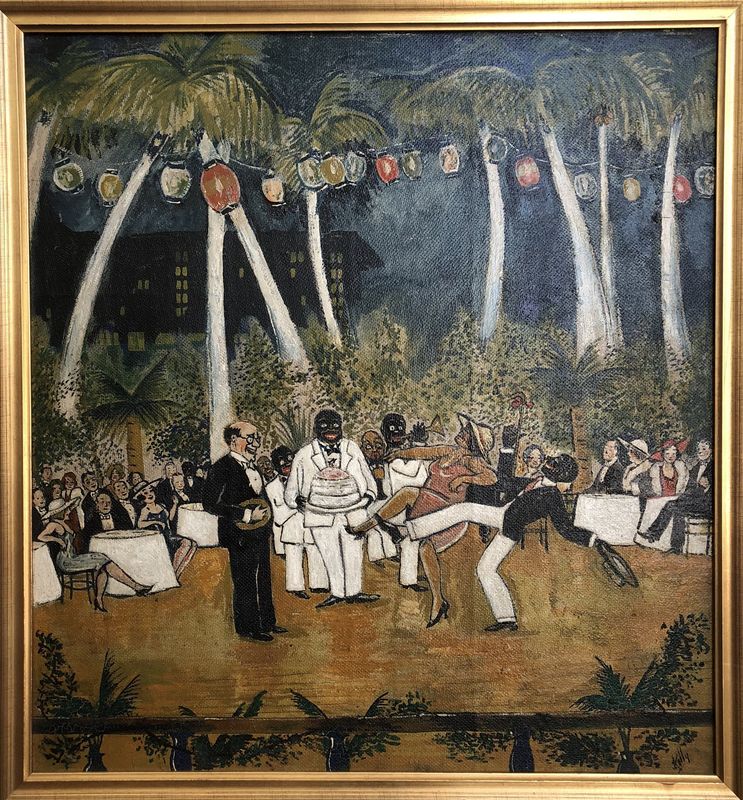
Black employees — waiters, laundresses and others — at a grand and now-gone 1890s-built lakefront resort-hotel just west of The Breakers — performed a couples’ promenade-style dance with a little strutting and prancing to heighten the drama.
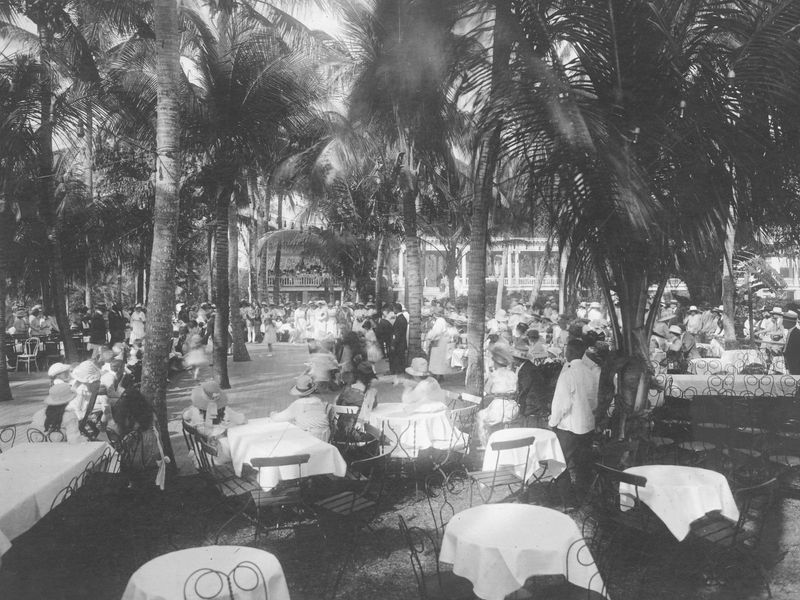
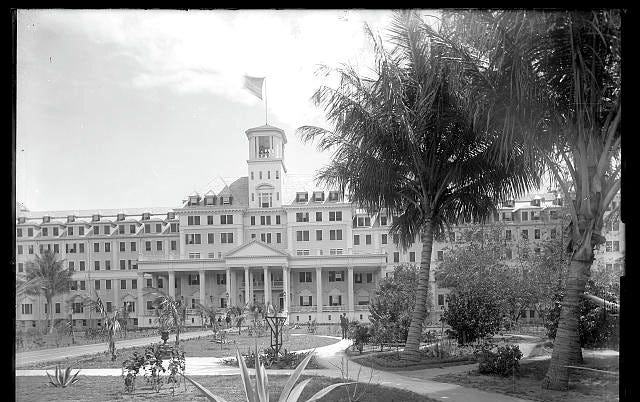
They did so once a week in an al fresco grove of coconut palm trees at the gargantuan amenity-rich 1894-built Hotel Royal Poinciana, which at one point included more than 1,000 rooms as part of what was deemed the largest wooden structure in the world.
For all of the activities offered at the Royal Poinciana — tennis, tea dances, fine dining and golf on an 1897 course shared with sister-hotel The Breakers — wealthy guests, including Astors and Vanderbilts, were said to be particular fond of cakewalks (John Jacob Astor reportedly once tried to do it himself).
After all, observers then noted, on a barrier island still largely undeveloped during the Gilded Age — Palm Beach then consisted largely of swamp and dense virgin landscape between the Atlantic Ocean and a pristine lake then-teeming with fish — there was “an odd charm to this open-air function of cakewalks.”
On warm moonlit evenings far away from the industrializing cities from where the socially and financially elite hotel guests hailed, “the coconut palms hung with colored lights as a thousand spectators were around the flooring on the lawn — most of the men in straw hats and dinner coats and the women, hatless, in elaborate evening gowns,” a local reporter described the scene of a cakewalk in 1903.
That same year, the New York Times called cakewalks in Palm Beach “among the most characteristic and picturesque” of affairs.
In an oral history recorded in the 1960s by the Historical Society of Palm Beach County, a longtime local who helmed a haberdashery with locations including shop at the Royal Poinciana said one of the chief reasons why the hotel became renowned was “that famous Cakewalk.”
The Royal Poinciana was razed in phases in the mid-1930s in the wake of a devastating 1928 hurricane and changing vacationing tastes among the wealthy seeking private residences for their winter getaways.
At each cakewalk at the hotel, a winning strut-dancing couple was awarded a cake; sometimes tips and cash prizes were given, according to the Historical Society of Palm Beach County.
Prizes or no prizes, officials at the Palm Beach museum that bears the Hotel Royal Poinciana founder’s name are not fans of these cakewalks.
“While cakewalks were once part of social life in early Palm Beach, their history is rooted in racial stereotypes and inequities that we unequivocally reject,” said Ben Hillman, director of external affairs at the Flagler Museum, centered around the former marble-pillared Palm Beach mansion built and once inhabited by famed Florida developed Henry Flagler and his third wife, Mary Lily Kenan Flagler.
“Though once viewed as entertainment, this is not an aspect of the community’s past we celebrate,” Hillman told the Palm Beach Daily News.
The Royal Poinciana and The Breakers were built (in 1894 and 1896, respectively) by Flagler, a Standard Oil partner and Florida developer who helped transform the state’s east coast by extending railroad service — all the way south to Key West — and building a string of resort hotels attracting visitors once leery of a wild and sparsely populated place that equaled a million-miles-away Florida.
What Flagler thought about cakewalks is unclear, but the management of his hotels evidently viewed them as beneficial for business.
Cakewalks can be traced back to the quarters for enslaved people in the South, where a strut-dance, of sorts — augmented by African dance movements — grew out of imitating the pompous mannerisms of plantation owners and their families, according to the National Museum of American History and other sources.
Evidently misunderstanding the meaning of this dance, plantation owners began requiring their enslaved adults to perform it for their guests at social affairs, where cakes sometimes were awarded.
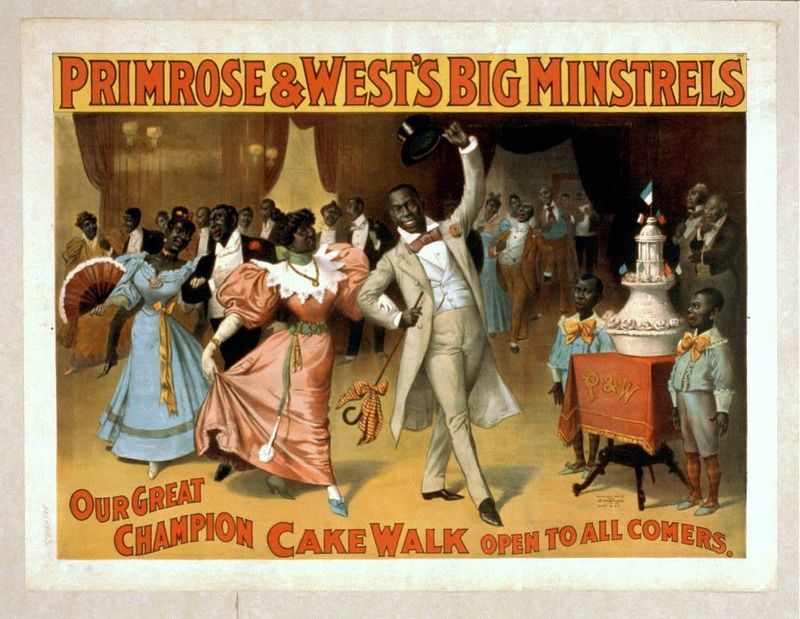
Later, white vaudevillians in blackface imitated the high-stepping dance and promenading, which by them was known as cakewalking.
“This whole dance and culture eventually was appropriated by white people,” said Marvin Dunn, a historian and Florida International University professor emeritus who has written extensively about the history of African Americans in South Florida.
“The sad thing about all of this is a Black source of culture became a source of entertainment that white people didn’t understand and it was turned into something that had nothing to do with how it began,” he said.
By 1900, a national cakewalk competition was being held at Madison Square Garden in New York: “Forty-nine negro couples competed for the championship at the annual cakewalk of the National Ethiopian Amusement Company last night,” the New York Times then reported. “For nearly three hours, the contestants pranced and glided about the arena with every kind of step, graceful and otherwise, that the ingenuity of cakewalkers could invent…”
By that time, cakewalks had become one of the star attractions in Palm Beach at the Royal Poinciana, but years before that, they entertained guests at the first Florida hotel Flagler developed, according to Charles A. Tingley, longtime senior research librarian and archivist at the St. Augustine Historical Society.
He refers inquiries about cakewalks at Flagler’s 1888-debuted Hotel Ponce de Leon in St. Augustine to a “good discussion” about them found in a 2022-published history book by Thomas H. Graham.
At the Ponce de Leon (now the centerpiece of Flagler College) with its stunning and voluminous rotunda, grand dining room, parlors and many other spaces, cakewalks began after bellhops at the hotel organized one in 1888 as a fundraiser for their fraternal organization, Graham, a history professor emeritus at Flagler College, writes.
Cakewalks at the time had long been a fixture in southern resort society, “a sort of anthropological venture into the world of African American folkways for upper-class northern visitors,” he notes. That said, cakewalks, he writes, “pandered to racial stereotypes.”
Said Dunn, the Florida International University professor emeritus, “Maybe cakewalks were a way for employees to make extra tips and maybe that was helpful, but that doesn’t make it right,” he said.
At the Royal Poinciana — and even periodically at The Breakers — cakewalks continued to around 1932, according to contemporaneous news reports, with some affairs referred to as “Old Plantation Nite.”
“Never were the darkies in better form, never was the season’s music more entrancing, and never have these well-known entertainers provided a better spectacle than at last evening’s cakewalk, when several hundred people applauded,” The Palm Beach Post noted in 1920.
In 1930, “a large throng of guests…assembled last evening in the Cocoanut Grove to watch the delight of the cakewalk staged by the maids and waiters of the Poinciana,” the newspaper reported. “For years, these unique and typically Palm Beach entertainments have been highlights on the resort’s pleasure calendar and no memories are more enjoyed when guests return north…”
This article originally appeared on Palm Beach Daily News: Palm Beach guests once enjoyed cakewalks, a dance built on stereotypes
Reporting by M.M. Cloutier, Special to Palm Beach Daily News / Palm Beach Daily News
USA TODAY Network via Reuters Connect