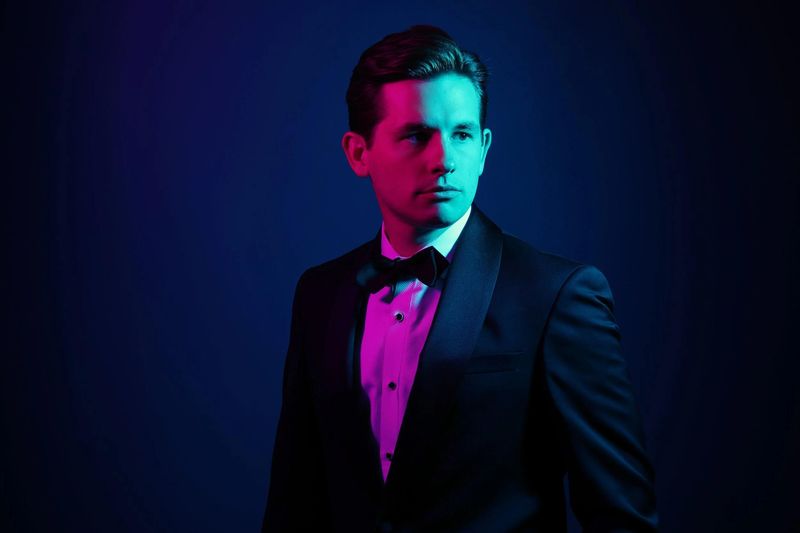
June 11 marks the centennial of the famous American opera composer Carlisle Floyd. Across the country, his work is being revisited, and at the center of these efforts are the Florida State University College of Music choirs and FSU College of Music alum Christopher James Ray.
Tallahassee was home to Carlisle Floyd, who taught at FSU for many years and premiered here what some consider his magnum opus, “Susannah.” Floyd died in Tallahassee on Sept. 30, 2021, at the age of 95.

Ray became connected to Floyd through his time at FSU and developed a close mentorship with him, working through his scores in detail. Soon after, Floyd’s niece invited Ray to travel with him as his musical assistant, a role he held for nearly five years, beginning with “Of Mice and Men” in Sarasota.
In a tribute to the Father of American Opera, Ray will conduct a celebratory Carlisle Floyd at 100 concert at Carnegie Hall on June 20, while also helping coordinate centennial activity nationwide.
The journey to conducting
Christopher James Ray’s journey to becoming a conductor began in college. He is originally from Sumrall, Mississippi, where he did his undergraduate work in piano at Mississippi College. His dream to become a conductor “started when my college choir took a trip to New York City, and I saw a show at the Met,” Ray said.
After, he began attending the Live from the Met broadcasts when he was back in Mississippi. Yet, it was after seeing Patricia Racette in “Madame Butterfly” that the course of his life changed. “I knew I had to work in opera,” he says. “Through my organ teacher at Mississippi College, I started working as a rehearsal pianist at Mississippi Opera.” During this time, highly acclaimed Juilliard-trained American opera conductor and educator William Boggs came to his college as a guest conductor.
“I watched him work and thought, that’s the job I want.” It led Ray to ask Boggs for advice on how to become a conductor. “And here we are.”
When a visiting professor from FSU, Dr. Kristen Johnson Gunn, came to teach voice at Mississippi College, she advised him of a program at FSU specifically focused on opera. That appealed to Christopher, who would later apply and eventually earn a master’s in opera conducting at FSU.
The art of conducting
Ray’s passion for conducting opera would lead him to become involved in music in a number of ways. He has worked as a conductor for opera and orchestra, a producer for concerts and opera, an organist at churches, and more.
And when it comes to teaching, Ray’s methods are to always begin with the musical side. “Phrasing, color, intention, expression,” he says. “Many technical problems resolve themselves naturally once the music is flowing in the right direction.”
Yet the “real flow state” experienced by a conductor is only one part of the twofold that is Ray’s favorite element: the art of conducting itself. “First, [there is] firing on all cylinders,” says Ray. “In the opera pit, there are so many moving parts and anything can happen.”
Ray elaborates on what a conductor experiences. They are present, attentively listening, observing, proactively engaging, and responding. The conductor effectively conveys multiple things in sync, tailoring messages to different groups of musicians in real time.
The second art of conducting is the connection that occurs in a symphonic setting, “looking at the players, moving almost as one organism, communicating deeply without saying a word.”
There are elements one may not realize go into the art of conducting. “All the networking and fundraising,” Ray explains. “Gigs tend to come from your network, and often you have to help find financial support for projects you’re interested in.”
Ray has built an undeniable network, including countless student ensembles during his time at FSU.
“Since then, I’ve worked as an assistant at the Bayreuth Festival, San Francisco Symphony, Staatsorchester Hamburg, San Diego Symphony, among others.” Ray has also conducted at Opera San José, San Francisco Symphony Soundbox, Vermont Symphony, Opera Las Vegas, with upcoming performances at Des Moines Metro Opera and, of course, Carnegie Hall.
The flow state of Florida State’s College of Music
The concert at Carnegie Hall will be a grand celebration of Carlisle Floyd featuring the FSU College of Music choirs alongside acclaimed alums. It will be a time for audiences to hear Floyd’s most beloved works alongside rarely performed gems, including tributes to Floyd’s life and legacy, video projections, and more. It’s a time to go out and wear something fun. “Black tie is optional, but style is not.”
The evening is a full-circle event for Ray in light of his connection to Floyd, who shaped Ray’s entire approach to music-making. “[His] influence on my life is total; personal, musical, and professional,” Ray said. “He helped me find my own voice as an artist at a time when I was still searching for it. And in a very real sense, he gave me my place in the music world.”
Ray is quick to expand on how Floyd’s influence on music is equally profound. “He mentored generations of composers, singers, directors, and conductors,” Ray said. He elaborates that Floyd helped build the very institutions that sustain American opera today, from the National Endowment for the Arts (NEA) to Opera America.
“From regional opera companies to university programs and young artist training programs,” Ray said. “He gave artists permission to write and create in their own voice. Even if it isn’t the most popular way, it may be the most enduring.”
And that legacy continues at Florida State University’s College of Music every day. The mentorship between professors and students. The way alums stay in touch through networking and programming that Ray says is vital to his career. It’s what led him to even learn of the program at FSU in the first place.
The flow state of music that shapes Ray’s conducting is the very flow state built into the composition that is FSU’s College of Music. And whether you travel to Carnegie Hall or stay home for the summer, there is a musical event ready for you to go out and be an equal, vital part of the music: the audience.
If you go
Florida State University’s College of Music events this summer:
Florida State Opera presents: Muhly’s Dark Sisters, 7:30 p.m. May 29-May 30, Opperman Music Hall. Tickets $10-$20.
A Grand Concert Honoring the Father of American Opera Carlisle Floyd, 8 p.m. June 20, 2026, Carnegie Hall, 57th St. and 7th Ave., New York, NY. Tickets: $30 – $200. Visit carlislefloyd.org/carnegie.
Summer Chorale Concert, 7 p.m. July 23, Ruby DIamond Concert Hall. Free.
Details: music.fsu.edu/events/calendar/
Samantha Sumler is the Marketing & Communications Manager for the Council on Culture & Arts. COCA is the capital area’s umbrella agency for arts and culture.
(This story was updated to correct an inaccuracy. Carlisle Floyd was born on June 11, 2026. An earlier version of the story mentioned June 12 as the centennial.)
This article originally appeared on Tallahassee Democrat: ‘Total influence’ of Carlisle Floyd takes FSU alum to Carnegie Hall
Reporting by Samantha Sumler, Council on Culture & Arts / Tallahassee Democrat
USA TODAY Network via Reuters Connect