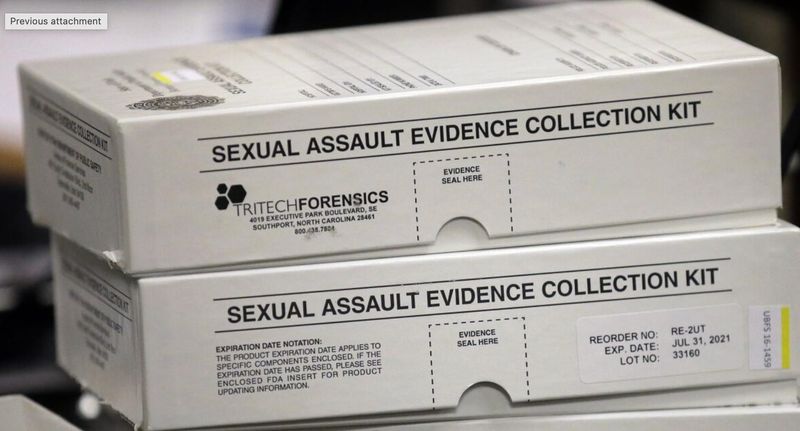
Emily Reber, with the Ventura County District Attorney’s Office, knows all too well that testing decades-old sexual assault kits often involves heartbreak.
Although modern DNA technology can identify suspects, some cases still cannot be prosecuted because the statute of limitations has expired or the offender died before being held accountable.

That’s why the lead prosecutor on the Ventura County Sexual Assault Kit Initiative — a collaborative effort between the DA’s office and Ventura County Sheriff’s Office to process every untested sexual assault kit in the county — believes it’s important to recognize accomplishments along the way, especially when those accomplishments result in long-awaited answers for survivors.
This month, the team reached a milestone by testing more than 2,000 of the 2,846 inventoried kits countywide using advanced DNA testing. The kits dated as far back as 1979.
“People were victimized in a really horrific way, and we’re able to solve their case and find the person who did this to them,” Reber said. “At the end of the day, to be able to let that victim know what happened and that they were believed is extremely rewarding.”
The initiative has been made possible by two, $2.5 million grants from the U.S. Department of Justice, the first received in 2021 and the second in 2023.
The team began by cataloging all untested kits from each law enforcement agency in the county. The kits may include hair strands, nail clippings or swabs from a victim’s body.
Some were previously tested for blood type or the presence of sperm using the technology available at the time. Others were never submitted for testing because police already identified the suspect, the victim knew the suspect, the victim did not want to press charges or there was insufficient evidence to prove the incident was not consensual.
Staff at the sheriff’s office’s crime lab then prepares the kits and sends them to a private lab, usually Virginia-based Bode Technology, for testing.
The private lab determines whether any offender DNA is present in a kit and, if it is present, generates a DNA profile and sends it back to Ventura County for review.
If the DNA profile meets all necessary criteria, then local staff upload the profile to a federal database called the Combined DNA Index System.
So far, staff have uploaded 923 DNA profiles to CODIS, generating 329 hits connected to potential suspects or linked cases.
As a result, Reber said, the team has investigated and closed 125 cases. This includes confirming the integrity of 33 previous convictions and overturning one wrongful conviction, she said.
“We’re always double-checking to make sure that the testing that comes on cases with convictions is accurate, and while none of us hope that there are any exonerations, the most important thing is the truth,” Reber said.
In some of the now-closed cases, the statute of limitations has already expired or the suspect has died. Reber said those are among the routine disappointments of investigating cold cases but the answers are still just as important.
“We really want to serve our victims and the community as best we can, whether that case can be prosecuted or not,” she said.
Of the 125 closed cases, 21 victims were notified that their cases were solved. Sometimes the victim has died or does not wish to pursue prosecution.
Reber meets with Yumi Kirk and Michael McManama, district attorney investigators, and victim advocate Destiny Sao to discuss whether it is appropriate to notify the victim and how to do so in a way that minimizes the retraumatization that is inherent in the process. Because of the grant funding, the team is able to immediately offer the victims free counseling services.
Some of the solved cases extend beyond Ventura County.
The testing of a kit from a local 1994 sexual assault identified a suspect who is now facing trial for four sexual assaults in Arizona, while the testing of kits from local 1982 and 1983 sexual assaults linked to four others in Indiana, Michigan and Ohio and identified a suspect who is now deceased, Reber said.
“We are able to help the entire CODIS system by uploading offender DNA that can solve cases from outside jurisdictions, so those things feel very big and influential, which is more than I could ever have imagined in my career,” she said.
Outside of testing the inventoried kits, the team assists local law enforcement agencies with other unsolved sexual assault cases, which has resulted in seven arrests and five convictions.
Three years after the first group of kits were sent to the private crime lab, just over 800 still need to be tested. The most recent Department of Justice grant, however, expires in September.
The team applied for an additional grant from the agency last fall and is waiting to hear back because they know that every kit represents an individual whose justice has been delayed.
Makena Huey is an investigative and watchdog reporter for the Ventura County Star. Reach her at makena.huey@vcstar.com. This story was made possible by a grant from the Ventura County Community Foundation’s Fund to Support Local Journalism.
This article originally appeared on Ventura County Star: County tests 2K sexual assault kits for DNA, some decades old
Reporting by Makena Huey, Ventura County Star / Ventura County Star
USA TODAY Network via Reuters Connect