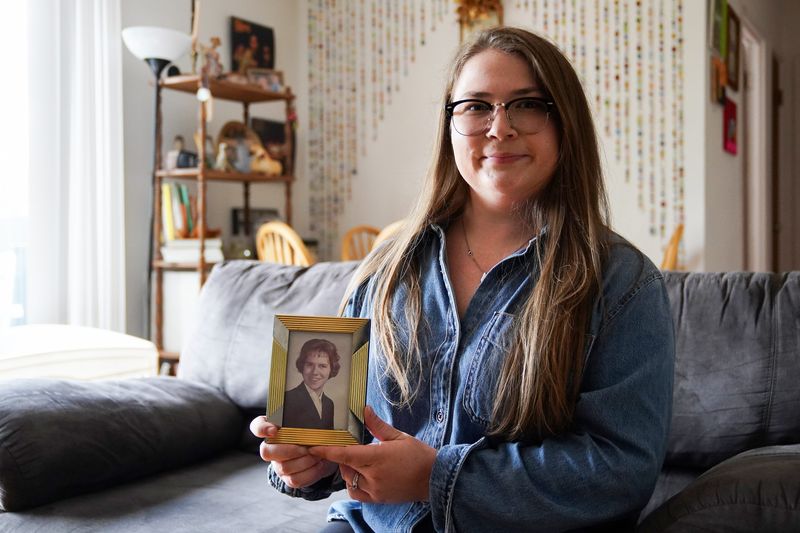
When Alycia Randazzo opened an email in March from the Galveston Police Department, she was surprised by what it contained: a trove of police reports detailing the investigation into her great-aunt’s unsolved homicide.
The revelations, a response to Randazzo’s public records request filed six weeks earlier, were the first answers she had about the killing of a family member she never knew, but whose tragic demise quietly loomed over her Northern Kentucky family for 56 years.

“This is a trauma that everybody in the family has to deal with and it’s just kind of been … like a big cloud in the room,” Randazzo told The Enquirer. She said that her great-aunt’s death was seldom a topic of discussion until recently.
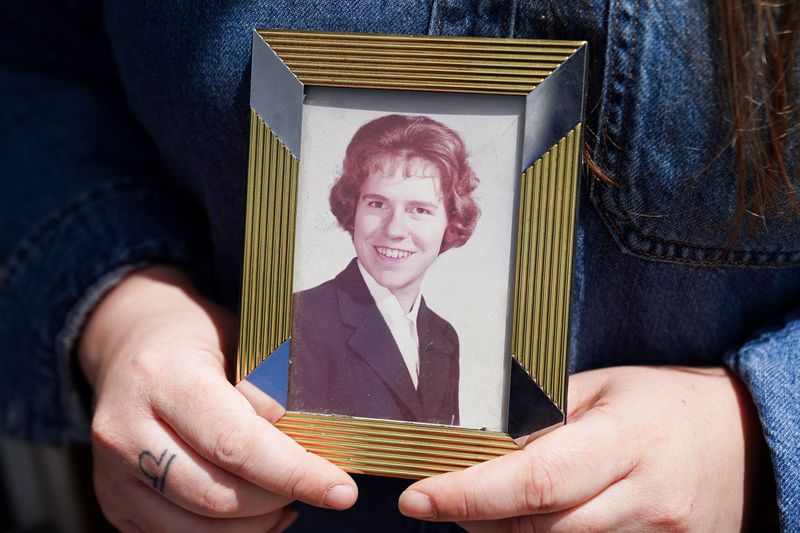
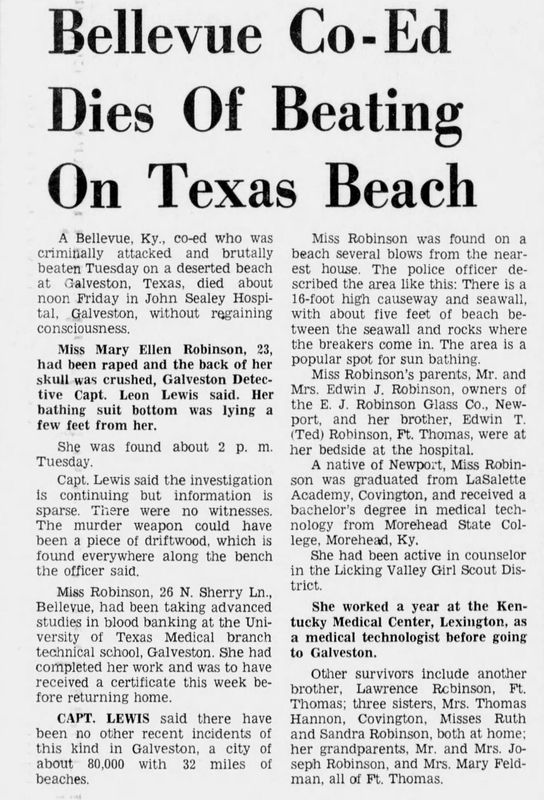
Mary Ellen Robinson was 23 years old when she was raped, beaten and left for dead on a Galveston, Texas, beach on May 12, 1970.
Robinson, of Bellevue, was studying blood banking technology at the University of Texas. She completed the program and planned to attend Ohio State University for graduate studies when she died of her injuries at the John Sealy Hospital, where she worked in the blood bank.
Her killer was never caught.
Authorities identified several people of interest during the investigation but never gathered enough evidence to charge anyone, police reports shared with The Enquirer show. The investigation stalled shortly after, and decades passed without new evidence pointing to who killed Robinson or why.
What little physical evidence investigators collected at the time was lost to natural disasters, according to Galveston Police Department spokesman Kurt Koopmann.
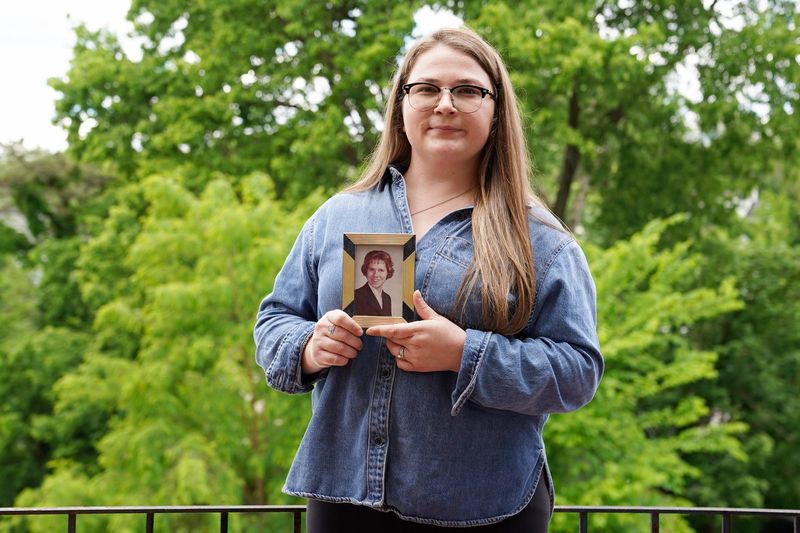
More than half a century after the crime, Randazzo made it her mission to uncover answers about Robinson’s killing. She’s requested public documents, asked questions of law enforcement and shared the story with reporters in Texas. While she and her family hope that someone will be held accountable, Randazzo’s priority is keeping her great-aunt’s story alive.
“The odds of us solving this are pretty low,” Randazzo said, “but the odds of us remembering this a little bit more are higher.”
Lack of evidence stymied efforts to solve NKY woman’s killing
It was a sunny, clear afternoon when police were called to West Beach, just 25 feet from Galveston city limits.
When officers arrived at the beach to investigate, according to the reports, they found Robinson lying on the sand with severe head injuries, unconscious and partly unclothed. Despite evidence that suggests she was viciously attacked, investigators said there was no indication of a struggle and no noticeable footprints in the sand.
Her condition was so grave that she wasn’t able to speak to the police. She died three days later from injuries caused by blunt force trauma. Investigators also noted signs of sexual assault.
With few clues left at the scene, a lack of fingerprints or other trace evidence and no witnesses to what happened, detectives focused their inquiry on suspicious circumstances surrounding the young woman’s death.
Robinson and her roommate were packing up their apartment, as she intended to return to Northern Kentucky before continuing her studies, according to the reports. She told her roommate that she wanted to visit the beach to get some sun if it was a nice day. She enjoyed swimming and collecting seashells, and sometimes visited West Beach to avoid the large crowds at other beaches.
The roommate described Robinson as a reserved, studious person who wasn’t overly friendly with strangers.
Among the evidence investigators gathered at the scene were four Coca-Cola bottles, indicating that someone was with Robinson on the beach. She was known to buy the soft drink, but never more than two bottles at a time, her roommate told police. There was no evidence that Robinson planned to meet with anyone.
At one point, investigators thought that one of those bottles might have been used in the assault, but the records don’t indicate that police ever found the murder weapon. A Galveston police captain told The Enquirer shortly after Robinson’s death that the killer could have used a piece of driftwood, which was scattered along the beach.
Investigators soon began zeroing in on several possible suspects, including those in the area at the time, people who might’ve known her from the blood bank and even a caretaker at her apartment building. They interviewed those persons of interest and conducted lie detector tests, but none admitted to the crime, and there wasn’t enough incriminating evidence to file charges.
Just over a week after the investigation began, the police reports show, a detective requested that the case be listed as inactive, citing a lack of witnesses and evidence left at the scene.
“I have exhausted all means to solve this case,” the detective wrote.
One piece of evidence remains missing: a white gold Hamilton wristwatch that Robison’s family gifted her as a high school graduation present.
She wasn’t wearing it when first responders found her. It also wasn’t found at her apartment, in her car or among her personal belongings at the beach. The roommate told police Robinson wore the watch everywhere.
Recent developments seen in Galveston-area cold cases
Koopmann, the Galveston police spokesman, said in an email that Robinson’s death is not actively under investigation due to a lack of leads and physical evidence. He added that new information could reopen the case at any point.
The recent arrest of 61-year-old James Dolphs Elmore Jr. in connection with the deaths of two people found in an area near Galveston dubbed the “Texas Killing Fields” garnered national media attention. The police department also announced that investigators solved the 1981 killing of a 22-year-old woman who was beaten and sexually assaulted.
In emails between Randazzo and Galveston police officers, it appears the department is once again taking note of Robinson’s killing; however, they’ve acknowledged the lack of physical evidence presents a challenge.
Advances in forensic technology, such as the use of third-party genetic genealogy services for DNA comparison, have become instrumental in closing cold cases with intact evidence, but such techniques aren’t the only way to solve decades-old homicides, said Camela Hughes, director of the Cold Case Analysis Center at the University at Albany.
She said that more indirect evidence based on the circumstances surrounding a crime is often used to identify and prosecute suspects in cold cases, though modern juries typically expect forensic evidence like cellphone data and DNA.
However, time is perhaps the most persistent challenge in solving and proving a case.
As time passes, Hughes said, there’s a greater likelihood of losing evidence to natural disasters, fires and storage mishaps, as happened in Robinson’s case. Investigators and eyewitnesses may no longer be alive to testify, she added, but even if only a few years pass, witnesses’ recollections quickly fade.
“What we know about eyewitnesses is they’re not very reliable, even directly after a crime has occurred,” Hughes said. “But boy, given time, they’re even less reliable.”
NKY family connects over search for answers
Randazzo said her mom’s side of the family never really talked about what happened to Robinson. She didn’t even know that her grandfather had another sister until she started researching her genealogy online.
She started asking about Robinson and learned that her grandfather was newly married and her mom had just been born when her great-aunt died. The revelation gave Randazzo a new perspective on her grandfather, whom she described as quiet.
“That changes who you are as a person, so it really reframed a lot of things in my mind,” she said. “It made him make a lot more sense.”
Robinson’s killing remained in the back of Randazzo’s mind since she first learned of her great-aunt’s death. It nagged at her when she’d hear about other unsolved cases.
She’d gone back to college for graduate studies and curiosity combined with downtime prompted her to request records about the killing from the police department. She didn’t initially tell her family because she was worried about opening an old wound.
Once she received the digital file of police reports, it dismantled the rest of her day. She called her mom with the news and canceled all of her plans to read through the 70-page file. Her excitement quickly turned to disappointment because of the lack of definitive evidence and the antiquated way investigators talked about Robinson.
She still felt encouraged to gather more information. Since her search for answers began, Randazzo said she’s talking more with extended family and more of her relatives have hung up pictures of Robinson. She said her grandfather doesn’t ask about what she’s uncovered, but he’s finding value in how the family is talking more about what happened.
“I’ll just keep advocating for her,” Randazzo said. “I’m settled in the fact that it’s OK if we don’t figure it out, because life’s bigger than that, her life was bigger than that.”
Anyone with information about Robinson’s death is urged to call the Galveston Police Department at 409-765-3764 or email Investigations@galvestontx.gov.
This article originally appeared on Cincinnati Enquirer: Who killed Mary Ellen Robinson? An unsolved homicide, a quest for answers
Reporting by Quinlan Bentley, Cincinnati Enquirer / Cincinnati Enquirer
USA TODAY Network via Reuters Connect