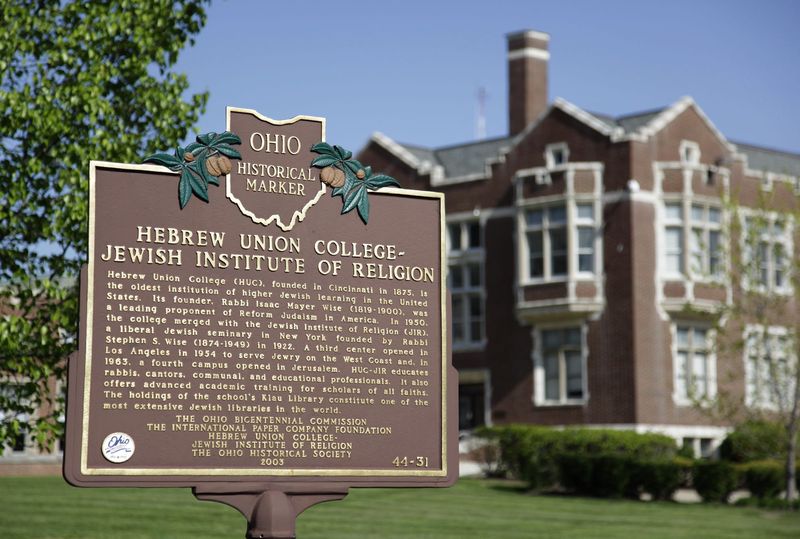
A group of former faculty and board members at Hebrew Union College-Jewish Institute of Religion asked a judge Thursday to consider allowing them to take over the college’s rabbinical school, which recently closed after more than 150 years in Cincinnati.

Calling themselves the College for Contemporary Judaism, the group said in a legal filing in Hamilton County Common Pleas Court that it is ideally suited to reopen HUC’s seminary and run it for years to come.
The new college would, essentially, replace the old one, using its buildings, campus and Klau Library, which is home to rare manuscripts and other sacred Jewish texts.
“We think we could put together the people that we need pretty quickly,” said Andrew Berger, board chairman of the new college and a former board member at HUC. “It is an ideal place for a rabbinical seminary.”
But the legal effort to take over HUC is unusual, and those behind it must overcome several legal hurdles before they can achieve their goal.
One of those potential hurdles is that while HUC closed its rabbinical school in Cincinnati, it continues to operate the campus and still owns the buildings and facilities. HUC officials have said the campus is now used primarily for research and visiting programs.
In its legal filing Thursday, the College of Contemporary Judaism asked to intervene in a lawsuit filed earlier this year by Ohio Attorney General Dave Yost against HUC and its board. Yost’s suit accused HUC of violating Ohio laws that protect the intent of donors who give money or objects to charitable organizations and other private institutions.
If donors intended their gifts to support HUC’s Cincinnati campus, Yost argued, then they must remain in Cincinnati. He said HUC’s board must abide by a consolidation agreement it signed in 1950 that promised to “permanently maintain” campuses in Cincinnati and New York.
“Hebrew Union accepted millions of dollars in donations based on a 76-year-old promise it now would like to break,” Yost said after filing the lawsuit.
But Yost likely can’t force HUC, which also has campuses in New York, Los Angeles and Jerusalem, to operate a rabbinical school it considers too costly to run. The leaders of the College for Contemporary Judaism say they are the solution to that problem.
“Since HUC has now disavowed the core of its Cincinnati-based charitable mission, a new entity must step in to take over those obligations and assets to ensure that they are utilized consistent with their charitable purposes,” the new college’s lawyers wrote in the motion filed Thursday.
“CCJ is ideally situated and firmly committed to doing that.”
Officials at HUC and the attorney general’s office could not immediately be reached to comment.
This latest twist in the court battle over the future of the Cincinnati campus comes about a month after HUC closed the rabbinical school and after years of financial challenges.
When plans to close the rabbinical program were announced in 2022, the college faced a record $8.8 million deficit and rabbinic student enrollment had dropped by 37% over the previous 15 years.
At the time, school officials said the campus would not close, though they did not reveal long-term plans. They said only that the campus would be used to host smaller study sessions and noted that it remains the home of the college’s Klau Library, American Jewish Archives and Skirball Museum.
According to the college’s website, school officials planned to create one national rabbinical school that will not operate in Cincinnati.
Berger said keeping a rabbinical school in Cincinnati is important for both historical and practical reasons. Rabbi Isaac Mayer Wise, the founder of the American Jewish Reform Movement, established HUC in 1875. In the 150 years since, HUC became a hub for the Reform Movement and for training rabbis who served congregations across the country and around the world.
“We think it’s important to have a rabbinical school somewhere in the middle of the country,” Berger said.
He said the College for Contemporary Judaism, which currently has no students or campus, notified the attorney general of its intent to intervene in the case. But he said the two parties are not partners in the litigation.
If the new college ultimately is permitted to take over the rabbinical school, Berger said, it would take some time to recruit faculty and students. But Berger said he’s optimistic that process would move swiftly.
The group behind the effort includes supporters in the community and some big names once associated with HUC, including Rabbi Sally Preisand, the first woman in North America ordained as a rabbi, and Rabbi Gary Zola, an author, professor and former administrator in the now-closed rabbinical school.
Filing the motion to intervene in the attorney general’s case is a first step. At this point, however, the new college and its leaders will have to wait until Yost’s lawsuit is resolved before learning whether they will be able to take over HUC’s rabbinical school.
Common Pleas Judge Christopher Wagner must consider the motion and decide what role, if any, they will play in the case.
This article originally appeared on Cincinnati Enquirer: Former faculty want to take over closed Hebrew Union College school
Reporting by Dan Horn, Cincinnati Enquirer / Cincinnati Enquirer
USA TODAY Network via Reuters Connect