This column contains a discussion of mental health. If you or someone you know might be struggling with suicidal thoughts, call the National Suicide Prevention Lifeline at 1-800-273-8255.
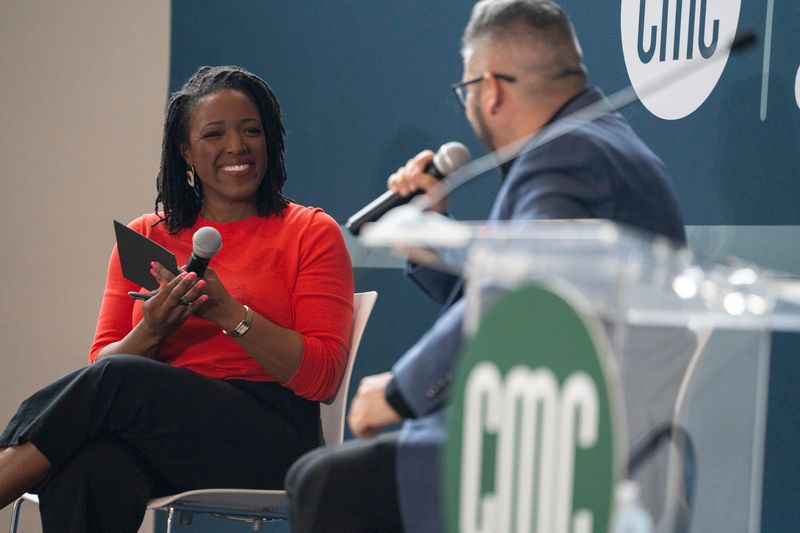
Sophia Fifner is the president and CEO of the Columbus Metropolitan Club.

My job, when you boil it all the way down, is to help people remember how to be neighbors. How to have hard conversations. How to gather. How to show up when it matters.
I have run a Columbus civic organization in Columbus for the past three years. Last year, I was so good at showing up that nobody knew I was disappearing.
In that time, I buried my grandfather, ended my marriage, lost the friend who knew me best, survived a night that brought every memory of being raped at 17 back into my body, came out as a lesbian to my conservative family, and spent a Fourth of July weekend in bed hoping not to wake up.
In the months since, I have been trying to figure out how any woman is supposed to grieve a year like that.
Do I throw myself a divorce shower? Do I register at Target for a single-occupancy life? (I actually did do this one.) Do I send out an announcement? Get a cake? Light a candle? Sit Shiva? Run a meal train for myself?
Alas. There is no casserole for that.
Last year happened in waves. The closest friendship of my life shifted in May, in a way I am still grieving and may never fully understand.
My grandfather died in late June. Days later, on the Fourth of July, I went to bed and tried not to wake up. My marriage came apart in October. In November, I told my family I am a lesbian.
I am not a crier, but I cried for nearly 234 days straight, sometimes more than once a day, followed by countless showers, on the advice of my therapist, to soothe my body back into itself. Seriously, by the time the year was over, almost nothing of the woman who had started it was still standing.
Nothing.
Who was I?
To understand why I had no idea who to call when my life broke in half, you have to understand what I was taught and what I wasn’t.
I grew up in Pickerington. It is technically a suburb of Columbus, but it always felt more Appalachian-adjacent than that. Cornfields. Pickup trucks. A deep and abiding love of high school football, somewhere between “Varsity Blues” and “Some Kind of Wonderful,” except nobody in Pickerington drove a sports car.
I was the first-generation American daughter of Jamaican immigrants in a town that was, in the 1990s, mostly white, mostly Christian and mostly full of women who knew each other from church, school or the community pool.
Women like Diane, who gathered clothes for her relatives in West Virginia. Kim, who baked the best chocolate chip cookies I have ever had in my life. The secret, my friends, is dark brown sugar and a whopping amount of Crisco.
Phyllis, who made plain white bread from scratch and grape jelly meatballs for post-church gatherings. I watched them do it. And learned, by osmosis, how a community is supposed to take care of itself. I learned that in the Midwest, there is a recipe for nearly every kind of grief and every kind of joy.
What you bring
When a baby is born, you bring a casserole.
When someone dies, you bring a houseplant. When a neighbor goes through chemotherapy, the church puts together a meal train, and someone starts a spreadsheet, and someone else organizes the dishes so everyone gets their Pyrex back, with masking tape on the bottom so you know whose is whose and what is what. When a baby comes too early, the women at church stitch a quilt with each square sewn by a different pair of hands, so the family can wrap the baby in the love of an entire community before they even bring her home from the hospital.
But there were things I never saw. I never saw what anyone did when a high school teacher had a miscarriage.
I never saw what the community did when a cross burned in a neighbor’s yard, and one did, once. I never saw how you welcome someone who is gay, or coming out, or both.
Maybe those rituals existed somewhere. But not where I could see them. And if you can’t see it, you can’t ask for it. And if you can’t ask for it, you carry it alone.
Women, especially, have been doing this work for centuries: the casserole, the quilt, the houseplants, the meal train, the receiving line, the hand on the back at the funeral…
What’s not in the card aisle
There is a card for nearly every important moment of an American woman’s life, and if you walk into any Hallmark in America right now and stand in the card aisle, you can find, sorted by category, the words for almost any occasion you might need to mark.
And yet. And yet?
There is no card for coming out at 40.There is no card for the day your marriage falls apart.There is no card for the friendship that ends without a funeral.There is no card for the faith you can no longer fit inside, or the faith you are just beginning to find.There is no card for the morning you realize the life you have been building is not the one you actually want.There is no card for recovering from alcoholism.There is no card for the miscarriage you didn’t tell anyone about.There is no card for the fertility treatments that didn’t work.And there is no card for the week you cannot get out of bed.
If you cannot fit your life into a card-aisle category… you carry it alone.
I know, because I carried it. All of it. And most days, I carried it so well that even I forgot I was carrying anything at all.
Soap in my eyes
On the morning of July 4 last year, I woke up before my husband did, around 7 a.m.
I let the dog out. I poured myself a cup of coffee, sat down, and worked for an hour on a proposal for a potential donor. And, I remember thinking (perhaps naively) optimistically… that the morning had a productive rhythm to it. And, that maybe it was going to be a good day after all.
By that afternoon,
after the neighborhood parade…and the family…and the smiling….and the visiting…and the smiling….and the small talk with folks next door…and the smiling….
I came home. I took off my makeup… and the fake grin too.
I opened my journal, and what came out of my hand and onto the page was a single sentence I had been afraid to write down all summer: I live in a glasshouse, alone.
What happened next, I have only told my therapist. I had a panic attack alone in my house, a real one, the kind that takes your breath and your stomach and your knees all at once. I threw up, and I crawled to the shower because water has always been the only thing that can calm my body when I am breaking. I turned the water as hot as it could be, so hot. I turned it as hot as I could stand, and I sat on the shower floor for I do not know how long, and wept.
When I finally got out, I wrapped myself in a towel and sat on the floor of my bedroom, and my dog, Dolly, came in and started licking my legs, the way dogs do (I know, totally gross, and also, somehow, the only act of care that did not require me to be fully human just yet.
Then I heard the garage door open downstairs, and I realized I wasn’t ready to be a mom, a wife, or… a human again, so I got back in the shower for another twenty minutes. When I finally came out of the shower, my youngest daughter met me at the dark entry to my bedroom, looked up at me, and, in the way only a small child can, asked with so much concern, “Momma, why are your eyes so red?”
And, I tried not to look at her and responded in the only way I knew how. I told her. “Oh, Hannah, I just got a little soap in my eyes.”
Soap in my eyes! Soap in my eyes!? I lied to shield her from my pain.
And that night, while my husband took the girls to a neighbor’s house to watch the fireworks, I stayed home.
I woke up
From somewhere down the street, I could hear them. Pewww. Buzzz. Whirl. The sounds of a neighborhood celebrating, muffled by walls and distance, and the particular silence of a house that had stopped feeling like mine.
I did not go to the window. Instead, I thought about the pain I had been carrying all summer. The kind that didn’t yet have a name, the kind you can’t hand to anyone because there is no vessel for it. The room felt close. Heavy. Like the walls, my blanket, and pillows had decided to participate in my grief.
I took more sleeping pills than I should have. I went to bed hoping not to wake up.
Dolly came in at some point. She did not ask what was wrong. She just put her body next to mine in the dark, and for just a moment something in that room knew I was still there.
I woke up.
I did not get out of bed for three more days.
And on the fourth day, I went to work.
There is a poem by Paul Laurence Dunbar titled “We Wear the Mask.”
We wear the mask that grins and lies,It hides our cheeks and shades our eyes,This debt we pay to human guile;With torn and bleeding hearts, we smile.
I have read it more times in the last year than I can count. Dunbar wrote about the African American experience of having to perform survival in a hostile world, and I will not flatten the specificity of what he meant. But I have also come to read it, in my own way, through the lens of leadership — what it means to be visible and how we navigate the gap between our truest selves and the selves we show the world, our neighbors, and even our own family.
We know how to smile and bring casserole
What I have come to understand, in the year since my own bedroom weekend, is that the public conversation about mental health has gotten loud, but the private one has not caught up.
We have posters in the break room. We have hashtags in May. We know how to bring a casserole. We do not know how to bring ourselves. And if you are a leader of any kind (a CEO, a teacher, a pastor, a parent), the gap is wider, because the script does not allow you to say the words I needed to say last summer.
You are allowed to say you struggled.You are allowed to say you went through a “hard season.”You are not allowed to say I took the pills and went to bed and prayed.
That is the position I held all year.
I did not ask for help. I did not know how to ask for help. I had built my entire career on being the woman who helps, who gathers, who shows up for others, and I could not figure out how to be the woman who needed showing up for. So I went to work each week, surrounded by hundreds of civic leaders. I stood on stages in front of thousands, I smiled and I hoped nobody would notice my inner suffering.
She sent a note anyway
And yet, despite every effort I made to keep my grief quietly and out of sight, a few people found their way through. They kept me alive, and I want to tell you about them.
A woman I had met for coffee maybe twice, in a business setting, sent me a message in December. She wrote that she had been thinking about me, that she knew the season was heavy, that she had blown her own life once before and would not have made it through without the women who had sat with her in uncomfortable moments. She said she was available for coffee, dinner, drinks or anything else I might need.
I cried after reading it. She did not know my story. She decided to send the message anyway.
A fellow nonprofit CEO who had heard a three-sentence summary of my year sent me a card with a spa gift card tucked inside. A massage with instructions to rest.
My college friend, whom I had not really updated in months, called. I told her everything, and she listened the way old college friends do, which is to say as though no time had passed at all.
A stranger saw me at an event and pulled me into a hug without asking what was wrong, because she could see it on my body, and she just held on.
A new friend, a light of joy, cooked me meals when I moved out of my house, helped me unpack boxes, walked me through the housewares aisle at Walmart and helped me figure out what kind of plates I needed because for weeks, I could not make the simplest decisions regarding the necessities of life.
And then there were my parents. In a world that has so often met people like me with judgment rather than grace, they did not hesitate. They hugged me. They told me they loved me.
Sometimes, even in the most visible roles, as a parent, a neighbor or a leader, it can feel like nobody sees you.
The truth is, sometimes people notice your light even when your light is dim. And the ones who show up may not always be the ones you would have predicted. But they are there. And, perhaps, they are not bringing a casserole, but making up an entirely new recipe to hold your grief, your joy and whoever you are becoming.
I have built a career on the idea that what we have lost in America is the practice of neighboring. That we have forgotten, somewhere between our increasingly small living rooms and our increasingly large algorithms, how to belong to one another in the small, daily, unremarkable ways that used to hold our towns together. I have given speeches. I have written newsletters. I have stood on stages and asked roomfuls of leaders, in a hundred different ways, what it would take to remember.
What’s killing us quietly
What I have come to understand, in the year since my own bedroom weekend, is that this is not a soft problem.
Then U.S. Surgeon General Vivek Murthy declared loneliness a public health epidemic in 2023. Half of all American adults report feeling lonely. And researchers have found that grief that goes unwitnessed does not just hurt. It lives in the body, raising cortisol, straining the heart, shortening lives.
We have known for decades, since Robert Putnam first sounded the alarm in Bowling Alone, that the collapse of community is killing us quietly. What we have not yet reckoned with is this: we have rituals for the grief that fit inside a card aisle, and almost none for everything else. And everything else is where most of us actually live.
The tragedy of my previous year was not that I almost did not survive it.
The tragedy was that the country I live in has invented a thousand ways to grieve a death, to celebrate a birth, and almost no ways to hold the vast middle of human experience.
The divorce. The coming out. The friendship that ends without a funeral. The faith that no longer fits. The week you cannot get out of bed. We have left all of that to be carried alone. And carrying it alone, the science tells us, is not a character flaw. It is a public health failure.
So maybe now is the time to build what we were never given. Meal trains for divorce. Quiet rituals for the miscarriage nobody knew about. A card aisle for coming out, at 20, at 30, at 40, at 60, because coming out is both a grief for the life you knew and a homecoming for the one you have always been.
A casserole for the week you cannot get out of bed, and another for the child who is struggling in a way you cannot fix, and another for the faith that no longer fits the shape of the woman you have become.
And maybe neighboring, in the end, is not about fixing any of it. Maybe it is simply about being the woman who shows up, without a recipe, without a category, without a vessel, and stays in the room, and stays in the room, and stays in the room, until the worst of it passes.
There is no casserole for that.There does not need to be.
Sophia Fifner is the president and CEO of the Columbus Metropolitan Club, which aims to cultivate community conversations. Find more of her writing at sophiafifner.substack.com.
This article originally appeared on The Columbus Dispatch: I cried for 234 days. A life I didn’t want was killing me | Opinion
Reporting by Sophia Fifner, Guest Columnist / The Columbus Dispatch
USA TODAY Network via Reuters Connect