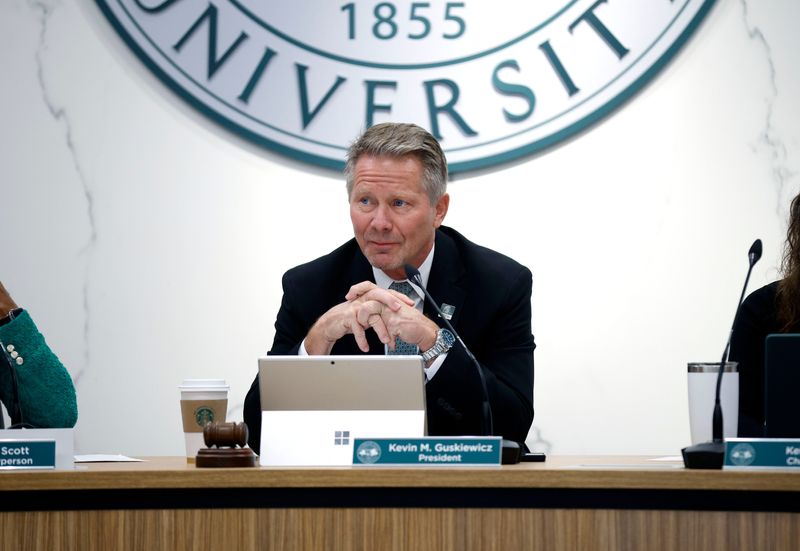
Turns out an offer of $2 million a year isn’t enough to keep Kevin Guskiewicz in the president’s office at Michigan State University.
Instead, yet another MSU president is bolting the confines of the Hannah Administration building and chronic dysfunction in the trustees’ boardroom, this time accepting a smaller $1.216 million salary for the presidency of Clemson University in South Carolina. Score one for the ACC.

“I am concerned the division of the fractured board just creates inertia,” Guskiewicz told The Detroit News in an exclusive interview. “It’s just unsustainable for me at the moment — for me. This opportunity at Clemson came at the right time for me and my family for the right reasons.”
The exit of Guskiewicz, 60, comes at precisely the wrong time for MSU and what passes for its board of trustees. In the wake of raising $2 billion toward a $4 billion fundraising goal, hiring a hotshot athletic director in J Batt and nabbing Pat Fitzgerald as head football coach, the abrupt decamping of Guskiewicz to Clemson threatens to once again destabilize MSU leadership and cloud its way forward.
The outrage his departure is sparking among Gov. Gretchen Whitmer and business leaders, as well as (some) lawmakers and members of the MSU family, should be channeled behind the push by two former governors — Republican John Engler and Democrat Jim Blanchard — to abolish the election of Big Three university boards in favor of gubernatorial appointments, as most other states do.
Stalling equals complicity. Who would want to come to East Lansing under the circumstances? And if they did — assuming the method for electing trustees of MSU, the University of Michigan and Wayne State University remains unchanged — what kind of president would they make given the leadership turmoil at all three schools?
This system for populating the boardrooms of Michigan’s Big Three universities simply does not work anymore. Michigan State alone has had eight presidents since 1995. Michigan’s chewing through presidents way too fast. Wayne State, too. By comparison, Clemson has had two presidents … in 27 years.
If leadership in East Lansing starts to wobble, credit will go to the trustees (or at least their mischievous minority) whose continuing antics and propensity to relitigate past slights are more appropriate to a middle school lunch room than the governing board of a major research university.
In his letter to the MSU community, Guskiewicz wrote: “What is perhaps most troubling is the actions of some to abuse their access to privileged and confidential information to mispresent facts, manipulate situations and selectively use and leak that information to promote personal agendas.”
Come sometime in August, MSU will lose its most capable (and marketable) president since M. Peter McPherson; a seasoned higher ed leader who carries the presidential imprimatur of another ACC school, the University of North Carolina; a prodigious fundraiser who helped marshal MSU’s deepest donor pockets toward a $4 billion campaign goal.
“Am I sad? You bet I am,” Trustee Sandra Pierce told The News at the Mackinac Policy Conference on Mackinac Island. “Do I think that we’re going to continue our progress? You bet I do. Do I think we’re going to choose a president that will continue to take us forward? You bet I do, and I’m going to stay committed to it.”
The surprise here is that anyone who’s been paying attention would be surprised by Guskiewicz’s exit. To seal his arrival roughly three years ago, he secured written pledges from the trustees circa 2023 that they would respect the difference between management and governance, only for some of them to demonstrate repeatedly their inability to do any such thing.
As recently as last month, the trustees received a confidential reminder illustrating how misguided their understanding of governance is. In a report prepared by Jill Derby, a senior consultant at the Association of Governing Boards of Universities and Colleges, the MSU trustees were credited with scoring “commendably high” on “financial stability” and “quality of educational experience.”
But “the board’s failure to comply with universally recognized good governance standards and their own internal documents laying out specific MSU governance standards and protocols continues to undermine their effectiveness and damage their reputation and that of the university.”
Bingo. That’s why the trustees, in a recent 8 p.m. Sunday electronic board meeting, voted to offer Guskiewicz $2 million to stay in East Lansing and, second, to adopt by a 5-3 vote a toughened ethics-and-speech policy — proving once again that understanding the MSU trustees’ actions requires answering “why now” and “who benefits.”
Over the past six months, according to a source familiar with the matter, Guskiewicz began questioning whether he could continue to lead MSU. Board dysfunction and partially broken governance practices weighed heavily, disrupting the life balance he seeks for himself and the senior staff he hires.
And criticism of close aides to Guskiewicz — namely General Counsel Brian Quinn — rankled, in part because hiring, evaluating and firing staff is the responsibility of the president, not the trustees. Under the Michigan Constitution, the governing boards of the state’s Big Three universities have two responsibilities: overseeing finances and hiring and firing a president.
The departure of Guskiewicz, expected to be finalized in August, is another self-inflicted wound for Michigan’s vaunted Big Three universities. Not so vaunted in recent years, as the politicization of the boardrooms mars reputations and complicates recruiting of students, faculty, staff and coaches.
“You asked me, like so many people have, when your appointed term ends in 2028, will you run,” Pierce said. “And the answer is absolutely not because I believe elected boards should be replaced by appointed boards.”
daniel.howes@detroitnews.com
@DanielHowesTDN
Daniel Howes is senior editor/business & columnist for The Detroit News.
This article originally appeared on The Detroit News: Howes: Behind Guskiewicz’s move to bolt MSU, dysfunctional board
Reporting by Daniel Howes, The Detroit News / The Detroit News
USA TODAY Network via Reuters Connect