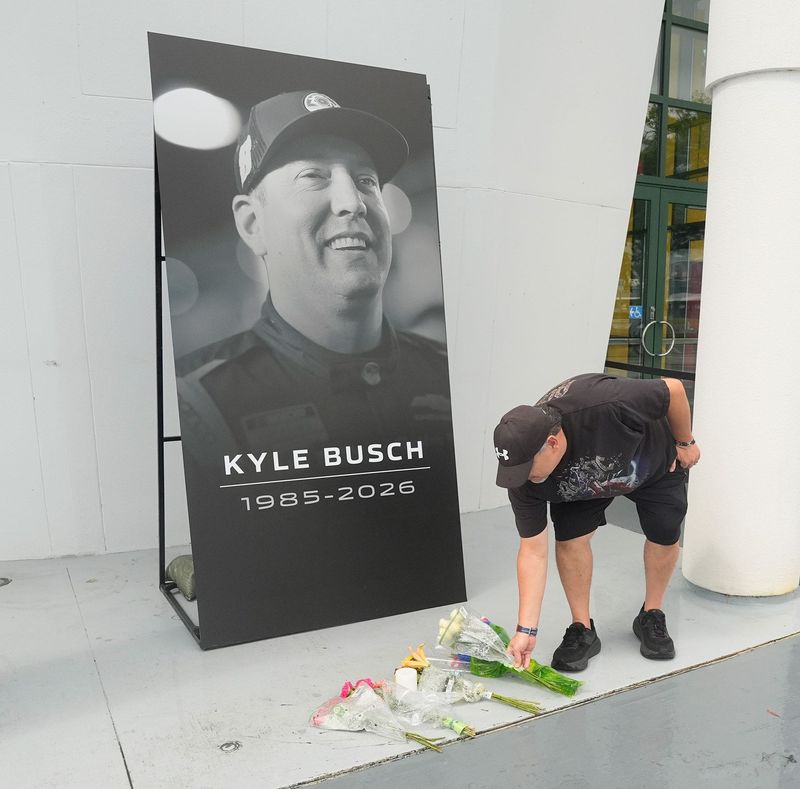
On Saturday, the family of NASCAR legend Kyle Busch released a statement that unveiled the cause of death of the two-time Cup Series champion, who passed away on Thursday at the age of 41.
“The medical evaluation provided to the Busch Family concluded that severe pneumonia progressed into sepsis, resulting in rapid and overwhelming associated complications,” the Busch family statement read. “The Family asks for continued understanding and privacy during this difficult time.”

Most people have had pneumonia or know someone who has. It’s common enough that it can feel routine; something you treat, something you recover from, something you push through.
Sometimes it isn’t.
Double pneumonia means both lungs are infected at once, according to the Cleveland Clinic. It sounds worse than a single-lung infection, and sometimes it is. Not always, though. A person can have a relatively mild case in both lungs or a catastrophic one. The name alone doesn’t tell you how sick someone is.
What matters is how fast it moves.
When pneumonia takes hold in both lungs, the body struggles to get oxygen where it needs to go. That’s when things can spiral into respiratory failure, into sepsis, into organ shutdown, according to the Mayo Clinic. The window for treatment can close faster than anyone expects.
What is severe pneumonia?
“When we look at people in the 40’s who are sick enough to get admitted to the hospital, about 1% of them will die of pneumonia,” Ryan Maves, MD, FCCP, Chair of the CHEST organization’s infections network and a Professor at Wake Forest, told USA TODAY Sports. He wanted to make it clear he does not know about Busch directly, but this is what he teaches at Wake Forest.
“After certain pneumonias, classically influenza, but some other viruses can do this as well, people start with a viral pneumonia, and then you get a bacterial super infection on top of that,” Maves said. “The bacterial super infections are often potentially very dangerous organisms – staphylococcal pneumonia, some bad streptococcal pneumonias — and these can be very severe and can progress very quickly. When I think about a young man dying of pneumonia after a preceding period of illness, that is the thing that I think about.”
Most people who suffer complications from pneumonia are older than 65 or dealing with other health problems that make fighting off infection harder. A 41-year-old dying from it is not the norm. But it happens. Underlying conditions, a delayed diagnosis, and an infection that gets ahead of treatment can all turn it into something life-threatening.
According to the Mayo Clinic, Pneumonia often starts looking like the flu. Fever, chills, cough, shortness of breath, chest pain. It can feel like something you push through. Sometimes people do push through it, but it can get worse.
What is sepsis?
Sepsis is a life-threatening condition in which the body responds improperly to an infection, according to the Mayo Clinic. It causes the body’s organs to malfunction as the infection-fighting processes are triggered, impairing their function.
Sepsis can also lead to septic shock, which happens when there is a severe blood pressure drop, leading to failure and damage to the lungs, kidneys, liver and other organs, and can lead to death.
Kyle Busch was racing four days before he died. That’s how fast it can move.
Busch was coughing up blood when emergency responders were called to a General Motors facility in Concord, N.C., the day before the two-time NASCAR Cup Series champion died, according to the 911 call obtained by USA Today.
During the call, a man tells a dispatcher that Busch was awake on the bathroom floor but in distress. He said Busch was coughing up blood, short of breath, and very hot. The caller asked emergency responders to turn off their sirens upon arrival.
“I’ve got an individual that’s (experiencing) shortness of breath, very hot, and thinks he’s going to pass out, and he’s producing a little bit of blood, coughing up some blood,” the caller told the dispatcher.
The 911 call adds new detail to what had been an increasingly alarming picture of Busch’s health in his final weeks. On May 10, during a Cup Series race at Watkins Glen International, Busch radioed his crew near the end of the race, asking for team physician Dr. Bill Heisel to meet him at the bus afterward. He wanted a “shot.” The FS1 broadcast noted he had been battling a sinus cold all week. He finished eighth in the race.
This article originally appeared on Indianapolis Star: Kyle Busch cause of death was pneumonia that progressed into sepsis, per family
Reporting by Kristie Ackert and Scooby Axson, USA TODAY / Indianapolis Star
USA TODAY Network via Reuters Connect