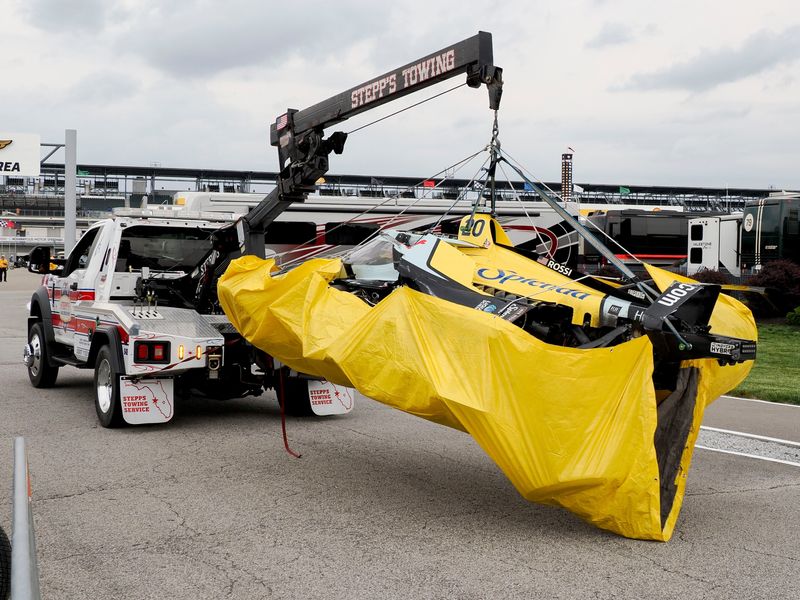
INDIANAPOLIS — Alexander Rossi arrived at Indianapolis 500 media day on crutches, balancing on one good foot as he maneuvered through the media center.
Three days earlier, Rossi slammed into the wall in Turn 2 during practice, suffering injuries that required surgery on his right ankle and left middle finger. On Thursday, the 2016 Indy 500 winner confirmed he will still start Sunday’s race from the front row after being medically cleared to compete.

Though for Rossi, there was never much debate about whether he would race.
“Oh, absolutely not,” he said when asked if he considered sitting out.
Before being cleared to race, Rossi had to drive on a simulator and demonstrate he could safely enter and exit the car in an emergency. He is also expected to compete with a specially fitted brace designed to stabilize his ankle without restricting movement on the pedals.
“Fortunately, to drive a race car, you don’t have to bear weight,” he said. “Range of motion is good. Pain is minimal. Swelling, as you can see, I fit into my race boot. I’m good to go.”
Inside the IndyCar paddock, Rossi’s decision was viewed less as extraordinary and more as part of the reality of the sport.
At Indianapolis especially, drivers understand how rare these opportunities are. Many spend entire careers chasing a single Indy 500 start, let alone a front-row chance to win it. That reality changes the way they think about pain.
“We’re a bunch of psychos, honestly,” Conor Daly said. “If you have this job, you’re very lucky to have this job, so you don’t want to let that go away at all.”
Drivers often describe racing as a place where pain temporarily disappears beneath adrenaline. Kyle Kirkwood learned that lesson during his rookie season after injuring his right wrist and hand in a head-on crash into a tire barrier during the Detroit Grand Prix. Despite the heavy sprain, he kept racing through the weekend and later won an IMSA race while still dealing with the injury.
“Our minds just don’t recognize pain when you’re in the race car,” Kirkwood said.
The physical toll usually arrives after the helmet comes off.
“We just eat the pain afterwards when we’re all swollen and not feeling good,” he said. “The adrenaline kind of keeps the pain down.”
Rinus VeeKay experienced something similar in 2021, when he fractured his left index finger during a testing crash at Indianapolis Motor Speedway. Just over a month later, he returned to IMS and won the GMR Grand Prix on the road course for his first career IndyCar victory.
“Adrenaline is an amazing drug that usually can drag you way further than you think is possible,” VeeKay said.
Still, crashing is just considered part of the sport.
“You’re almost guaranteed to injure yourself,” Santino Ferrucci said.
Ferrucci broke his fibula at Indianapolis in 2021. O’Ward was involved in the same multi-car practice crash Monday that injured Rossi, though he and Romain Grosjean escaped without serious harm.
“There’s only so much the human body can take,” Pato O’Ward said. “Even like a small hit can surprise you how much damage it can do.”
Every driver on Sunday’s grid understands the risks that come with racing 500 miles at more than 230 mph. They also understand how few people ever get the chance to do it.
For Rossi, the opportunity to chase a second victory in front of more than 350,000 fans outweighed almost everything else.
Jessica Garcete is an IndyStar sports reporter. Get IndyStar’s motor sports coverage sent directly to your inbox with our Motor Sports newsletter. Subscribe to theYouTube channel IndyStar TV: IndyCar for a behind-the-scenes look at IndyCar and expert analysis.
This article originally appeared on Indianapolis Star: Alexander Rossi racing after crash is reality of Indy 500: ‘We’re a bunch of psychos’
Reporting by Jessica Garcete, Indianapolis Star / Indianapolis Star
USA TODAY Network via Reuters Connect