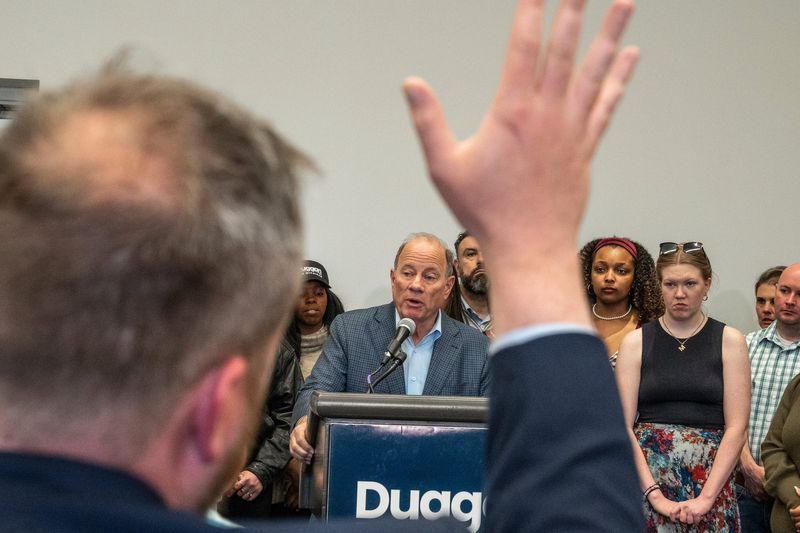
Mike Duggan’s independent bid for governor ended May 21, not with a bang but a whimper.
In January, the former Detroit mayor was neck-and-neck with Jocelyn Benson and John James, the presumptive Democratic and Republican nominees. But the intervening months haven’t been kind to Duggan, who trailed Benson by 11 points in a recent Glengariff Group poll; a poll conducted earlier this month for the Lansing news service MIRS was even more bleak, showing just 13% of likely voters backing Duggan.

Duggan, a longtime Democrat, announced his independent bid in late 2024, seeming to believe the party’s unpopularity after that year’s disastrous election was a permanent realignment, not the typical backlash that follows an unsuccessful cycle. He gambled that voters’ dissatisfaction with polarized politics and both major parties would endure through the 2026 gubernatorial election ― and, in a handy-for-him twofer, opted out of a serious Democratic primary fight against the popular, well-funded Benson.
For a man who spent 40 years establishing himself as Michigan’s premier political operator, it was an astonishing misread of the electorate, and the moment.
“If anyone can do it, he can,” became a common refrain among Michigan politicos, with a lot of emphasis on “he,” and not enough on “if.”
It’s an ignominious exit from an improbable campaign. But in leaving the race, Duggan is finally doing the right thing ― the smart thing ― for himself, and for the state of Michigan.
Why it’s smart for Duggan
In short? Because he wasn’t going to win.
Announcing his independent bid in 2024, the mayor claimed that he’d never fit in either party ― a fairly surprising contention, considering that Duggan has spent those four decades in public life as one of Michigan’s most powerful Democrats ― and believed he could cut through partisan gridlock in Lansing.
For the first year of his campaign, Duggan was on a positive trajectory. But his numbers peaked in February, with the support of roughly 30% of likely voters; since then, voters have abandoned him in droves, despite a recent $14 million advertising spend by an affiliated political action committee.
Last month, Glengariff pollster Richard Czuba told me that at a distance, an independent candidate may seem attractive. But as Election Day nears, it’s not surprising that voters, even those frustrated by political polarization, will reconcile with their own parties.
Democrats who wanted their own party to pound sand in 2024 are galvanized by opposition to Donald Trump and ready to come home.
That anyone indulged the notion that his candidacy was viable is a testament to the pervasiveness of Mike Duggan’s political myth-making. But it was never going to happen, and the political environment finally caught up to reality.
That’s why dropping out is smart for Duggan.
Why it’s smart for Michigan
I’ve spent almost two years bemused by Duggan’s strategy, particularly how the mayor could believe his candidacy would amount to anything other than handing the governorship to James, whose extreme political beliefs are out of step with the average Michigander, or maybe self-described “quality guru” Perry Johnson, a self-funded late entry into the GOP primary.
To win, Duggan would’ve needed to pull votes from Democrats and Republicans alike; both in metro Detroit, where he’s popular, but also outstate, where there are roughly 700,000 Democratic votes and Detroit is still, to many, a toxic brand.
The backing of prominent business leaders like Dan Gilbert and Bill Ford, and the controversial early endorsement of the Detroit Regional Chamber’s political action committee, weren’t enough to convince Republicans to break ranks, because of course it wasn’t. Republicans didn’t break ranks when Donald Trump, the most divisive political candidate of my lifetime, was on the ballot; they’re absolutely not going to do it for Mike Duggan.
(This is an embarrassing turn of events for the Detroit Regional Chamber, which went all in on Duggan, and now has fences to mend; because of the Chamber’s Duggan endorsement, candidates from both parties reportedly declined to participate in a gubernatorial debate at the group’s annual Mackinac Policy Conference next week.)
So it never seemed probable that Duggan could snag sufficient votes to win, not least because Benson is hardly a Tudor Dixon-level candidate who would push Dems to sit this one out. Still, even with dwindling support, Duggan could have leached enough Dem votes to kneecap Benson.
Benson has a clear, cohesive message, she’s been a staunch defender of core principles and on the front lines of election security. She’s a prodigious fundraiser who’s won twice on a statewide ballot, in 2022 outperforming Gov. Gretchen Whitmer, who is considered unusually popular; Benson’s biggest vulnerability was in a three-way race.
While Duggan has been working diligently to establish his bona fides by trash-talking Democrats, I have to believe that he has some residual allegiance to the principles of the party that was his political home for 40 years, at least enough to want a Democrat in the governor’s office.
And that’s why this is a smart move for Michigan.
Duggan’s departure from the race changes the game. Now, it’s Benson’s to win or lose.
Nancy Kaffer is editorial page editor of the Detroit Free Press. Submit a letter to the editor at freep.com/letters, and we may publish it in print or online.
This article originally appeared on Detroit Free Press: Mike Duggan’s independent governor bid was a strategic mistake | Opinion
Reporting by Nancy Kaffer, Detroit Free Press / Detroit Free Press
USA TODAY Network via Reuters Connect