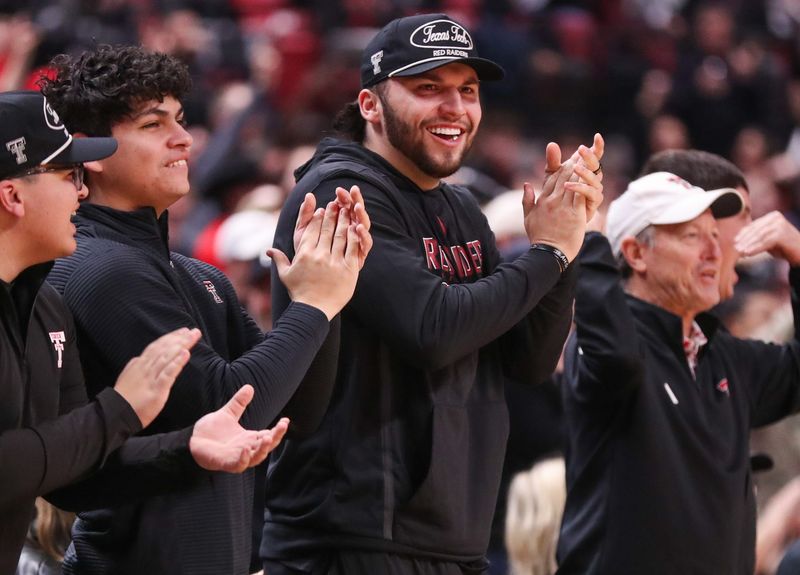
Lawyers for Brendan Sorsby filed an injunction to grant the would-be Texas Tech football quarterback eligibility for the 2026 season.
The 514-page suit was filed in Lubbock County on Monday, May 18, in the 99th District Court and obtained by the Lubbock Avalanche-Journal. The suit requests a hearing to “be held no later than June 15 so that the Court has the opportunity to render a decision on his request for a temporary injunction prior to June 22,” the deadline for Sorsby to declare for the NFL supplemental draft.

Sorsby’s legal team states in the suit that, “Mr. Sorsby is currently ineligible to play for Texas Tech due to prior violations of the NCAA’s sports gambling rules.” It states later that Tech ruled Sorsby ineligible shortly after learning of the NCAA’s inquiry into the gambling and “requested to move forward to begin the reinstatement process to regain Mr. Sorsby’s eligibility.”
At the time the suit was filed, there had been no decision made public about Sorsby’s eligibility for the 2026 season. However, Texas Tech Athletics released a statement later Monday, which reads, “After finalizing an agreed-upon stipulation of facts between Texas Tech University, the NCAA, and Brendan Sorsby, the University has declared Sorsby ineligible for competition. Texas Tech intends to quickly initiate the reinstatement process.
“Texas Tech’s primary focus remains supporting Sorsby’s health and well-being.”
The bulk of the introduction focuses on Sorsby’s gambling addiction, for which he voluntarily began a 30-day inpatient treatment program on April 27.
“Mr. Sorsby went further still,” the filing says, “offering to accept a two-game suspension and to have his eligibility conditioned on completing his residential treatment, continuing treatment at Texas Tech, taking any gambling-education classes the NCAA determines are necessary, and working with the NCAA to educate other athletes and fans about the dangers of gambling.
“He also offered to consider any other conditions the NCAA deemed appropriate. The NCAA rejected his offer. Instead, the NCAA’s response to Mr. Sorsby and Texas Tech has been a breach of its contractual and other legal obligations.”
According to the petition, Sorsby’s legal team consists of local attorneys Duston Burrows and Ted A. Liggett, as well as Jeffrey L. Kessler, Eva W. Cole, Sofia Arguello, Adam I. Dale, and Necha Vyas.
The suit calls attention to the diagnosed disorder of gambling addiction and alleges, “… the NCAA has weaponized his condition to shore up a facade of competitive integrity, while simultaneously profiting from the very gambling ecosystem it polices.”
Sorsby was a high school athlete at Corinth Lake Dallas before spending the 2022 and 2023 seasons at Indiana and the 2024 and 2025 seasons at Cincinnati, throwing for 2,800 yards in both seasons, combining for 45 touchdown passes. He transferred to Texas Tech in January and threw four touchdown passes in the Red Raiders’ spring game.
According to the suit, Sorsby began gambling as a high-school senior, making a short drive with friends to a casino near the Oklahoma border where he could gamble legally.
“What began as a seemingly harmless activity with friends quickly developed into an addiction,” the filing says.
It goes on to say Sorsby made small bets, typically between $5 and $50, on his Indiana football team to win or individual teammates to exceed expectations during the 2022 season, stressing that he stopped doing so in October 2022 when he was promoted after eight games from scout-team quarterback with no chance of playing to backup quarterback. While a scout-team member, he didn’t travel with the team and wasn’t privy to the game plan for the week’s game.
The suit states that Sorsby never bet against his own team or its players, never shared insider information with anyone else, and did not manipulate games.
“The NCAA’s own robust, real-time integrity-monitoring systems confirm this: there is no evidence that they ever generated a single alert or otherwise gave the NCAA any reason to question Mr. Sorsby’s betting activity before April 2026,” the suit states.
Since the 2022 season, the filing says, Sorsby has never bet on any of his other teams, including Cincinnati, in games his teams participated in, or on players in those games.
“Mr. Sorsby, however, was addicted to sports gambling,” it says, “and he continued to place bets on other sports as his gambling escalated into a compulsion he could not control. He placed thousands of bets — often on events he did not even regularly follow, like games in the Turkish basketball league and Romanian soccer matches. None of his bets involved teams he played on or players he held any non-public information about.”
Sorbsy’s legal team asserts the NCAA has “contractual authority” to look at Sorsby’s eligibility case “which typically call for review within 48 hours.”
Tech was informed of the NCAA’s investigation into Sorsby’s gambling in mid-April, after which Sorsby did not deny the allegations, though he “emphasized that he never bet on a game he played in and never took any action to influence the outcome of any game because of a bet. He recognized he had a gambling addiction.”
The filing says Sorsby volunteered to enter a treatment program and “educate young men about the risks of gambling — not because a court or the NCAA required that, but because he does not want anyone else to go through what he has.”
The suit alleges that the NCAA “demanded years of bank records, credit card statements, Venmo transactions, phone logs, text messages, and social media records and insisted on a live interview that would force Mr. Sorsby to interrupt residential treatment.”
Texas Tech, the suit claims, has also been harmed by the process after having recruited Sorsby to “be the centerpiece of its upcoming football season and fully supported his residential treatment.”
Timing is the key issue in the suit. The Red Raiders open the season Sept. 5. Sorsby also faces a June 22 deadline if he wants to apply for the NFL supplemental draft.
“As things stand, either way, Mr. Sorsby loses,” the suit says. “If he enters the Supplemental Draft prior to the NCAA determining his eligibility, he surrenders his senior season — even though his goal is to return as Texas Tech’s starting quarterback, an irreplaceable opportunity. If he waits, and the NCAA eventually denies reinstatement, he will have forfeited a year of high-level football at either the college or NFL level that no future judgment can restore.”
According to NCAA rules, athletes who wager on their own games or on other sports at their own schools can be penalized with permanent ineligibility. NCAA rules also prohibit gambling on any sports in which the NCAA sponsors a championship. For other wagering-related violations, including gambling on professional sports, the cumulative dollar value of wagers is taken into consideration in assessing punishment.
Sorsby’s attorneys allege hypocrisy in how the NCAA deals with gambling.
“While it imposes harsh gambling restrictions on student-athletes in the name of ‘integrity,’ the suit says, “the NCAA has partnered with Genius Sports to distribute real-time data feeds to sportsbooks, publicly touted gambling as a ‘major opportunity,’ and presided over an ecosystem in which $3.3 billion was wagered on its basketball tournaments in 2026 alone.”
The suit used the words of NCAA president Charlie Baker in elaborating on gambling as an opportunity.
“None other than the NCAA’s president, Charlie Baker, has identified potential revenue from sports gambling as a ‘major opportunity’ for the NCAA,” the filing says, “underscoring that ‘anybody who has a phone [is] able to bet from any place they want’ and that ‘two-thirds to almost three quarters of all people between the ages of 18 and 22 [are] betting on sports.’ Read that again: the NCAA’s president identified the gambling habits of college-age students — his own member schools’ students — not as a mental-health crisis to address, but as a market to monetize.
“This wasn’t just lip service. In April 2025, the NCAA announced a partnership with Genius Sports to make it the exclusive distributor of NCAA data feeds to sportsbooks. ESPN aptly called the deal ‘the latest twist in the NCAA’s complicated relationship with betting.’ “
This story has been updated to reflect new information. Look for more coverage of lubbockonline.com.
Gabriel Monte of the Avalanche-Journal contributed to this report.
This article originally appeared on Lubbock Avalanche-Journal: Texas Tech QB Brendan Sorsby files injunction vs NCAA in gambling probe
Reporting by Nathan Giese and Don Williams, Lubbock Avalanche-Journal / Lubbock Avalanche-Journal
USA TODAY Network via Reuters Connect