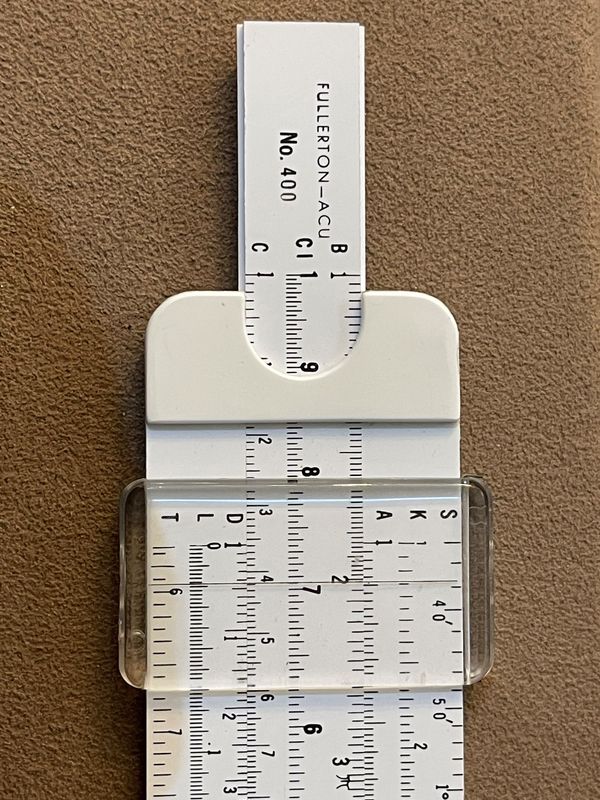
Back when my kids were younger, I would periodically complain about the deafening racket coming out of their rooms that they passed off as music. The answer that came back was always the same: If it’s too loud, then you’re too old. That may be, but I can still tell them a thing or two about rotary telephones, adding machines, portable typewriters and the Wide World of Sports. In fact, I can even show them how to work a slide rule, not that any of them would possibly care.
Slide rules may now be the stuff of antique galleries like ours, but that doesn’t make them any less significant back in the pre-digital world. So, hey, let’s slide in a little on that subject today.

In fact, you could say that a slide rule is actually just an analog computer. No bits, no bytes, no circuitry. They were an outgrowth of the groundbreaking discovery of logarithms by Scottish mathematician John Napier. His publication in 1617 of logarithmic tables basically reduced the time needed to solve complex arithmetic computations. It was an astounding breakthrough, especially for astronomers, engineers and navigators who relied on a range of otherwise tedious calculations to achieve their ends. The slide rule appeared shortly thereafter as a paperless means of logarithmic problem-solving. Invented in England by a gifted group of mathematicians and clergy, its impact over the next two centuries can hardly be overstated.
Indeed, what’s really remarkable is that the slide rule remained an intrinsic part of scientific and commercial undertakings for more than 200 years. It wasn’t until the introduction of the Hewlett-Packard calculator in 1972 that slide rules were finally rendered obsolete. It’s not too much to say that the invention of this little device surely must rank among the most significant scientific catalysts of all time.
For those of you with analog myopia, a slide rule consists of a scaled ruler-shaped frame, an internal element that slides back and forth, and a transparent cursor that glides over the top and basically allows alignment of the various scales to mark a solution. Once you get the hang of it, they’re fairly easy to use and can be manipulated very quickly by a skilled technician. OK — it’s too much to explain exactly how a slide rule works in 500 words, but suffice it to say that it reduces almost all types of calculations to basic addition and subtraction.
Over the years, many variants were developed depending on the type of work being undertaken. Among the most famous of these was a circular slide rule known as the E6-B, widely used by pilots to assist in navigation.
Not surprisingly, so many years and so many variations have produced a universe of opportunities for collectors. Slide rules are rarely expensive, easy to store and fascinating in their myriad combinations. Many come marked with their industrial origins or branch of military service in which they were employed. In my view, they are a grossly underappreciated collectible given their influence and longevity, and anyone out there looking for a new category might do well to inspect this one. Who knows but it might even make you seem a bit less of a Luddite to your kids.
Mike Rivkin and his wife, Linda, are long-time residents of Rancho Mirage. For many years, he was an award-winning catalogue publisher and has authored seven books, along with countless articles. Now, he’s the owner of Antique Galleries of Palm Springs. His antiques column appears Sundays in The Desert Sun. Want to send Mike a question about antiques? Drop him a line at silverfishpress@gmail.com.
This article originally appeared on Palm Springs Desert Sun: Slide rules were the first analog computer
Reporting by Mike Rivkin, Special to The Desert Sun / Palm Springs Desert Sun
USA TODAY Network via Reuters Connect