Last week we talked about the free bread that comes (or used to come) at the start of a restaurant meal.
Readers have responded to my call for help, telling me where the free bread can be found. Keep the suggestions coming, and we’ll do a full report down the line.

It may be telling that the bread at Roncone’s restaurant on Lyell Avenue is getting a lot of praise. That’s good, but as its fans note, it would be even better if Roncone’s were still open.
Speaking of disappearing acts, let’s celebrate a grocery store bread that once was a favorite in Rochester and beyond. Like Roncone’s, is no more.
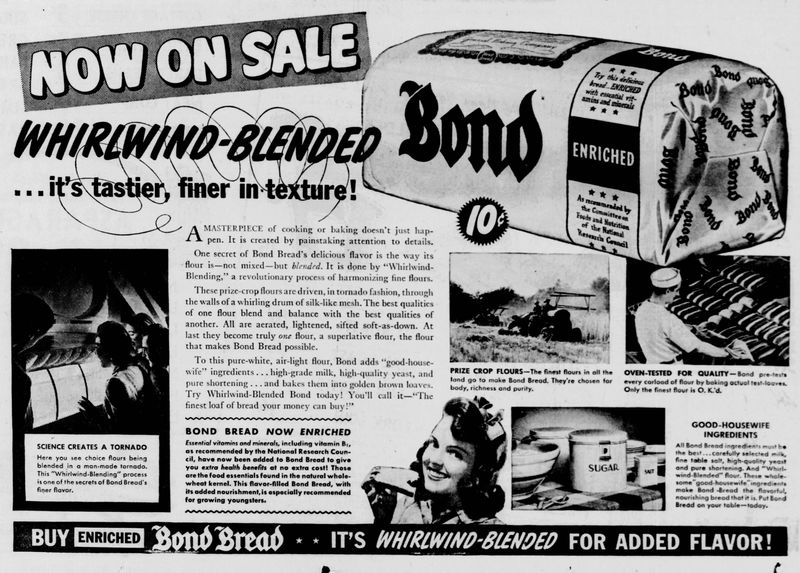
Bond Bread was Rochester’s biggest player in the bread market for more than 60 years. From 1915 to 1979, it had a national presence.
The General Baking Co., which baked and marketed the product, started on North Street in Rochester and expanded to factories in several cities. It became, according to The New York Times, one of the largest baking companies in the country.
The bread was good, and it was also good for you, at least according to the ads.
The company boasted that one loaf of Bond Bread provided the energy of 13 fresh eggs, five lean pork chops and 20 ears of sweet corn. If you didn’t like it, you got double your money back.
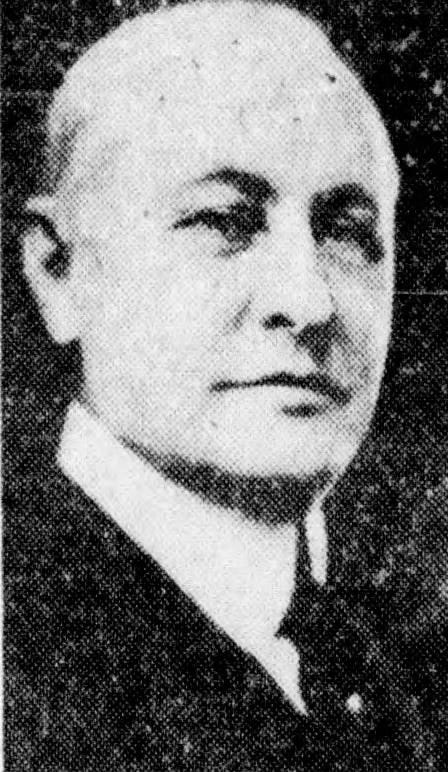
The driving force behind Bond Bread was William C. Deininger, whose father, Frederick Deininger, started the Deininger Baking Co. after arriving in Rochester in the late 1840s from his native Germany.
Deininger Baking Co. became Deininger Brothers after William Deininger and his brothers Frederick, Henry and Louis took over.
Ads for its Deininger’s bread stressed that it was made from the best wheat and had a high volume of gluten, thus aiding digestion. (Not sure how that would play today.)
Before launching Bond Bread in 1915, William C. Deininger held a national “best bread recipe” contest.
As the historian Donovan A. Shilling writes in “Made in Rochester,” the company received more than 45,000 responses.
Having created a bond (hence the name) with customers – specially housewives, the target audience – the company then released its bread.
By the early 1930s, Bond Bread had introduced a sliced version of its bread, which had earlier been sold only as an unsliced loaf.
“Increasing consumer preference proves that, sliced or unsliced … there is no bread like Bond, the home-like loaf,” declared an ad in 1930.
The company expanded and later merged with another company. According to Shilling, both Hopalong Cassidy and the Lone Ranger, fictional western heroes, endorsed the bread, a backing that must have helped with younger eaters.
The Deininger family gave back to Rochester, supporting various philanthropies and building projects.
Bond Bread’s biggest competition may have been Wonder Bread, which was also fortified and famously claimed to build strong bodies, first eight ways and then 12 ways.
In 1972, a mouse was found in a Bond Bread loaf that was baked in Philadelphia. It was a public relations nightmare for the company, then the General Host Co.
The 1970s were rough and the company declared bankruptcy in 1979. Bond Bread was no more. Other breads came along, some even on restaurant tables. More on that later.
Remarkable Rochesterian
Many thanks to David E. Laiacona, who alerted me to the Deininger story. His wife, Marlowe Berrien Hagood Laiacona, is a descendant of that family, which was a force in Rochester for years. Let’s add the name of one of its prominent members to the list of Remarkable Rochesterians that can be found at: https://data.democratandchronicle.com/remarkable-rochesterians/.
William C. Deininger (1861-1941): In1915 he came up with the idea for Bond Bread, turning it into a national brand that was produced by the General Baking Company and its outshoots in several cities until 1979. The son of Frederick Deininger, a German immigrant and baker, he had grown the business along with his brothers, Frederick, Henry and Louis. After retiring from General Baking in 1925, he later returned as chairman of the board. He and his wife, Lucy, funded a new wing for St. John’s Home, and he donated to several other causes and served on many local and national organizations.
From his home in Geneseo, Livingston County, retired senior editor Jim Memmott writes Remarkable Rochester about who we were, who we are. He can be reached at jmemmott@gannett.com or write Box 274, Geneseo, NY 14454.
This article originally appeared on Rochester Democrat and Chronicle: The Rochester bread that fed generations and then vanished
Reporting by Rochester Democrat and Chronicle / Rochester Democrat and Chronicle
USA TODAY Network via Reuters Connect