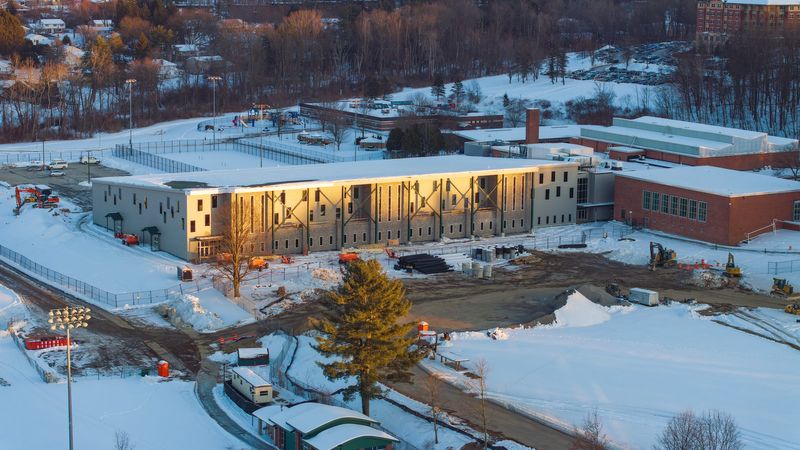
While Binghamton University continues to expand its campus footprint, one of its most recent new buildings is noticeable for those driving the Vestal Parkway.
The latest attention-gatherer is a $35 million addition to the existent East Gymnasium that will add an additional 75,000 square feet for the Department of Campus Recreational Service to support its wide-ranging programming.

As universities struggle to maintain enrollments, it turns out that while Binghamton’s elevation of its intercollegiate athletics program 25 years ago was instituted to legitimize its standing among peer institutions, it also had student matriculation implications. Meanwhile, investing in modern campus recreation facilities for prospective students is another means for colleges to lure students to their campuses.
For the uninitiated, the goal of the BU recreation department as stated on its website is “to offer unique programs designed to support positive lifestyle choices and lifelong learning through physical activity.” It also seeks to “promote social connection, personal growth and leadership development.”
Established in 1991 as a separate entity within the athletic department, it was initially titled the Office of Campus Recreation and housed in the East Gymnasium. Central to its mission was conduct of its established intramural program. New additions included outdoor education and fitness/wellness programs with the latter centered on a revamped EG facility (FitSpace).
It was Vice President for Student Affairs Brian Rose who alerted BU officialdom that while the intercollegiate athletic program served some 400-plus student-athletes, the university was terribly behind other institutions when compared to space dedicated to meet the recreational demands of its thousands of other students.
One correction to right this imbalance was to spend $13 million in 2011 to refurbish the EG (the oldest building on campus). That makeover served to expand FitSpace and offer new spaces for other programming, particularly in aquatics. Still, even after the EG remodel, BU was still behind its competitors in dedicated square footage for recreation.
Thus, it is the $35 million expansion that seeks to bring BU into what might be termed “recreational compliance.” Rose shares that internal (non-SUNY) monies will pay for the new addition while a dedicated student fee as well as other fees will underwrite ongoing programing.
While not as highly visible as intercollegiate athletics, the rec program involves a good percentage of the 18,000 BU students. Many participate in traditional intramurals. Many more find both playing and leadership opportunities in one of the 27 club sports teams. Others are attracted to opportunities available in outdoor education. There are also programs that address the immediate short – and long-term fitness and nutrition needs of students.
Meanwhile over 200 student jobs are created in the various of the programs mentioned.
While locals are familiar with how both private and university construction has tried to keep up with the housing needs of BU students, it might be informative (and encouraging) as well to learn that the university is also dedicated to investing in its students’ physical well-being.
Schum was the first director of the campus recreation program.
This article originally appeared on Binghamton Press & Sun-Bulletin: Binghamton U. expands rec space to stay competitive | Opinion
Reporting by Tim Schum, Guest Columnist / Binghamton Press & Sun-Bulletin
USA TODAY Network via Reuters Connect