

By Jim Bloch

With the cold clinging to Michigan’s Thumb Coast, you may be pondering a mid-spring break in Florida.
Consider Fort Myers Beach.

It’s horrible to say that hurricanes, with their massively destructive force, have improved the barrier island in southwest Florida. But three-and-a-half years after Hurricane Ian and year-and-a-half after the triple whammy of hurricanes Debby, Helene and Milton, the island is more open, less crowded, more relaxed.
It’s like going back in time. Not to the time of the Calusa Indians, maybe, but back to around 1999. Instead of hotels, condos, restaurants and overlarge homes lining both sides of Estero Blvd., the main north-south artery on the island, blocking views of the Gulf of Mexico and closing in around motorists and pedestrians like a sunken freeway, the island now boasts ocean views galore.
Hurricane Ian slammed into the fully developed barrier island Sept. 28, 2022, with wind speeds approaching 150 miles per hour, just below a Category 5, pushing a storm surge of up to 15 feet water over the island. By the time it was over, the hurricane killed at least 156 people, according to National Oceanic and Atmospheric Administration. The storm surge claimed 41 lives in Florida, 36 in Lee County, home to Fort Myers Beach; a total of about 100 county residents perished.
“In Fort Myers Beach alone, an estimated 900 structures were totally destroyed, and 2,200 were damaged,” NOAA said in its March 2026 report on the hurricane. That’s 3,100 structures. There were 3,200 structures on the island before Ian.
According to Federal Emergency Management Administration, 1,009 structures were “substantially damaged” and required demolition or significant rebuilding.
“In Lee County, at least 52,514 structures were impacted, of which 5,369 were destroyed and 14,245 received major damage,” NOAA said.
With reconstruction proceeding, the barrier island experienced back-to-back-to-back hurricanes in 2024. Debby, which peaked as a Cat 1 hurricane, stayed offshore Aug. 4-5 but triggered two to four feet of storm surge on Fort Myers Beach. Hurricane Helene sent
three to five feet of surge and tons of sand over the island Sept. 26. Two weeks later, Oct. 9, Milton pushed five feet of sand over the island and triggered significant flooding.
“Ian caused an estimated $112.9 billion worth of total damage in the United States … making Ian the third-costliest United States hurricane on record,” according to the NOAA National Centers for Environmental Information. “Of that total, $109.5 billion occurred in Florida, making Ian the costliest hurricane to ever affect that state.”
YouTube videos, Facebook posts and local news stories hint at the horror of lives lost, homes floating away and businesses blasted off their foundations.
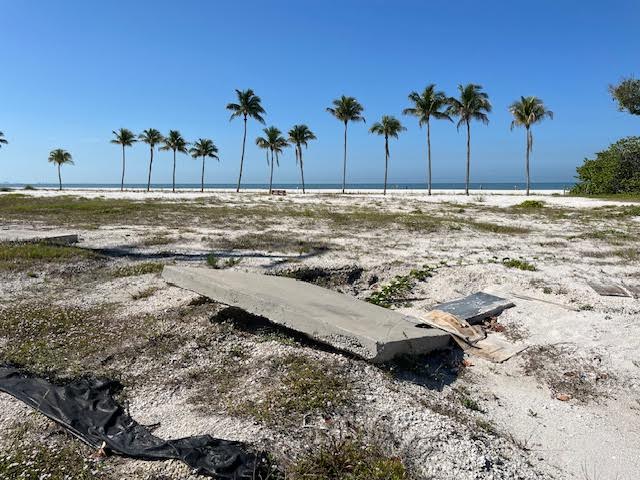
Vast stretches of beachfront are still empty. The clatter of palm fronds in the onshore breeze blends with the hammering and sawing of reconstruction. For Sale signs are everywhere. There are food trucks instead of restaurants. Mobile homes stand where actual homes used to stand. There are plenty of eerie remnants of the horrific storm surges: Stairways to nowhere; mailboxes without residences; driveways into empty parcels; highwater stilts with no structures on them.
Public access walkways to the beach, sometimes bordered by saw palmettos, coco plums and tropical flowers, which used to run between hotels or condos, now strangely cut through vast open parcels.
Your rental in the neighborhood south of town is likely to sit across the street from an empty lot. Maybe the tiled front porch is still there. Or a pool. Pools tended to survive the maelstrom.
You might enjoy a grouper sandwich at the restaurant called Junkanoo on the east side of the island overlooking a marina on Estero Bay. The next day, you might spot the remaining half of an angled cement sign jutting up from the rubble on a vast vacant swatch of beach overlooking the Gulf, its sky-blue paint peeling, featuring the ironic message “Junk.” On the opposite side, it says “anoo” and you realize that you’re looking at a weird kind of gravestone marking the former home of the restaurant.
Jim Bloch is a freelance writer based in St. Clair, Michigan. Contact him at bloch.jim@gmail.com.
