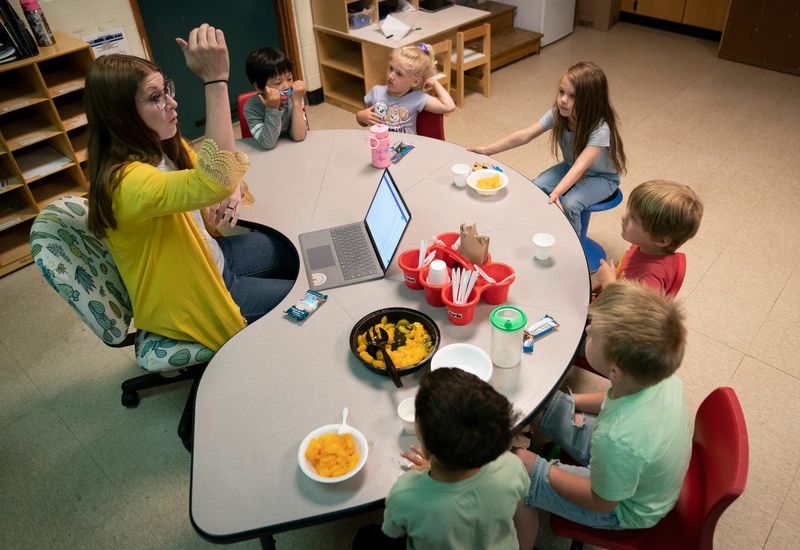
Michigan’s free pre-K program continues to attract more families while being one of only a handful of states to meet all national quality standards.
At the same time, it’s still not achieving state enrollment goals. According to state data reviewed by the Free Press, the Great Start for Readiness Program’s enrollment is short of its target by roughly 3,000 kids for the 2025-26 school year and is on track to underspend around $36 million.

Meanwhile, though, there are 4-year-olds on waitlists in some counties across the state waiting to get into the program, which was expanded by Gov. Gretchen Whitmer in 2024 to eliminate income eligibility caps.
What conclusions can be made about a free, state-funded pre-K program coming up short on enrollment while kids sit on waitlists?
Not much yet, says Steven Barnett, education economist at Rutgers University and founder of the National Institute for Early Education Research.
When you zoom out, many of the free pre-K enrollment hiccups Michigan is experiencing likely have to do with outside factors, like declining overall population, fewer kids, changes in local demographics resulting from families moving around post-pandemic, along with changes in immigration policy.
“There are issues in meeting expansion targets in Michigan, but are they because people are not doing the best they can? I think it’s too early to say that,” Barnett said.
These kinds of large scale population changes coupled with teacher shortages and the fact that some counties are better positioned than others to open new classrooms rapidly, leads to kids waiting for a slot in one school district, while a GSRP classroom in another nearby sits at half capacity.
Though the state touts a pre-K for all program, that doesn’t actually end up being the reality in every community, hard as school district leaders may try.
Why families end up on free pre-K waitlists and other rollout kinks
The nitty gritty of rapidly increasing free pre-K access for 4-year-olds across the state is complex. According to MiLEAP, there were around 300 kids on GSRP wait lists in the 2024-25 school year across Michigan’s counties. Some counties had no kids on wait lists, others had many. Meanwhile, some classrooms sat under-enrolled for lack of 4-year-olds.
Rachel Roberts, director for early childhood at Kalamazoo RESA, sees this dichotomy across her school districts. For example, in Comstock Public Schools’ 2025-26 school year, its seven GSRP classrooms were cut to five because they couldn’t enroll enough kids. And those five classrooms took time getting fully enrolled.
But a 20-minute drive south, in Kalamazoo’s Portage Public School District, which recently started operating their GSRP program again, families enrolled rapidly, including those with high family income. The district’s four GSRP classrooms serving 80 kids were full before the beginning of the school year. They still have a waiting list of around 50 kids, Roberts said.
The example illustrates the unevenness of enrollment and the difficulty knowing exactly where families are going to enroll their kids. In Comstock’s case, Roberts said she believed lacking enrollment had to do with families moving out of the area and not having as many babies. And as Portage’s case illustrates, Roberts said she’s careful with how she markets the program given that some areas don’t have capacity for all families seeking a spot.
“I do not advertise and put it out there that it’s pre-K for all, because that’s not real in our community,” said Roberts.
Some early education offices in intermediate school districts or regional educational service agencies have centralized their GSRP enrollment systems post Whitmer’s expansion, so they can better track which areas in their counties don’t have enough seats versus those that may be reaching a saturation point. In many cases, this allows them to take families off wait lists and place them in another GSRP program with open seats, though this doesn’t always work out given parent preferences and barriers like transportation.
To cater to the diversity of needs families have, a successful GSRP program will have classrooms opened in a variety of care settings in any given area because more options for families means less barriers, said Dawn Koger, director of early childhood at Oakland County ISD. The ideal is that there’s a program for every need to make it possible to enroll for every family that wants to, she said.
“If you have a one-sized-fits-all universal pre-K program, it’s not gonna work for today’s families,” said Koger. “There’s too much variety.”
But Koger said Oakland County is lucky because of the existing childcare and early education partners (including childcare sites, Montessori schools, preschool co-op’s) they were able to tap to rapidly open GSRP classrooms alongside school districts.
As a result, the county has more than tripled its enrollment since 2024 and is shooting for enrolling 9,000 of its 13,000 4-year-olds in the coming school year. But not every county has this existing infrastructure and two years is a quick turn around time to build new sites and get them licensed, said Koger. Expanding seats for kids in these areas, often rural counties, will take more time, she said.
Where Michigan GSRP stands and where it goes post-Whitmer
On a macro-level, experts say Michigan’s GSRP program is doing well.
Since Whitmer’s expansion of the program, GSRP has continued in the right direction, according to the newest annual National Institute for Early Education Research report, released in late April. The report noted that in the 2024-25 school year, Michigan enrolled nearly 7,000 more kids than the previous year which amounted to 43% of 4-year-olds in the state.
Michigan’s GSRP enrollment exceeded national enrollment averages for 4-year-olds, barreling forward towards Whitmer’s goal of increasing pre-K access across the state with 75% enrolled by 2027. To be clear, the state’s total enrollment rate is at 56%, which is significantly higher than NIEER’s because it includes enrollment of 4-year-old’s not just in GSRP, but in any publicly-funded preschool program including Head Start and special-ed pre-K programs – Whitmer’s 75% enrollment goal refers to total 4-year-olds enrolled in publicly-funded preschool, not just GSRP.
This all while keeping quality high through continued substantial investment, said Barnett. Michigan’s GSRP ranks 6th in the nation in spending per child at around $13,600 per head.
To Barnett, who spearheads the NIEER annual report, it was particularly striking that Michigan was one of only two states that added more than $100 million into their preschool budget for 2024-25.
Part of the continued expansion can be seen in the numbers of sites opening GSRP classrooms as compared with the previous year. According to data from MiLEAP, the state’s early childhood education agency, in 2024-25, the number of GSRP sites increased by 332 and the number of GSRP classrooms by 421 (for comparison, in 2023-2024, sites increased by 77 and classrooms by 147).
To achieve its goal of universal free pre-K access, Michigan has to stay vigilant, said Barnett, especially with a coming gubernatorial election on the horizon.
“You get leadership that sees no reason in putting more funding into it,” said Barnett.
To continue increasing GSRP enrollment while maintaining a high quality program, Michigan’s legislature will have to keep increasing state investment until enrollment is maxed out which he estimates is between five to ten years away for Michigan.
For those hoping to see Michigan’s pre-K for all program continuing beyond Whitmer, who’s made it one of her marquee policies, Barnett said it bodes well that GSRP expansion has continued even towards the end of Whitmer’s term.
“This suggests it’s not just the governor’s leadership, that there’s also support in the legislature,” he said.
Beki San Martin is a fellow at the Detroit Free Press who covers childcare, early childhood education and other issues that affect the lives of children ages 5 and under and their families in metro Detroit and across Michigan. Contact her at rsanmartin@freepress.com.
This fellowship is supported by the Bainum Family Foundation. The Free Press retains editorial control of this work.
This article originally appeared on Detroit Free Press: Why Michigan’s GSRP expansion isn’t quite ‘Pre‑K for All’ yet
Reporting by Beki San Martin, Detroit Free Press / Detroit Free Press
USA TODAY Network via Reuters Connect