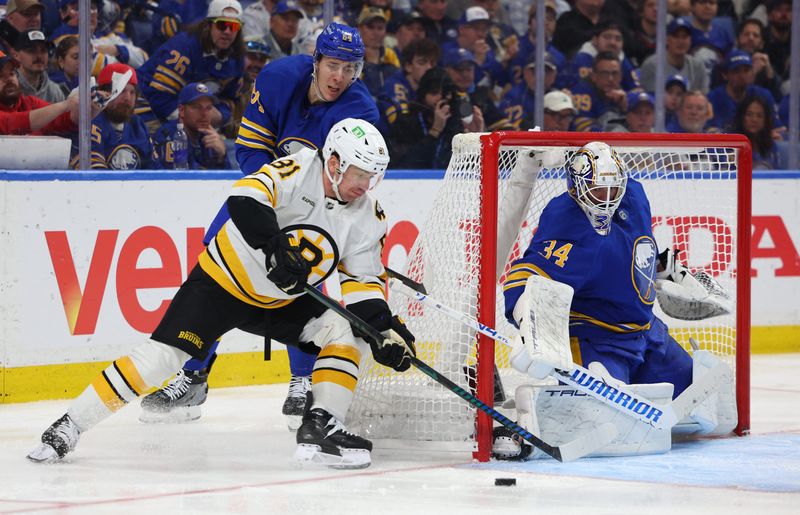
If there’s one thing we can surely count on, the Buffalo Sabres and Montreal Canadiens are about to embark on a Stanley Cup playoff series that will provide high anxiety for both fan bases.
These teams, both among the youngest still alive in the tournament, are about as evenly matched as two opponents can be heading into their best-of-seven Eastern Conference semifinal showdown. Buffalo won the Atlantic Division with 109 points while Montreal tied for second with Tampa Bay at 106 points, and in their four-game season series, each side won twice and both totaled 13 goals.

“A few times we played them this year, we had really good games and coming out of a few of those games, I was really impressed with their team speed and how fast they play, with and without the puck,” defenseman Bowen Byram said Monday on Sabres Live. “I feel like we’re kind of looking in the mirror so it’s going to be whoever can play their game better.”
The Sabres, who have advanced to the second round for the first time since the 2007 postseason, are riding an emotional tidal wave after breaking their NHL-record 15-year postseason drought. But the Canadiens are flying high, too, having just won their first series since 2021, eliminating the Lightning in one of the tightest series ever played.
All seven games were decided by one goal, just the third time that has happened in Stanley Cup history, and four went to overtime, tied for the second-most in a seven-game series. The score was either tied, or within one goal for 98.74% of the total playing time.
Buffalo earned home-ice advantage, but it really hasn’t been much of an advantage yet. Both losses to Boston came at KeyBank Center, and it could have been all three if not for a stunning third-period rally that rescued Game 1. Coach Lindy Ruff knows his team has to be better on home ice in this series, especially because the games figure to be so closely contested.
“Our home game has to be better,” he said. “That’s controlling emotions. I think sometimes your home fans can drive you to a crazier level of play, maybe even a reckless level of play. You’re in your own building, you want to entertain sometimes, but we need to get our home game in a better place. We’ve become a pretty damn resilient team. We can manage the emotions of a series, the disappointment of losing a couple games at home.”
Here are a few things I have my eye on as the series gets underway:
What’s up with Montreal’s top line?
There were several reasons why the Canadiens’ elimination of the Lightning was somewhat surprising, not the least of which was winning Game 7 on the road despite getting just nine shots on a goal, a new record-low for a Stanley Cup playoff game. But this one might be the most prominent of all: The dynamic first line of Cole Caufield, Nick Suzuki and Juraj Slafkovsky had very little impact.
While they weren’t together all year, that threesome combined for 110 goals and 152 assists for 262 points during the regular season. Suzuki led the way with 101 points, Caufield scored 51 goals including a league-leading 12 game-winners, and Slafkovsky – the No. 1 overall pick in the 2022 NHL Entry Draft – had a breakout season with 30 goals and 73 points.
But Tampa Bay, with its physicality and imposing size, did a great job limiting that line. The only goal they managed at even strength was Suzuki’s which opened the scoring in Game 7, and even that was a little fluky as it caromed in off a Tampa Bay defender.
Slafkovsky had a remarkable Game 1 when he scored a hat trick to lead the Canadiens to a 4-3 overtime victory, but all three goals came on the power play. All four of Caufield’s points in the series came on the power play, too, as he and Slafkovsky did not have a single point 5-on-5. That’s pretty amazing, and if the Sabres can play defense as well as Tampa Bay did against that group, it would be huge.
“They have a lot of skilled guys, but it’s the same with everybody – you have to take away time and space, stay on top of them, be hard on them,” Sabres defenseman Rasmus Dahlin told reporters. “When they get time, it doesn’t take much for them to score a goal. They have so much skill, so we have to play a solid defensive game in this series.”
This season, as the teams split four games with each scoring 13 goals, Caufield did what he always does against the Sabres. He had four goals and six points, adding to his career numbers which now stand at 10 goals and 16 points in 18 games against Buffalo. Like David Pastrnak was the player you worried about most in the Boston series, Caufield is that guy for Montreal.
Sabres power play needs to do something
While it started to show some life in the last couple games against Boston, that didn’t translate to goals as the Sabres finished that series a gruesome 1-for-24 and dating back to the regular season, the man advantage hasn’t been an advantage at all as the Sabres are in an unfathomable 1-for-46 slump.
“There’s a good part of both sides of the special teams we need to improve,” Ruff said. “We want to continue to improve. This isn’t about just moving onto the next series, we’ve got to improve some stuff. Stay with the process and something will go. We’re still a young power play. The best power plays a lot of times are power plays that have been together.”
Fine, wipe the slate and start over is a good philosophy, but now there needs to be results along with the process because a 4.2% success rate, worst in the postseason, isn’t going to cut it. And it can happen against a Montreal penalty kill that came in at 82.8% against Tampa Bay, ranking 11th among the 16 playoff teams.
Goaltending battle will be tight
When Ukka-Pekka Luukonnen stumbled in Game 2 against Boston, Ruff made the move to go with Alex Lyon in the third period, and after he stopped all seven shots he faced, he was given the net for Game 3 in Boston. He hasn’t relinquished it.
In the final four games he allowed just five goals and his 1.14 goals-against average is third-best to date in the postseason and his goals saved above expected of 4.6 ranks fourth. His GAA and his .955 save percentage set new franchise records for a playoff series with a minimum of five games played.
The 33-year-old Lyon was great in Game 6 because the Bruins were desperate and they were pushing hard, yet he turned aside 25 of 26 shots.
“Unbelievable. He bailed us out so many times,” Tage Thompson said of Lyon. “In big games like that, there’s a lot of moment. um swings and you’re getting each team’s best. A couple huge saves in key moments in the game when it’s still 2-1 keeps us right in it. It gives us confidence, and then we’re able to extend the lead. He’s one of those guys, he likes the big moments. He’s not afraid of them. Stands on his head when we need him.”
However, the Sabres don’t have a goalie advantage because 24-year-old Jakub Dobes, who posted a 29-10-4 record in the regular season, has been every bit as good, and he did his work against a Lightning team that is more dangerous offensively than the Bruins.
Dobes ranks fifth in the postseason with a 4.4 goals saved above expected mark, and his goals-against average of 2.03 is seventh, though Canadiens coach Martin St. Louis made sure to point out how strong the defense was in front of Dobes.
“We protected the inner slot really well,” he said. “Our commitment to blocking shots, hard actions, hits, we were very physical. There were a lot of things to take away from Tampa and we’re going to need to do that again.”
Sal Maiorana has covered the Buffalo Bills for more than four decades including 37 years as the full-time beat writer/columnist for the D&C. He has written numerous books about the history of the team, and he is also co-host of the BLEAV in Bills podcast/YouTube show. He can be reached at maiorana@gannett.com, and you can follow him on X @salmaiorana and on Bluesky @salmaiorana.bsky.social.
This article originally appeared on Rochester Democrat and Chronicle: Sabres brace for high-drama series against young Canadiens
Reporting by Sal Maiorana, Rochester Democrat and Chronicle / Rochester Democrat and Chronicle
USA TODAY Network via Reuters Connect