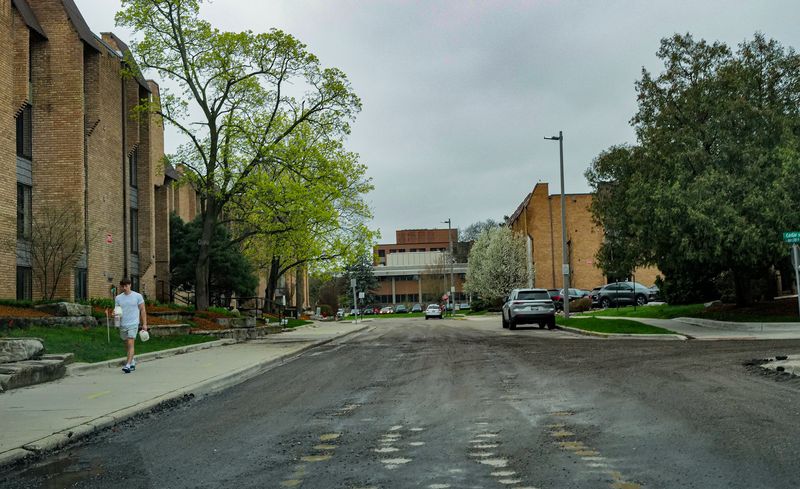
EAST LANSING — A group of Michigan State students has big ideas about what city officials should do to remake the neighborhood that abuts the eastern edge of campus and includes Cedar Village, the site of several riots during the late 90s and early years of this century.
Think of it less as a party exercise and more of a planning activity.

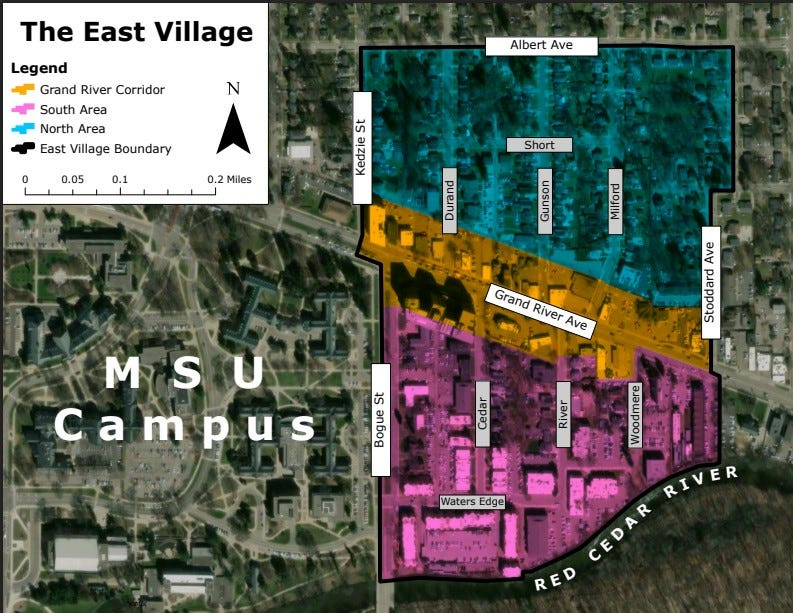
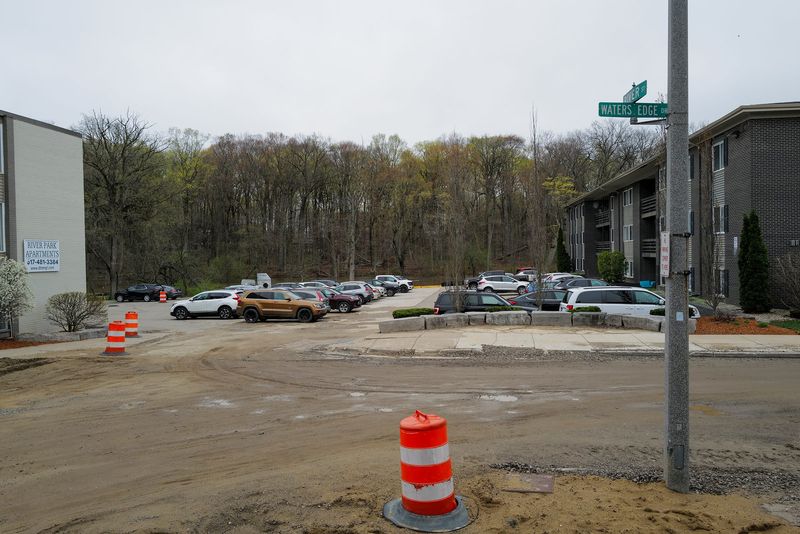
The goal is to give city officials a development plan for a neighborhood centered on Grand River Avenue that sits between the Red Cedar River to the south and Albert Avenue to the north, bounded by Bogue and Kedzie streets to the west and Stoddard Avenue to the east.
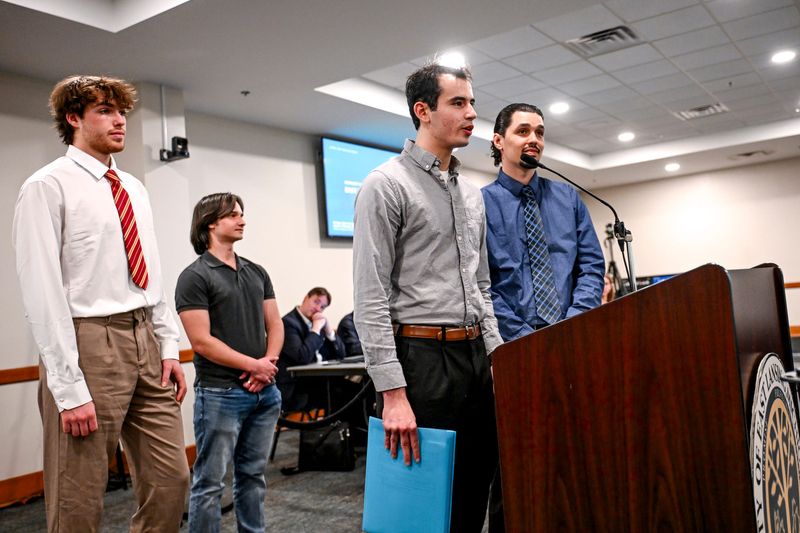
“We want to incentivize mixed-use development,” Max Levinson, a 22-year-old senior, told City Council members. “This includes reducing parking requirements to spur development, connecting property owners with existing development resources that the city already offers and a few other zoning adjustments as well. We want to assure that these developments are affordable and attainable.”
Ideas from the group, which calls themselves The Red Cedar Squad, were sought by city planning officials at a time when MSU’s campus and its surroundings seem ripe for transformation.
East Lansing Planner Landon Bartley said the East Village could help fulfill the need for more student housing, despite big developments that rose up in recent years in downtown high-rises and several plans currently being considered or recently shelved.
Three developers have submitted proposals now under review for a “Spartan Stadium District” within the heart of MSU’s campus, and those include new student housing as part of a major remake of central campus.
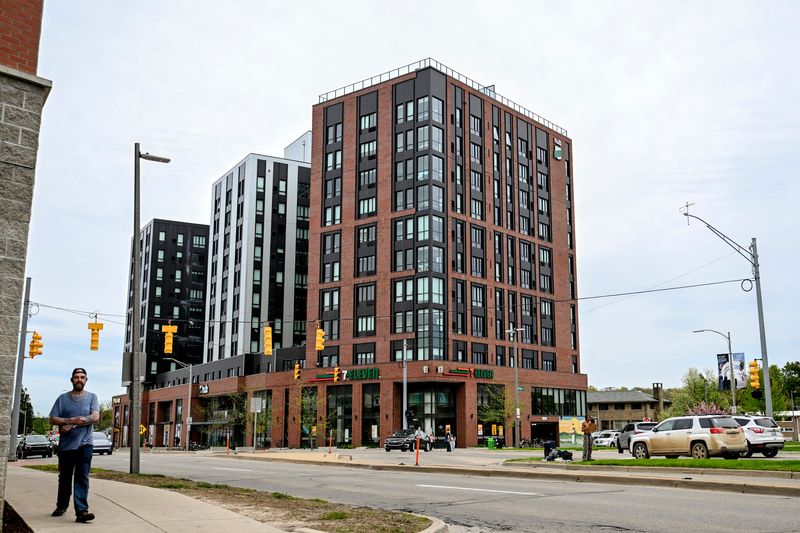
Separately, Northbrook, Illinois-based Harbor Bay Ventures submitted plans to convert the Student Book Store on Grand River Avenue into a 12-story – down from 15 stories – mixed-use development with apartments. Recently, ,community members railed against another mixed-use, Albert Avenue proposal with more than 200 new apartments primarily for MSU students.
New plans are expected for the book store, while the $90 million, 13-story Albert Avenue proposal is up in the air. Minnesota developer Cody Dietrich of Tareen Development Partners faced criticism because of the parking plans and student housing that’s part of his proposal and said he would submit new designs.
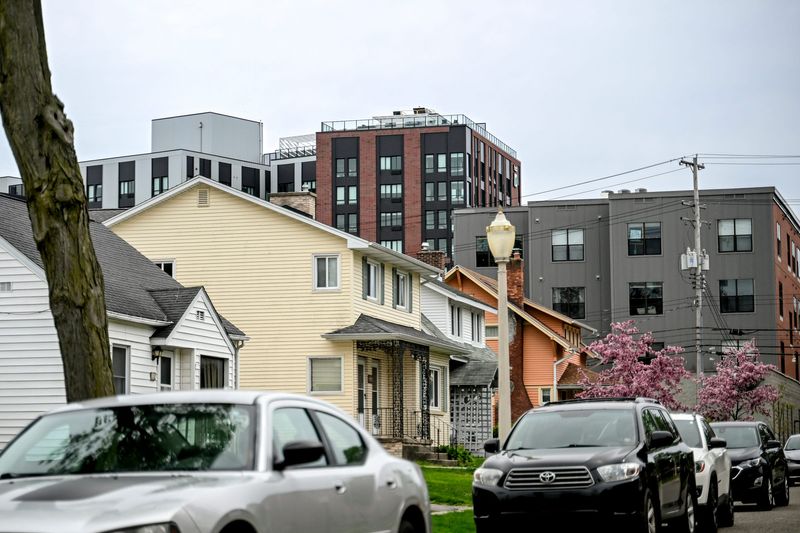
“We get a decent amount typically of heartburn from residents, long-term residents, when there’s a student housing proposal, which is part of why we haven’t seen much student housing be approved in several years,” Bartley said. “So I’ve kind of been like grasping with where does it make sense? Is there an area in town where it would be much more acceptable to the greater community?”
Logical place for student housing
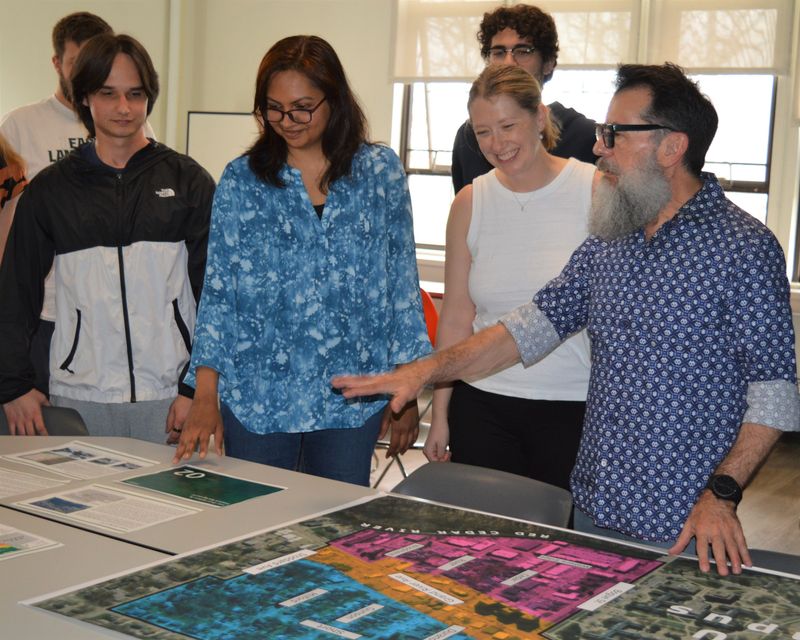
Enter Professor Jesus Lara and his planning class, which offers tomorrow’s planners the opportunity to work with government officials and Michigan communities on modern problems like blight, climate resilience and, in East Lansing’s case, MSU students’ evolving housing demands while considering community needs and development pressures.
Bartley approached Lara and got his wish for MSU planning students to study the East Village, or, as it worked out, a large portion of it.
Technically, East Lansing planners consider the area east of Bogue Street and south of Grand River Avenue as the East Village, which is included in a zoning district that allows residential uses and stretches to Hagadorn Road. A plan for that area was created in 2006, but, other than 2019 The HUB development, 918 E. Grand River, “very little of the 2006 plan has come to fruition,” according to city documents. Planners decided to include streets north of Grand River for the MSU planning students’ study area.
Like Bartley, the students realized the potential was there for mixed-use developments, student housing and an urban village feel found in other college towns like Ann Arbor, Champaign, Illinois, and College Station, Texas, each of which has vibrant business corridors and neighborhoods.
“I describe the area as a largely student neighborhood with limited retail on the north end right along Grand River,” Bartley said. “To me it seems like this is a logical place. Talking to people in the neighborhood, they go, ‘Oh, yeah, this is a student area anyway.’”
While other students took on projects in Flint and Grand Rapids, a dozen of Lara’s kids spent this past semester analyzing their assigned East Village area, coming up with 33 short- to long-term “actionable recommendations.”
The Red Cedar Squad saw potential for mixed-use developments along Bogue Street and Grand River, specifically at the Milford Street intersection, but realized the neighborhood needed some updates for today’s students.
“We wanted to sort of increase access to and support multimodal transit in the area … or transportation options,” said Jack Shannon, a 22-year-old senior from outside of Chicago. “Right now, the area is sort of built primarily around car usage. There’s a lot of parking, a lot of drive thrus along Grand River. It’s not a very welcoming place to walk or bike. There’s not a lot of infrastructure.
He chuckled.
“Something we found to highlight that was one of our field study pictures was of a bike rack. It was at the top of a set of stairs.”
And then he chuckled some more, before turning serious once again.
He and Rachel Oelsner, a 24-year-old Wisconsin resident pursuing a career in municipal law, enjoyed the opportunity to learn more about one of most destructive events in East Lansing’s history. The March 27, 1999, riot that followed the MSU men’s basketball team’s loss to Duke in their NCAA Final Four matchup included several dozen fires, destruction of property and police deploying tear gas to combat crowds that had swelled to more than 10,000. Eventually more than 120 people were arrested and the property damage exceeded $500,000.
Other smaller riots occurred in Cedar Village after MSU basketball losses in the NCAA tournament in 2003 and 2005, as well as after the football team’s Big Ten championship victory over Ohio State in 2013.
“Learning about the riots helped me to contextualize some of the feedback that we received from long-time East Lansing residents during our community engagement meetings,” Oelsner said. “The riots have clearly had an influence on the relationship between some permanent East Lansing residents and students, as evidenced by the fact that several community engagement participants still brought up the riots, even years after they occurred.”
Planning in real time
The students’ perceptions are all part of the professor’s grand scheme of giving them the real-world experiences that goes with being a planner working with clients.
The semester involved six different phases, each lasting about two weeks and requiring a presentation and “book chapter.” Those included becoming familiar with the area and figuring out what’s working and not working; studying city reports, census data and other documents to match up with what they’re seeing on the ground; engaging with the community; taking stock of what they’ve learned and their preliminary ideas; reviewing case studies and what’s happening in other communities; and putting everything together for concrete recommendations and planning for presentations.
During the week of April 20, the Red Cedar Squad delivered their findings to the East Lansing City Council, Planning Commission and Downtown Development Authority.
They shared the three themes behind their recommendations – weak infrastructure because of limited framework for bikes and sidewalks needing repairs; the neighborhood’s undesirable character, backed by four vacant parcels on Grand River and no gyms or grocery stores in the study area; and a “student housing capacity gap,” with about 16,000 students living off campus outside the city of East Lansing because they feel priced out.
Their 33 short- to long-term “actionable recommendations” fell under seven guiding principles for their East Village study area: Supporting multi-modal transit, improving pedestrian accessibility, revitalizing the Grand River corridor, developing more public places, adding character, incentivizing mixed-use development and ensuring affordable and attainable housing options,
“It really offers them sort of a view into their future by doing projects like this,” said Andrea Polverento, an MSU alum and past Watertown Township planning and zoning director who has helped guide the squad this semester. “This is similar to what any type of planner will do in their future, whether it’s transportation planning or city planning or working as a consultant. These projects give them opportunities to have those experiences in all of those fields.”
While with Watertown Township, she worked with MSU’s planning students a few times and components of their recommendations helped guide playground and tennis court improvements.
“They made some recommendations about our tennis courts and how they could be improved and how people might be able to use them more frequently,” Polverento said. “After some work that we did in there, we did really see a big uptick in users.
“While not every component will ever come to fruition, certainly pieces and parts of these plans have been utilized in our local communities.”
Levinson and the other Red Cedar Squad members took about a half hour to share their findings with City Council on April 21.
“For our first planning priority, supporting multi-modal transit, we want to add a dedicated bus lane to that section of Grand River and East Village,” Levinson said. “This pulls from the original bus route and transit plan of 2017. We also want to replace street parking with bike lanes and we want to reroute the CATA Route 31 to go into East Village.”
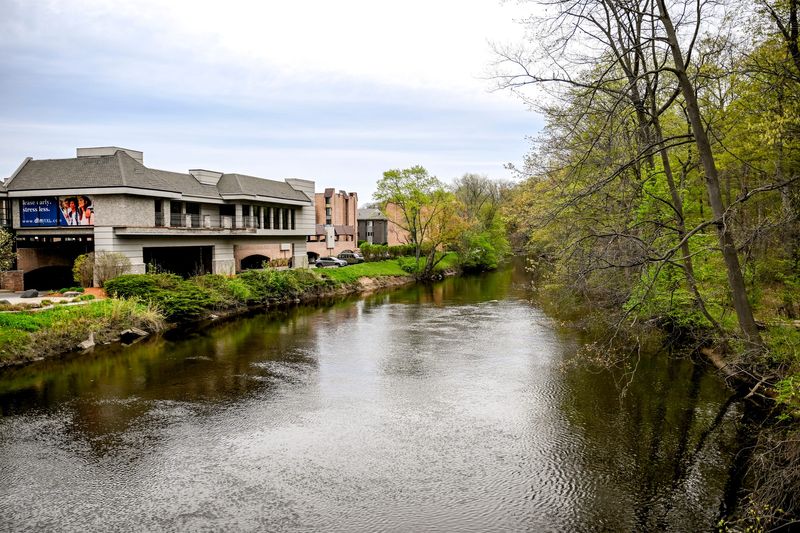
The list went on to include accents like murals, additional crosswalks, a riverfront trail and park on the north side of the Red Cedar River, more trees and benches to make Grand River’s streetscape pop, and an “urban format grocery store,” which was the No. 1 request from their community meetings.
Fellow squad member Ben Hamrick, a junior from Virginia, backed him up.
“We, at the Red Cedar Squad, we really believe the East Village is something worth keeping an eye on,” he said. “It is really ripe with potential.”
Mayor Erik Altmann complimented the group for its professional presentation. Councilmember Steven Whelan offered to connect them with the Capital Area Transportation Authority, and Councilwoman Kerry Ebersole Singh asked for a picture while congratulating them for “nice work.”
“This area does feel like it’s a diamond in the rough, along the Red Cedar there,” Singh said. “So I want to thank the Red Cedar Squad for doing a deep dive on this.”
Oelsner, the team manager, appreciated council’s response.
“I thought that my team did a fantastic job of presenting,” she said.
The students hope to return to East Lansing in years to come and hope they’ll then see changes that came from their recommendations.
Levinson believes there’s a good chance they’ll see the neighborhood signs, cross walks and bike lanes they’re recommending because they’re relatively cheap and non-political.
“For the longer term things like a grocery store or a park, I would love to come back and visit and see that they were having a meeting about it,” he said. “That would make me comfortable with our work. (But) I would be shocked if those were done within the next five 5 to 10 years.”
Bartley, the planner, is confident their recommendations will be seriously considered.
“I’m not worried,” he said. “I think council is interested to see what the results are and also wants to see development on that side of town. It could use some help.”
Contact editor Susan Vela at svela@lsj.com or 248-873-7044. Follow her on Twitter @susanvela.
This article originally appeared on Lansing State Journal: Could Cedar Village be remade? MSU students have big ideas for East Village
Reporting by Susan Vela, Lansing State Journal / Lansing State Journal
USA TODAY Network via Reuters Connect