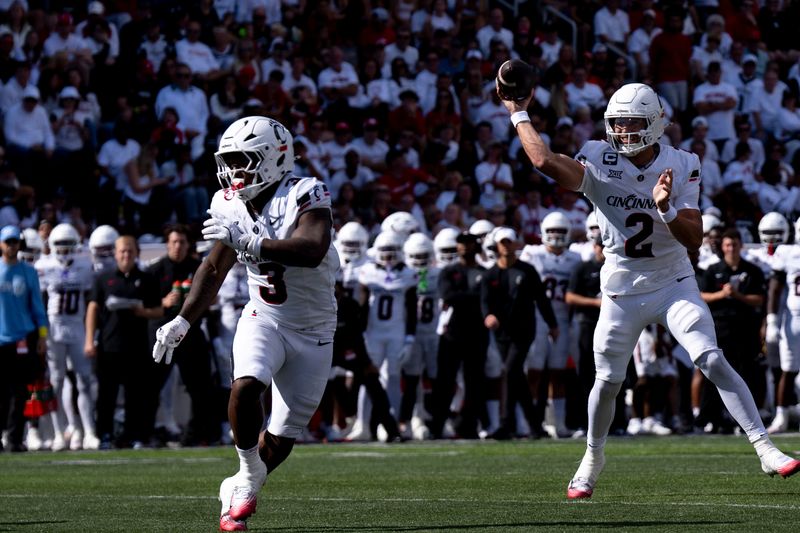
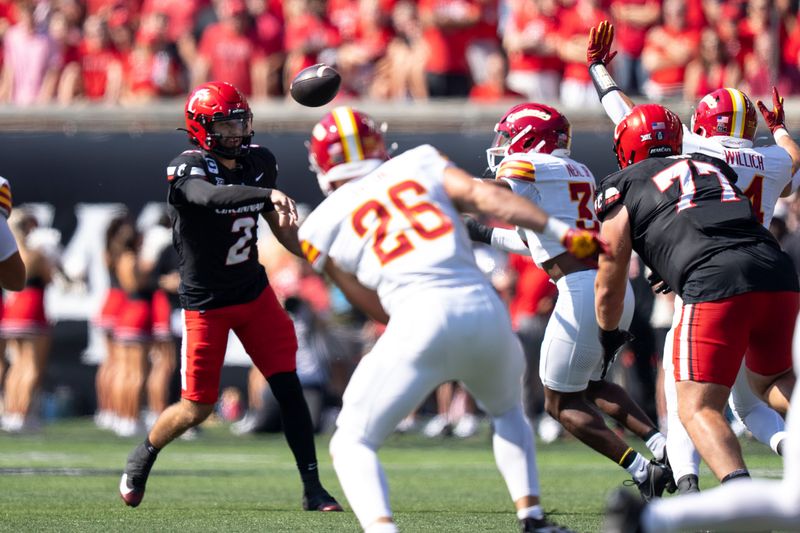
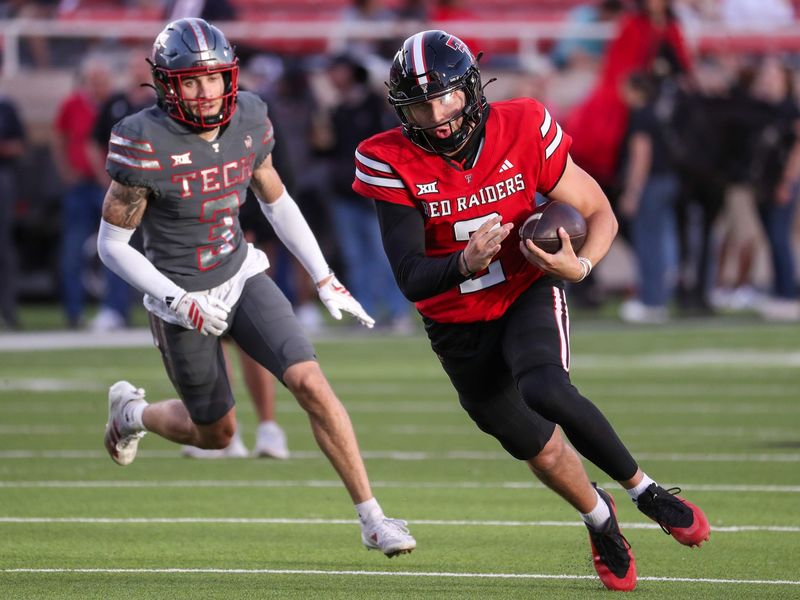
If what has been reported about former Cincinnati Bearcats/now Texas Tech quarterback Brendan Sorsby is true, the player who commanded around $5 million in the transfer portal may be done with college football.
Sorsby reportedly gambled on football while at Indiana and is alleged to have gambled via apps while at Cincinnati before transferring to Texas Tech. A program source at the University of Cincinnati has told The Enquirer: “No one inside the UC Athletics Department was aware of any illegal gambling. The University would not knowingly play an athlete involved in illegal gambling.”

Enquirer investigative reporter Kevin Grasha also reached out to the University on the morning of April 29, contacting multiple university officials – including UC President Neville Pinto, Director of Athletics John Cunningham and Assistant Athletic Director for Compliance Grace List – about whether they knew or were told in 2025 about Sorsby’s sports gambling. No one responded as of press time.
On the day the Sorsby news broke, April 27, The Enquirer reached out to head coach Scott Satterfield, asking if he had a comment on Sorsby being under investigation or getting gambling treatment away from Texas Tech.
“Haven’t heard anything about it,” Satterfield responded.
Brendan Sorsby’s current status, past issues
The 22-year-old is in a residential gambling addiction program, as first reported by ESPN’s Pete Thamel.
While a freshman at Indiana, Sorsby reportedly gambled on Hoosiers football games except the one he played in that season. Two issues are involved: 1) he was 18 at the time and not old enough to gamble in the state of Indiana, and 2) the NCAA prohibits collegiate gambling, whether or not you bet to win or lose. From NCAA.org:
Student-athletes who engage in activities to influence the outcomes of their own games or knowingly provide information to individuals involved in sports betting activities will potentially face permanent loss of collegiate eligibility in all sports. This would also apply to student-athletes who wager on their own games or on other sports at their own schools.
Sorsby came to the Cincinnati Bearcats in 2023, not yet 20-years-old. If he was betting at the time, he was also below the legal age in Ohio. If he were placing bets after his 21st birthday in January 2025, he would be legal by age but not as an NCAA student-athlete.
NCAA athletes can’t wager on any activity for which the NCAA holds a championship, including college or professional football, basketball, baseball, softball, volleyball and others. An unpunished wager would be on a UFC fight, as the NCAA does not sponsor the sport.
The Enquirer has confirmed Sorsby’s admission to placing small bets on random balls and strikes in Cincinnati Reds games. Small as they are, they would violate NCAA rules and if done before his 21st birthday, they would also be illegal under Ohio law.
Did Cincinnati know of Brendan Sorsby’s betting issues?
Sources with knowledge of the investigation are adamant that “Cincinnati” knew as far back as last August. But, specifically, who knew? The University of Cincinnati had a consistent “no comment” on the issue until a source familiar with the investigation said there was “no knowledge of illegal gambling”.
Before the 2023 season, then-Iowa State quarterback Hunter Dekkers was one of seven Cyclones charged with records tampering involving underage use of the DraftKings app. The bets were on Iowa State events, including one football game. He was banned by the NCAA and fined $645 for making 366 bets.
Penalty options for Brendan Sorsby
Wagering on his own sport is a potential permanent loss of eligibility. Wagering less than $200 triggers sports wagering rules and prevention education. Wagering $201-500 includes a loss of 10% of a season’s eligibility, $501-$800 involves 20% loss of eligibility and over $800 a 30% loss of eligibility.
All indicators point toward a permanent ban. Schools aware of such gambling activity could risk NCAA investigations, fines and reputation damage, while staff members involved face severe employment consequences according to NCAA.org.
NCAA/institution preventive measures on gambling
The NCAA and Big 12 use ProhiBet, a mandatory compliance app loaded on the phones of athletes. It uses geolocation technology to track phones and monitor illegal betting activity. The technology is from IC360, formerly known as U.S. Integrity. Sorsby could have been tracked this way or could have used a phone minus the tracking but with a gambling app.
Several sources on the topic have mentioned the prevalence of the apps and the ability for underage students to use them with fictitious names and a credit card.
NCAA inconsistencies with gambling
Though athletes and sports gambling have been historically controversial, pro sports and even the NCAA have done business with the industry. It’s hard to find a stadium without a gambling reference, and many sports stories reference betting lines. The NCAA just last year began selling data from its championship events to sports books.
What is Brendan Sorsby’s next move?
If declared ineligible, he or Texas Tech could sue to have him reinstated. A favorable judge might be needed and may not be difficult to find. Trying a case in a state court has worked for other athletes, most recently, Trinidad Chambliss, starting quarterback for Ole Miss.
But Chambliss didn’t have gambling allegations.
When did Texas Tech know of Brendan Sorsby’s gambling issue?
On3 has reported that Texas Tech knew of Sorsby’s issues two weeks ago. Two weeks from April 28 when this was reported, it was April 14, four days before Texas Tech’s spring game, where Sorsby threw four touchdown passes on April 18. The following weekend, Sorsby held a Pro Camps event for kids in Lubbock on Saturday, Aug. 25. By Monday, word was out that he was seeking treatment for a gambling addiction.
An On3 report on April 29 said Sorsby placed as many as 10,000 wagers dating back to 2022, including as many as 20 per day.
Could Brendan Sorsby land in NFL’s supplemental draft?
If ineligible for the 2026 season, Sorsby could apply for the NFL’s supplemental draft. However, the league hasn’t held one since 2023 and a player has been taken in one since 2019. Bernie Kosar and Cris Carter are famous NFL players who have been selected, but the issue would be how far Sorsby’s stock has dropped with the current gambling allegations.
In 2011, Ohio State quarterback Terrelle Pryor had NCAA violations and was taken in the supplemental draft by the Raiders. He was also given a five-game suspension, and he also was not involved in gambling.
Was timing of Brendan Sorsby’s ‘motion to dismiss’ purposeful?
The same day the Sorsby story broke, his local attorney, Joseph Braun of Strauss Troy, filed a motion to dismiss the lawsuit brought by UC to collect a $1 million buyout of his Bearcats deal. UC would not have enforced it had he entered the NFL draft, but filed the suit in late February.
Sorsby’s lawyers had 60 days to respond and that time was up on the business day of Monday, April 27. Here’s an excerpt from that motion:
UC offered to waive the $1 million if he entered the NFL draft rather than transfer to another school. However, UC has no power to ignore the NCAA’s transfer rules, which allow Mr. Sorsby to transfer and play football at a new school for his final year of eligibility. UC only paid Mr. Sorsby $875,800 in monthly payments under the Agreement for the one season that he fully completed. This alone makes UC’s attempt to now try to collect $1 million from Mr. Sorsby a penalty and invalid as a matter of law, as it is more money than he was paid by UC under the Agreement.
Backup Will Hammond, who beat Utah last season in relief of last year’s starter Behren Morton, tore his ACL shortly after and is not believed to be available until Week 3 of the season. The Red Raiders could pursue another quarterback, but that would also come with a penalty. It would involve a suspension of coach Joey McGuire for 50% of their games and a fine equivalent to 20% of their budget.
This article originally appeared on Cincinnati Enquirer: Did UC Bearcats leaders know Brendan Sorsby was betting? What we know
Reporting by Scott Springer, Cincinnati Enquirer / Cincinnati Enquirer
USA TODAY Network via Reuters Connect